

“How can we protect it, if we don’t even realize it’s missing?”
That core question motivated artist Maya Lin to create “What Is Missing?” — an extensive art project that calls attention to the loss of biodiversity and is designed to inspire action to protect threatened species.
On Sept. 22, Princeton’s High Meadows Environmental Institute will open “What Is Missing? What If?”, an installation of Lin’s project, as the inaugural show in its new Environmental Gallery. Lin will give an artist’s talk at 4:30 p.m. on opening day, joined by Princeton professors David Wilcove and Rachael DeLue.
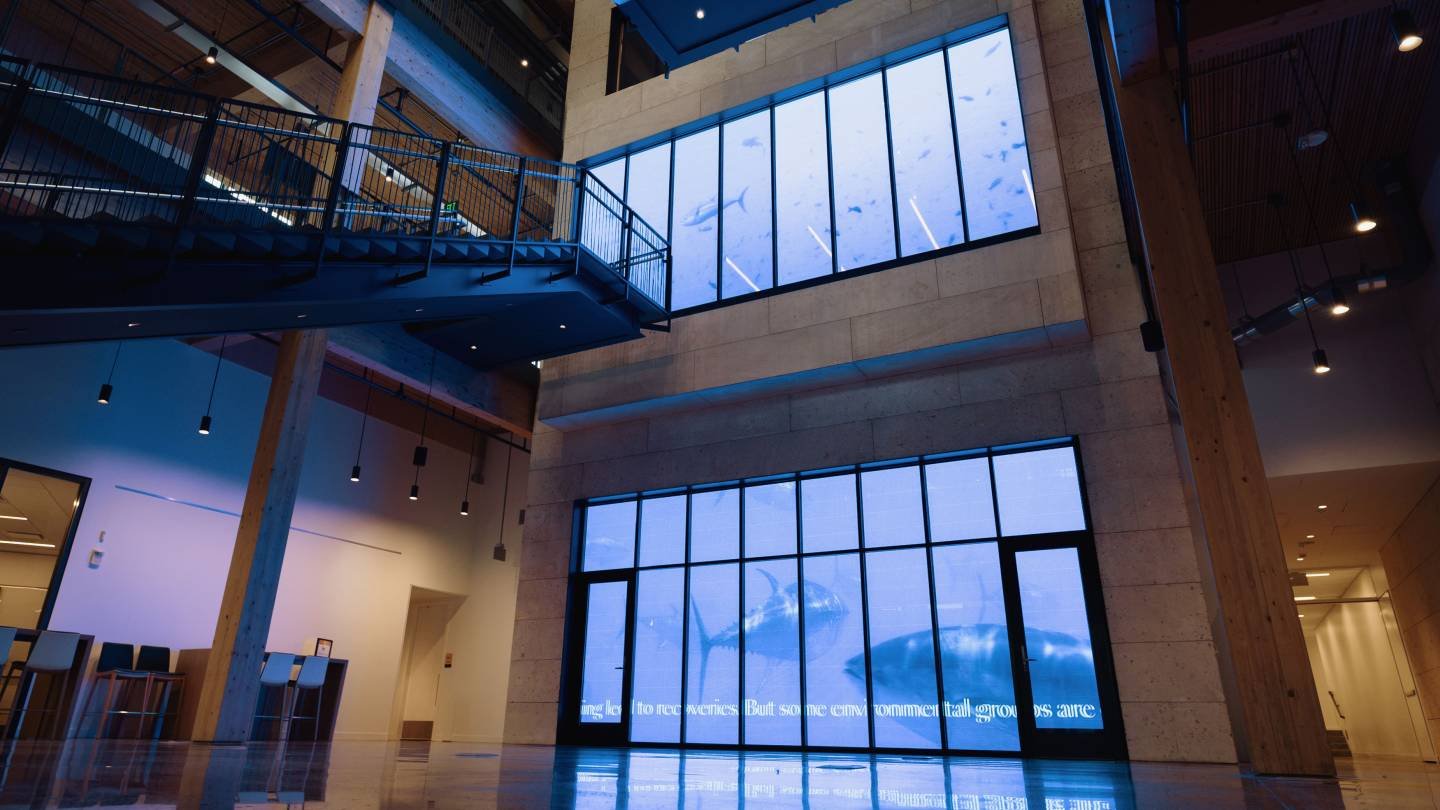
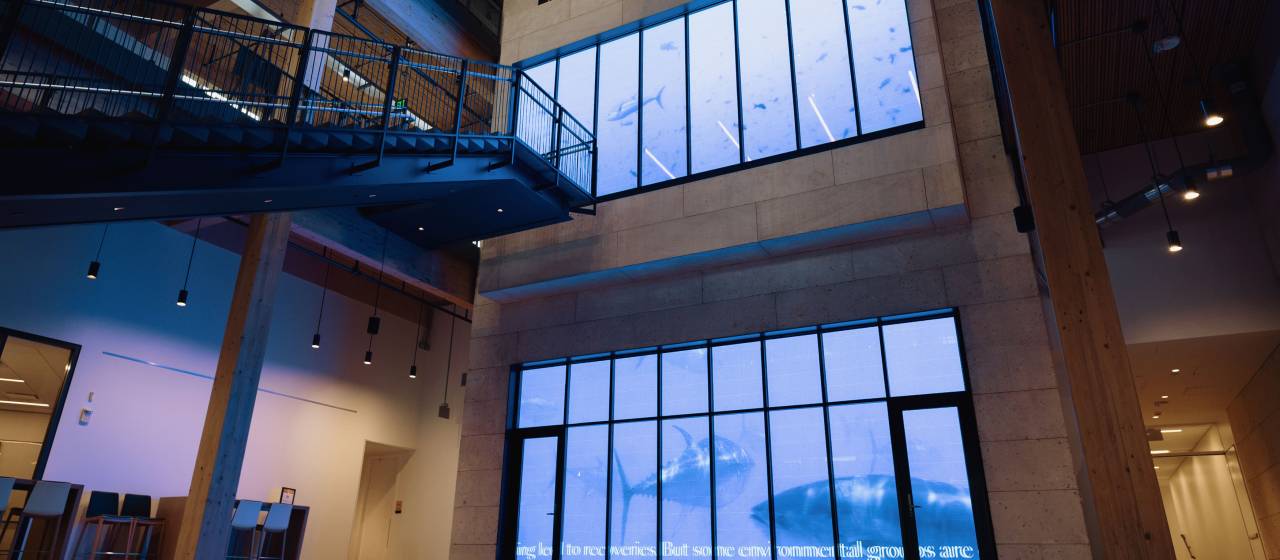
The centerpiece of the exhibition is a two-story multimedia display that presents immersive, larger-than-life audio and video of threatened and endangered species.
Students on their way to class will see a giraffe strolling past, a tiger slinking through the forest, and a full-scale whale swimming straight up the wall, complete with the sound of its haunting song.
In addition to the jaw-dropping centerpiece at the entrance to the Environmental Gallery, an interactive learning lab inside traces natural history, invites visitors to share memories of former abundance, and explores nature-based solutions.
A “What If?” poster series, lining adjacent Briger hallways, suggests possibilities: What if you gave half your yard back to nature? What if humanity invested as much protecting the planet as we do exploring space?
A wall inside the gallery, devoted to what Lin calls Greenprint, celebrates success stories worldwide in sustainability, conservation, transportation, renewable energy and more.
Taken together, the work offers a hopeful arc: first abundance, then loss, but if followed by meaningful conservation, the potential for real recovery.
Lin says Greenprint was inspired in part by research at Princeton, specifically the “wedges” diagram that, back in 2004, mapped practical pathways to meaningful carbon mitigation.
The exhibition will expand over the year to feature additional environmental innovations in development at Princeton and in the local community and region.
Planned programming includes lectures, workshops, film screenings and engagement opportunities for area schools. Lin said she hopes communities on and off campus will volunteer to participate in bird counts, butterfly counts, wetland restoration and more.
‘We don’t even realize what we’re losing’
Lin rose to fame at 21 when, as an undergraduate student at Yale University, she won a national competition to design the Vietnam Veterans Memorial in Washington, D.C. She has since been awarded the National Medal of Arts, the nation’s highest honor for artistic excellence, and the Presidential Medal of Freedom, the nation’s highest civilian honor.
The subject of her “What Is Missing?” project is not only the loss of biodiversity, but ignorance of that loss. “It’s not just what we’re losing,” she said. “It’s the fact that we don’t even realize what we’re losing.”
Through what scholars have come to call shifting baselines, each generation is overwhelmingly unaware of the natural world that came before, and the speed at which species are disappearing across ecosystems. Lin uses science-based artwork to show, quite literally, what is missing.
The work has been shaped by scientists from a range of institutions who urged her not to create a memorial to extinct animals. Instead, she focused on action and hope, featuring threatened species the world is losing but has not yet lost — from eagles to elephants, tree frogs to turtles, tuna to tigers, wolves to whales.
The project continues to expand through extensive environmental research and crowd-sourced contributions. In addition to the Princeton show, Lin has exhibited iterations of “What Is Missing?” at the United Nations, the Smithsonian, the California Academy of Sciences, Colby College, New York City transit stops and even MTV’s billboard in Times Square.
Teaching and learning with the Maya Lin exhibit
Princeton professors from multiple academic disciplines are incorporating the exhibition into their teaching including, among others, Wilcove in public affairs, ecology and evolutionary biology and HMEI, Allison Carruth in American studies and HMEI, Elizabeth Niespolo in geosciences and Jeff Whetstone in visual arts at the Lewis Center for the Arts.
Whetstone says the exhibition will be a major component of his popular course “The Visible Wild,” which is cross-listed in visual arts and environmental studies. This fall’s course will focus particularly on the pollinating insects on Princeton’s campus — and the ones missing from it.
“Maya Lin’s exhibition prompts a call for action,” Whetstone said. “She thinks globally, but the exhibition asks the viewer to think locally. That’s what this class is doing. What kinds of natural wonder can be found right outside your dorm? And what biodiversity is missing in that landscape that can be historically verified. It’s a local project with a global vision — perfectly suited for a Princeton course.”
“Universities are the greatest place to work,” said Lin. “The research at Princeton is so critical. I can’t wait to engage with the faculty, the students and this beautiful new center.”
Some students began engaging with the exhibition while it was still in development. This past summer, through HMEI’s environmental internship program, undergraduates Keylan Howard ‘29 and Haeon Lee ‘28 worked with Princeton University Library ecosystem sciences librarian Maria Kochis to develop a natural history of New Jersey, from the Ice Age to the present.
Drawing on sources including Indigenous voices, European settler records and state historians, they researched species from the Garden State, from the beaver to the bog turtle — some abundant, some endangered and some that are no longer found in New Jersey. Their resulting timeline will be on view in the gallery during the opening exhibit.
Cross-disciplinary discovery
While “What Is Missing?” poses one question, HMEI’s exhibition of environmental art asks another of academia: What role can the visual arts, and humanities more broadly, play in environmental scholarship?
Since its founding in 1994, HMEI has engaged all disciplines in environmental studiest — bringing together researchers from across the natural sciences, social sciences, engineering and humanities.
“Nature’s Nation: American Art and the Environment,” a 2018 exhibition at the Art Museum developed with support from and in collaboration with HMEI, demonstrated the potential for environmental scholarship to engage visual culture.
Curated jointly by Karl Kusserow, the curator of American art at the Princeton University Art Museum, and Alan Braddock, HMEI’s 2016-17 Barron Visiting Professor, the exhibition drew several hundred thousand people and won multiple awards.
The show’s success helped inspire HMEI’s plans for the new Environmental Gallery in the ES-SEAS complex, designed to be a centrally located, public-facing springboard for cross-disciplinary environmental conversations and programming.
Nearly a decade ago, “when we first talked about the kinds of exhibitions we envisioned, there was interest in capturing the dynamic and complex nature of environment spanning time and place, at different scales,” said HMEI Executive Director Katharine Hackett. “This opening exhibition portrays beautifully the ways in which biodiversity is intricately entwined with climate, hydrology and land use, globally and over vast periods of time. That intersection is a major theme in our research and teaching.”
“What Is Missing?” is an ideal first project,” said Gabriel Vecchi, the Knox Taylor Professor of Geosciences and a professor in and director of HMEI, currently on sabbatical. “It’s engaged with loss — but also recovery — of biodiversity, and its relationship to climate. That fits perfectly with HMEI and our partner departments in Briger Hall, Geosciences and Ecology and Evolutionary Biology, but also the larger University community. It’s a multidisciplinary exploration [with] opportunity for engagement across all disciplines.”
“Addressing today’s environmental challenges requires the expertise of many different fields of study, including the humanities,” said DeLue, the Christopher Binyon Sarofim ’86 Professor in American Art and director of the Princeton Humanities Initiative, which is collaborating with HMEI to launch the gallery. “The study of things like literature, history, philosophy, and the arts provides insight into how humans understand their relationship to the natural world and in turn helps us comprehend the cultural and social dimensions of environmental history. The conversation really has to be a deeply interdisciplinary one.”
The 4:30 p.m. artist talk with Maya Lin on Sept. 22 will take place in the Briger Hall auditorium, and is free and open to the public. Please register at the exhibit website.
Registration does not guarantee a seat in the auditorium. Doors will open at 4 p.m. and seating will be allocated on a first come, first served basis. Should the auditorium fill to capacity, guests will be able to view the program in an overflow room, which will simulcast Lin’s talk.
The exhibition opens following the talk and remains on view at Briger Hall, 11 Ivy Lane, Princeton, New Jersey. Exhibition hours beginning Sept. 23 are 10 a.m. to 4:30 p.m. weekdays, with additional evening hours until 7 p.m. Thursdays.
