



On August 13, 2025, a man aboard a Breeze Airways flight to Los Angeles allegedly started shouting racial slurs and struck a flight attendant. Passengers restrained him. When he broke out, the other passengers physically held him down until the plane diverted and law enforcement took him into custody.
Nobody waited for anyone to tell them what to do.
Last week, a 67-year-old Arizona realtor named Arthur Lundeen allegedly started screaming racial slurs and anti-gay insults at 30,000 feet last week on American Airlines flight 618 from Dallas to Newark, passengers sprang into action.
A former law enforcement officer two rows in front of Lundeen stood up, moved to the next row back, and helped the crew duct-tape him to his chair and zip-tie his hands until the plane could divert to Baltimore and hand him to the FBI.
There’s a pattern here. A new one.
The Federal Aviation Administration logged 1,163 unruly passenger reports through August of this year alone, on pace for 1,745 for the calendar year, with penalties running up to $43,658 per violation.
The FAA calls this an enforcement problem. But there has also been a cultural shift.
The American traveling public has decided that a man screaming slurs at strangers is not going to spend another hour ruining a flight while the crew waits for a diversion. He is going to be restrained. He is going to be duct-taped to his seat if that is what it takes. And he is going to be handed to the FBI on the tarmac.
The Lundeen incident was not about terrorism. It was about a drunk bigot. But the two men getting out of their seats without being asked, the crew reaching for the zip ties, the rest of the cabin backing them up on video — all of it is the same reflex that took Flight 93 out of the hands of the hijackers.
It is not something the federal government trained Americans to do. It is something that welled up within the American soul on September 11, 2001, and which has never gone away.
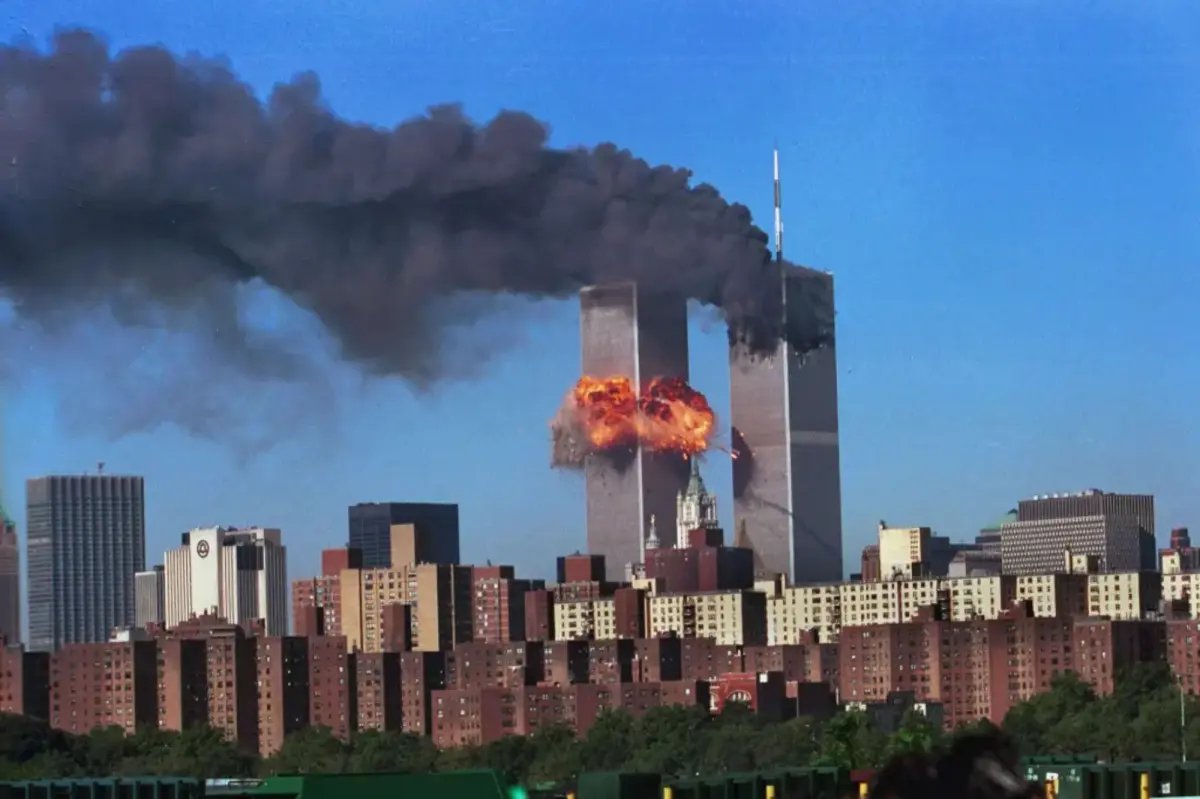
Before 9/11, the standard advice on a hijacked plane was to stay calm, follow instructions, and wait for the situation to be resolved on the ground. That was the training and assumption until 19 al Qaeda hijackers exploited it on four aircraft in a single morning and killed nearly 3,000 people.
Three of those planes reached their targets. One did not.
United Airlines Flight 93 left Newark for San Francisco at 8:42 that morning. About 40 minutes in, four hijackers stormed the cockpit. The passengers began making phone calls from the seatback airphones and their cell phones, and learned within minutes what had already happened at the World Trade Center and the Pentagon. They understood what their plane was going to be used to do.
They took a vote. And a 32-year-old software account manager named Todd Beamer, on the line with a Verizon supervisor named Lisa Jefferson, said the words that have stood as a testimony to the heroism of Flight 93.
“Are you ready? OK. Let’s roll.”
Beamer, Tom Burnett, Jeremy Glick, Sandra Bradshaw and the other passengers stormed the cockpit. The plane went down in a Pennsylvania field, upside down, 20 minutes from Washington. Every person on board was killed. The Capitol and the White House were spared.
So much in America changed that day. American passengers were never going to wait again.
Since then, most security incidents have been resolved on board before the plane landed.
In December 2001, Richard Reid tried to light the fuse on his shoe on an American Airlines flight from Paris to Miami. Passengers and crew tackled him and tied him to his seat with belts.
On Christmas Day 2009, Umar Farouk Abdulmutallab tried to detonate explosives sewn into his underwear on a Northwest flight from Amsterdam to Detroit. A Dutch filmmaker named Jasper Schuringa climbed over three rows, put out the flames with his hands and dragged Abdulmutallab to the front of the plane.
Our country is not weak. We have spent 25 years rebuilding a security infrastructure that includes the Department of Homeland Security, the Transportation Security Administration, the federal air marshals, hardened cockpit doors, no-fly lists and biometric screening.
All of that matters.
But when the moment actually comes and something goes wrong at 30,000 feet, the first line of defense is not the badge. It is not the checkpoint. It is not the marshal in row 12 if there even is one. It is the American in the aisle seat two rows away who is already unbuckling.
Yet what matters most is that when the moment comes and Americans need to act, we do not wait for instructions.
We know now that “never again” is up to us.
Let’s roll.
Lisa Daftari is a foreign policy analyst and media commentator based in Los Angeles.
