



School’s out.
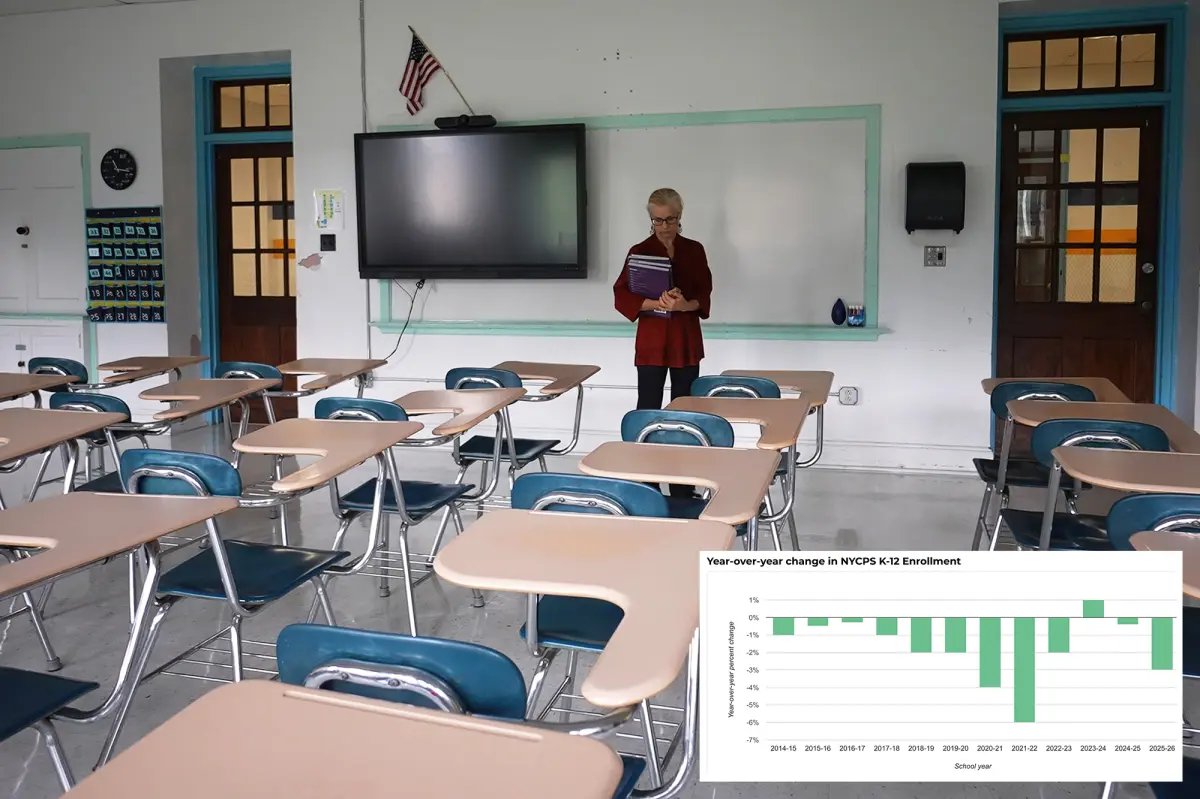
Enrollment in New York City public schools has taken a nosedive, dropping by nearly 22,000 students last year alone — in the steepest drop since the COVID pandemic, according to a new report.
The sobering study, released Thursday by City Comptroller Mark Levine, shows the number of Big Apple K-12 students plummeted by a whopping 19% — or nearly 187,000 students — since the 2013-14 school year.
And there’s no end in sight.
Total enrollment is projected to decline by another 128,000 over the next decade amid a decline in birthrates, the analysis noted.
The Big Apple’s sky-high cost of living has also been a major factor in the decline, Levine emphasized.
“Declining school enrollment is not only a challenge for our education system – it raises fundamental questions about affordability, the ability of young families to build a future in New York and the kind of city we want to be,” Levine said.
At the same time, the city Department of Education spends $44,000 per student — more than any large school district in the country — despite mediocre to poor results on standardized math and reading tests.
Only half of public school students in 3rd-8th grade scored proficient on the most recent state English Language Arts/reading exam, a drop of six points. Forty three percent flunked the standardized math exam while just 57% scored proficient.
The comptroller’s analysis shows:
- The NYC Public School System saw its steepest drop in enrollment since the pandemic in the 2025-26 school year, with a drop of 21,793 students, or 3%.
- Amid the enrollment decline, the city Department of Education is serving a greater share of students with special needs, more non-English speakers and one in 7, or 14%, who were housing insecure or living temporary housing.
- The share of pupils who are black has shrunk from 26% of the student body in 2014 to 19% now.
- The steepest drop in enrollment was between 5th grade and 6th grade, when parents need to decide where to send their kids to middle school.
- Even enrollment in charter schools has tapered off, increasing no more than 4% annually in recent years. The state has imposed a cap that bars the opening of new charter schools in the city.
Even with the early childhood education expansion in pre-K and 3-K, total enrollment cratered, resulting in 147,930 fewer students between 2013-14 to last year, the comptroller’s office noted.
Over that period, enrollment in 3K and Pre-K increased by nearly 40,000 students, to 94,726 in the 2025-26 school year.
Overall enrollment, however, has sunk from more than 1 million students to under 885,000 students.
There are 219 schools with fewer than 200 students, and many can’t even field a sports team or offer advanced placement courses, Levine has said.
Levine’s report did not issue recommendations, but in September he issued a statement saying the situation was “not sustainable.”
“As painful as it is, there is going to have to be some consolidation of schools with sharply declining enrollment,” he said at the time.
The report also shows that even the significant increase in charter school growth seen in the prior two decades has waned — in part because of a state cap that blocks more of them from opening due to opposition from the teachers’ union and allies in the legislature.
During the expansion of charter schools over the past quarter century, many parents opted to enroll their students in the publicly-funded, mostly non-union, privately managed alternatives to traditional public schools. The increase in independently run charters came at the expense of the NYCPS.
Between the 2013-14 and 2020-21 school years, charter school enrollment increased by 66,107, with year-over-year spikes as high as 18%, the comptroller’s report said.
But in recent years, the annual increase in charter school enrollment has never exceeded 4%, and most years has been less than 2%, the study found.
There are now 156,000 students enrolled in 286 charter schools.
Levine said NYCPS wasn’t just losing enrollment to charter, parochial and other private schools. A decline in the total population of students across the city is driving enrollment decreases.
The overall population of K-12 students in public, private and charter schools across the city sank by 81,506 students over the prior five years.
Aside from charter school enrollment leveling off, there were 6,841 fewer students in private schools since 2020-21.
There were 13,079 homeschooled students in the city last year — a fourfold increase from 10 years ago.
The number and proportion of students whose native language is not English make up 15% of NYCPS’ current enrollment.
Meanwhile 135,000 students—14% of the student body—are experiencing housing insecurity and living in temporary shelter, highlighting the affordability challenges facing city families, Levine said.
“The needs of our students are changing at the same time as a growing number of students face economic hardship and require specialized support,” Levine said.
“We need to understand these trends to make our schools stronger, direct resources where they are needed most, and give all kids the education they deserve.”
Schools Chancellor Kamar Samuels said the DOE has to make adjustments to manage smaller classrooms.
“This report makes it clear that New York City is not immune to national declines in birth rate, as the comptroller states. Adjusting to this reality will require honestly confronting the problem and engaging deeply with communities, which we’ve already begun,” a spokesperson for Samuels and the DOE said.
The spokesperson said the Mamdani administration was addressing the affordability crisis to keep families in the city by launching a universal 2-K program.
