


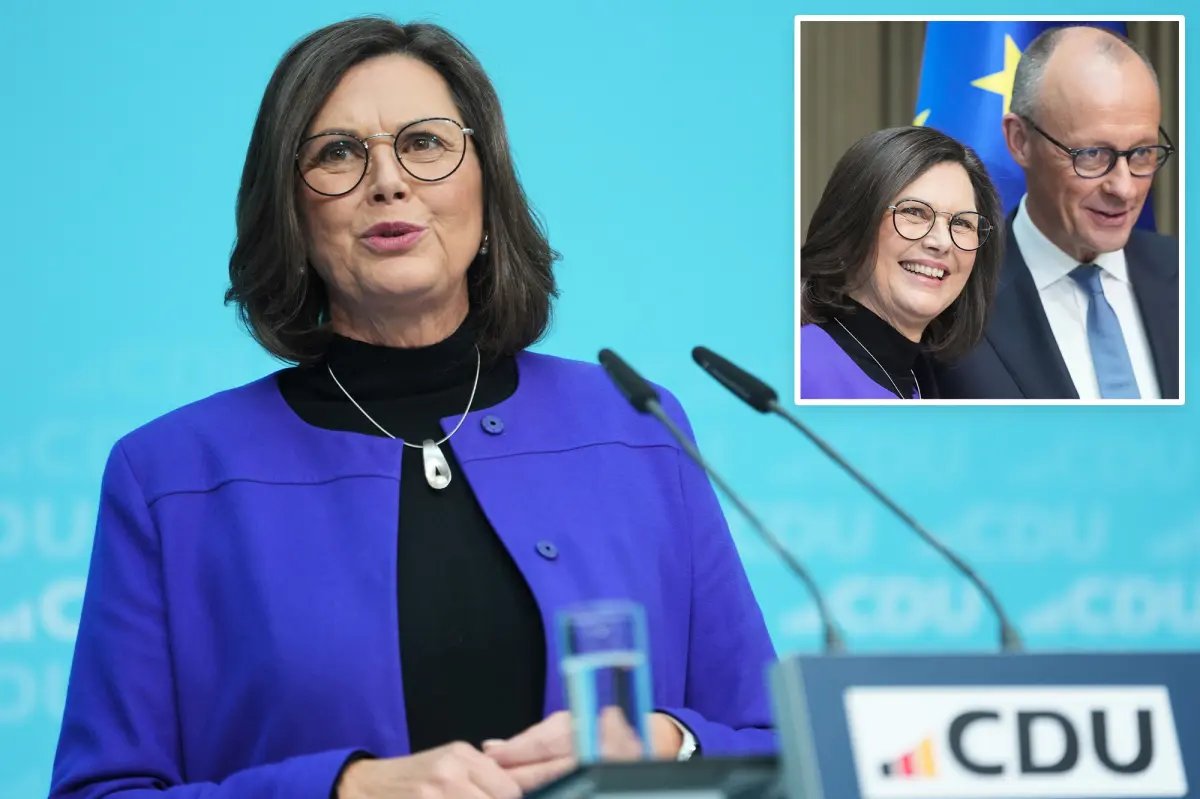

Germany is set to get its first female president after Chancellor Friedrich Merz’s party nominated Ilse Aigner, a center-right politician with appeal to liberals, to become the country’s head of state next year.
Aigner presented herself Monday as a unifying figure in an increasingly polarized country, saying that she hopes to represent a “strong center.” She said the broad political support taking shape for her is “an important signal against populist and extremist forces in our country.”
The new head of state will be elected Jan. 30 when a special parliamentary assembly chooses a successor to President Frank-Walter Steinmeier, who is constitutionally barred from seeking a third five-year term. It is made up of the 630 members of the national parliament’s lower house and an equal number of delegates from Germany’s 16 state parliaments.
Aigner, 61, is the speaker of Bavaria’s state legislature and hails from the Christian Social Union, the smallest of three parties in the national government and part of Merz’s conservative bloc, which has long pushed her candidacy. After it won official backing Monday from leaders of Merz’s Christian Democratic Union and the center-left Social Democrats, she looks all but assured of election.
The governing parties will have a majority in the assembly that elects the president. Aigner also has received a positive reception from the opposition Greens.
“From my point of view, it is high time for a woman to hold this highest office for the first time,” Merz said as he presented Aigner. He said her background as an electrical engineer would also be a first for a president, reflecting “the reality of millions of people in our country” in manual work.
Aigner has been active in politics since her late teens and was elected to the Bavarian state legislature in 1994. She served as Germany’s agriculture minister from 2008 to 2013 under Chancellor Angela Merkel.
She then served as Bavaria’s economy minister and transport minister before becoming the speaker of the Bavarian state legislature eight years ago. She has a relatively liberal reputation; in her current role, for example, she was supportive of Germany’s first openly transgender lawmaker in 2019.
“I am in politics to overcome divisions, bring people together and also reach those who perhaps feel that they stand on the sidelines,” Aigner said, adding that she stands against “every attack on human dignity.”
Germany’s post-World War II federal republic has had 12 presidents since 1949, all men. Women have held most of the country’s other top jobs.
Merkel was the first female chancellor, from 2005 to 2021. Four women have served as speaker of the lower house of parliament, in protocol terms Germany’s No. 2 official ahead of the chancellor, including incumbent Julia Klöckner.
The president is supposed to be above party politics and usually has a largely ceremonial and representative job, but the head of state can play a part in times of political crisis. Steinmeier, for example, took an unusually active role in nudging rival politicians toward forming a new government after an inconclusive election in 2017.
German politics has become more turbulent since, with rising support for the far-right Alternative for Germany further complicating efforts to form politically cohesive governments.
Alternative for Germany intends to field a candidate of its own. Co-leader Alice Weidel criticized the nomination of Aigner and said that, as parliamentary speaker, she “has proven several times that she cannot set aside the role of party politician.”
