


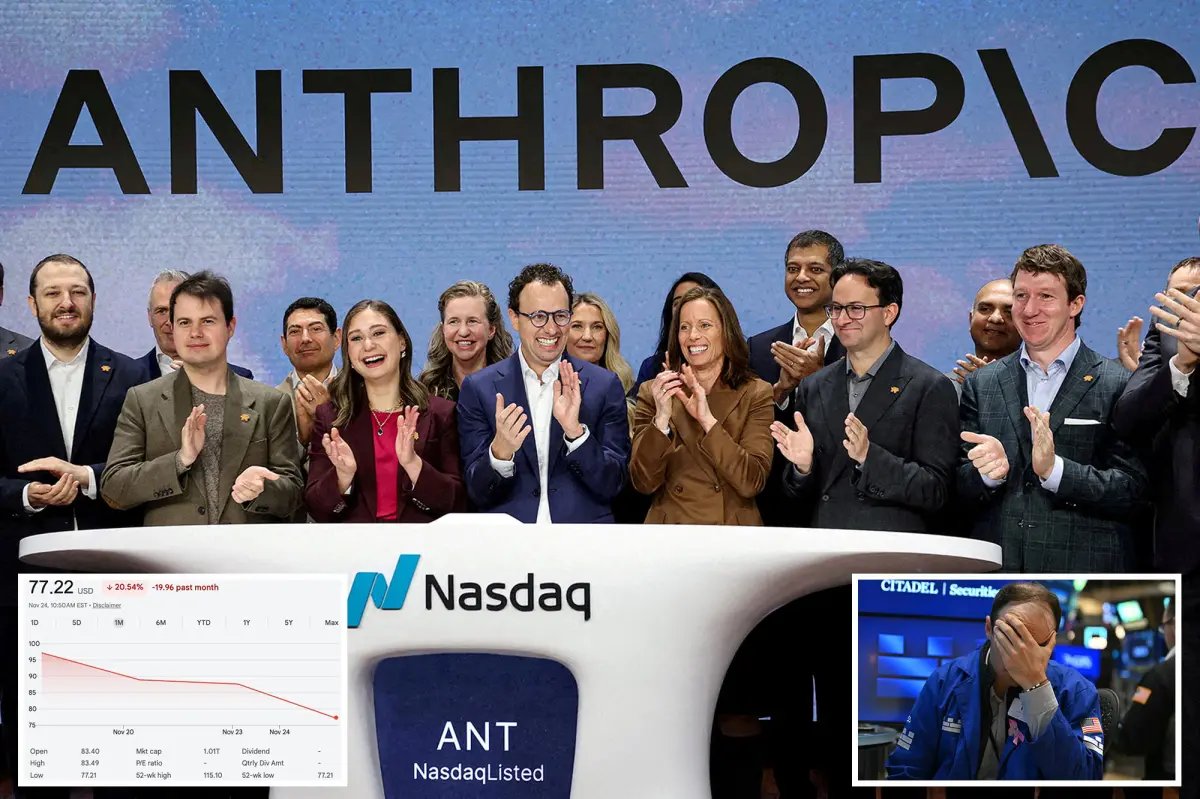

Anthropic on Tuesday fell below its $83-a-share IPO price as investors grew concerned that the momentum around the AI trade might be fizzling out.
The stock plummeted 12.3% to $76.88 a share on Tuesday – down more than 20% since it debuted on the Nasdaq on last Thursday. Its market value also dipped slightly below $1 trillion.
Tech stocks also continued to stumble, with the Nasdaq falling about 2%. Nvidia declined as trader euphoria around the Monday return of CEO Jensen Huang appeared to dissipate.
Anthropic has been steadily falling since opening to great fanfare at $111.50 a share and raising $81.3 billion in the largest-ever IPO, topping the record $75 billion Elon Musk’s SpaceX raised in June.
Dennis Follmer, chief investment officer at Montis Financial, said it’s no surprise that Anthropic has been declining, as newly-public companies typically experience volatility for months following their debut – and the stock could still turn around.
“The AI stock environment right now is trying to find its footing after several weeks of extreme volatility, and Anthropic is arguably the new focus of the AI story,” he told The Post.
“Ultimately, it may take several months, and several quarterly earnings reports from Anthropic, in order for the stock to stabilize.”
Investors hoped Anthropic’s massive IPO would revive optimism around the AI trade – but many are still nervous about the trillions of dollars being poured into the new tech, especially as the industry faces a growing number of threats.
Huang’s scandalous affair with an alleged Chinese spy has prompted the Commerce Department to crack down on Chinese chip export controls, and any further tightening on the AI trade could hurt chipmakers that rely on foreign manufacturers and buyers.
Democrats’ sweep of the midterm elections has also raised concerns that data-center construction could be halted in states around the country, potentially hitting revenue at top AI labs.
Many analysts remain optimistic that Anthropic will eventually turn around and deliver blowout profits in the long term.
Analysts at Canaccord Genuity initiated coverage of the stock with a buy rating and $135 price target; Wedbush gave Anthropic an outperform rating and a $120 price target; and Oppenheimer analysts gave the stock an outperform rating and $150 price target.
Nic Puckrin, cross-asset analyst and founder of Coin Bureau, described Anthropic as the first true AI stock – making it more vulnerable to shifts in how traders feel about the risky sector. SpaceX, for example, also owns a rocket-launch firm and satellite business.
“Anthropic is the first stock that lets investors express their doubts about the AI trade directly, and that’s what its share price is showing us,” Puckrin told The Post.
“Investors are questioning whether it can live up to its massive valuation, which would require stratospheric growth in future profits, but the headwinds it’s facing are significant.”
He added that Anthropic needs “to show some strong revenue growth and convince investors that it’s able to generate significant cash flow, which is tough in this environment.”
Ex-Securities and Exchange Commission Chair Gary Gensler recently warned that AI investments have created a bubble that will likely burst and trigger a recession by the 2028 presidential election – one of the most dire warnings from a senior regulator yet.
Anthropic – like other AI giants – has struggled to turn sizable profits as it spends big on the new tech, with its commitments currently reaching over $900 billion.
Dan Ives, partner and analyst at Yorkville Ives & Co, said Anthropic’s stock is also being hit by the return of Jensen Huang to Nvidia, after he was briefly forced out for reported extramarital affairs with a suspected Communist spy and two Nvidia employees.
“Anthropic is selling off on fears Jensen back in town is going to be negative for the frontier models like Anthropic,” Ives told The Post.
Huang has been viewed as one of the most ardent defenders of open-weight AI models, which are released to the public and can be downloaded and tweaked by users.
Closed frontier models – like OpenAI’s ChatGPT, xAI’s Grok and Anthropic’s Claude – are accessible only through the provider, which then handles everything around the bot, including training, infrastructure, safety systems and updates.
The growth of open-weight models has become a major business opportunity for Nvidia, since it broadens demand for the company’s chips beyond just a handful of large developers – and the once rudimentary models are gaining ground and can perform nearly as well as frontier rivals.
Nvidia in August agreed to buy Hugging Face, a platform that developers use to host open-weight models, and Huang has lobbied US lawmakers not to implement “premature restrictions” on open-weight tools so American firms can better compete with China.
