


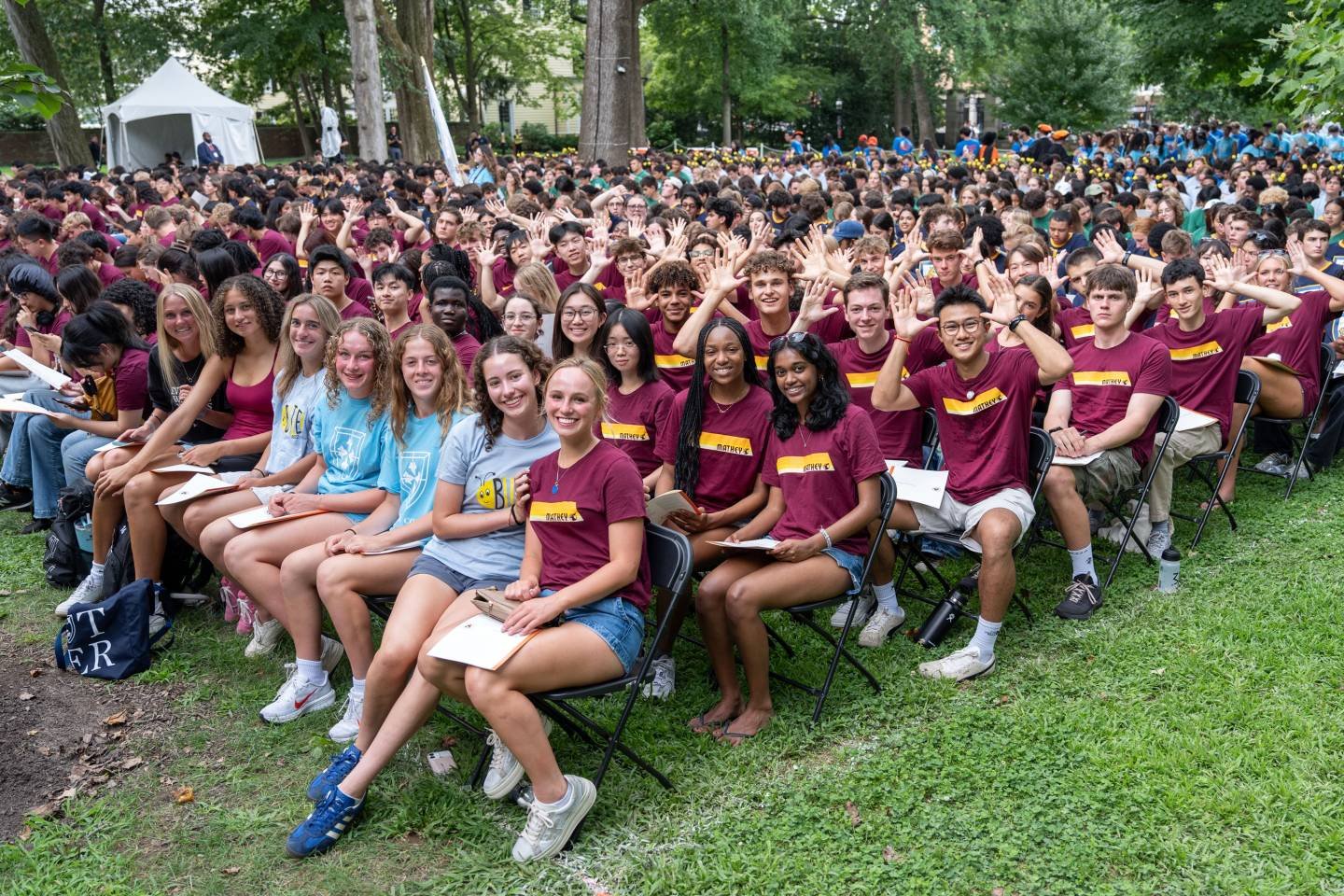
President Christopher L. Eisgruber welcomed incoming undergraduate and graduate students to campus during the annual Opening Exercises ceremony on Sunday, Aug. 30, encouraging them to value the myriad opportunities to learn deeply and think critically while at Princeton.
“As you enter Princeton, I hope that you will not hurry the journey at all,” Eisgruber told students seated on the lawn in front of Nassau Hall. “Give yourself permission to savor the experiences and the ideas that make this campus magical. Linger and reflect, because it matters profoundly what you gain along the way.”
Opening Exercises is a Princeton tradition that dates to at least 1802. The ceremony also includes readings from various faith traditions and the awarding of undergraduate academic prizes. In presenting the awards, Dean of the College Michael D. Gordin recognized the students for their intellectual curiosity, wide-ranging interests and superb academic accomplishments.
The event marks the start of a new academic year for first-year students in the Class of 2030, incoming transfer students and new graduate students ahead of classes beginning Sept. 2. The high spirits of the afternoon were not dampened by a passing cloudburst, which gave way quickly to sunny skies. “We are going to keep powering through because you are the Class of 2030 and this will be memorable,” Eisgruber said as students cheered during the rain.
As he began the ceremony, Eisgruber reflected on “how fortunate we are” to be on a campus that values the pursuit of truth, cherishes the importance of service and celebrates the rich tapestry of our community.
The enduring power of learning deeply and broadly
In his speech, titled “What You Learn Along the Way,” Eisgruber emphasized the enduring power of a liberal arts education to prepare students for whatever the future may hold.
“Human advantage often comes from learning things without knowing why or how they will be useful,” he said.
Deep and broad learning is essential, Eisgruber said, particularly in this moment when AI and other technologies are transforming society. He noted: “The easy availability of AI tools may tempt us to skip the journey that makes learning possible, but the capacity, and temptation, to replace learning with summary is nothing new.”
“So how can we know which knowledge or skills will be most useful in a world where technology changes with dazzling and dizzying speed?” Eisgruber posited to students. “The honest answer is that we do not know. But that is not new. It has been true for centuries, if not millennia, because one thing we do know, and have long known, is that the world will change in unexpected ways.”
“At Princeton, we want your education to equip you not only to succeed at your first jobs, but also to become leaders many years from now in a world far different from the one we now inhabit,” he continued. “Liberal arts universities like Princeton are based on the idea that you should learn both deeply and broadly, so that you will acquire not just knowledge but, more fundamentally, multiple ways of knowing that will enable you to discover, attack, and conquer questions that nobody has yet answered or even asked.”
Eisgruber said students “lose a lot” if they take shortcuts to learning new subjects.
“Lectures, essays, and books travel an intellectual path. They are invitations to think along with the author,” he said. “As you know from the work that earned you a place at Princeton, scholarly exercise strengthens the mind. Conceptual details stimulate insight. Serendipitous connections among ideas launch discoveries and open new horizons.”
He added: “Genuinely understanding an argument or an idea is not merely a matter of repeating a conclusion; it requires your intelligence, your presence, your active participation in the train of thought. A good book or a good lecture is a journey, and if you take that journey you grow because of what you learn along the way.”
To close his remarks, Eisgruber harkened back to another Opening Exercises ceremony 45 years ago, when President William G. Bowen recited from C.P. Cavafy’s poem “Ithaka,” based on Homer’s Odyssey.
Inspired by the poem’s wish for a road “full of adventure, full of discovery,” Eisgruber told students that “It is not the degree you will earn, nor your post-graduation career prospects, it is not the endpoint, it is not Ithaka, but rather the marvelous, challenging, bewildering, sometimes uncomfortable and sometimes awesome journey that will be Princeton’s most precious gift to you.”
A robust Orientation week
After the Opening Exercises ceremony, the new students walked in the Pre-rade as students from Princeton’s sophomore, junior and senior classes cheered them on, joined by faculty, staff, alumni, family and friends.
In the evening, Eisgruber led the annual Pre-Read Assembly in Jadwin Gymnasium, which featured a discussion on the vital importance of deep reading in a digital age with Maryanne Wolf, author of “Reader, Come Home: The Reading Brain in a Digital World.”
The events were part of a robust week of Orientation activities, including a session on academic freedom and free expression held last week with Eisgruber and PEN America’s Summer Lopez *08.
Orientation also included three small-group experiences — Community Action, Dialogue and Difference in Action, and Outdoor Action.
Community Action, coordinated by the John H. Pace Jr. ’39 Center for Civic Engagement, introduces students to the University’s long-standing commitment to service.
Dialogue and Difference in Action provides opportunities to engage in critical conversations focused on community building and social action.
Outdoor Action helps incoming undergraduates establish new friendships through activities such as camping, canoeing, biking and hiking.
Opening Exercises can be viewed on the University’s YouTube channel. The event will be archived online for later viewing.
-

Outdoor Action included hiking, kayaking, biking and other trips.
-

Community Action (shown here) was also among the small-group activities during this year’s Orientation.
-
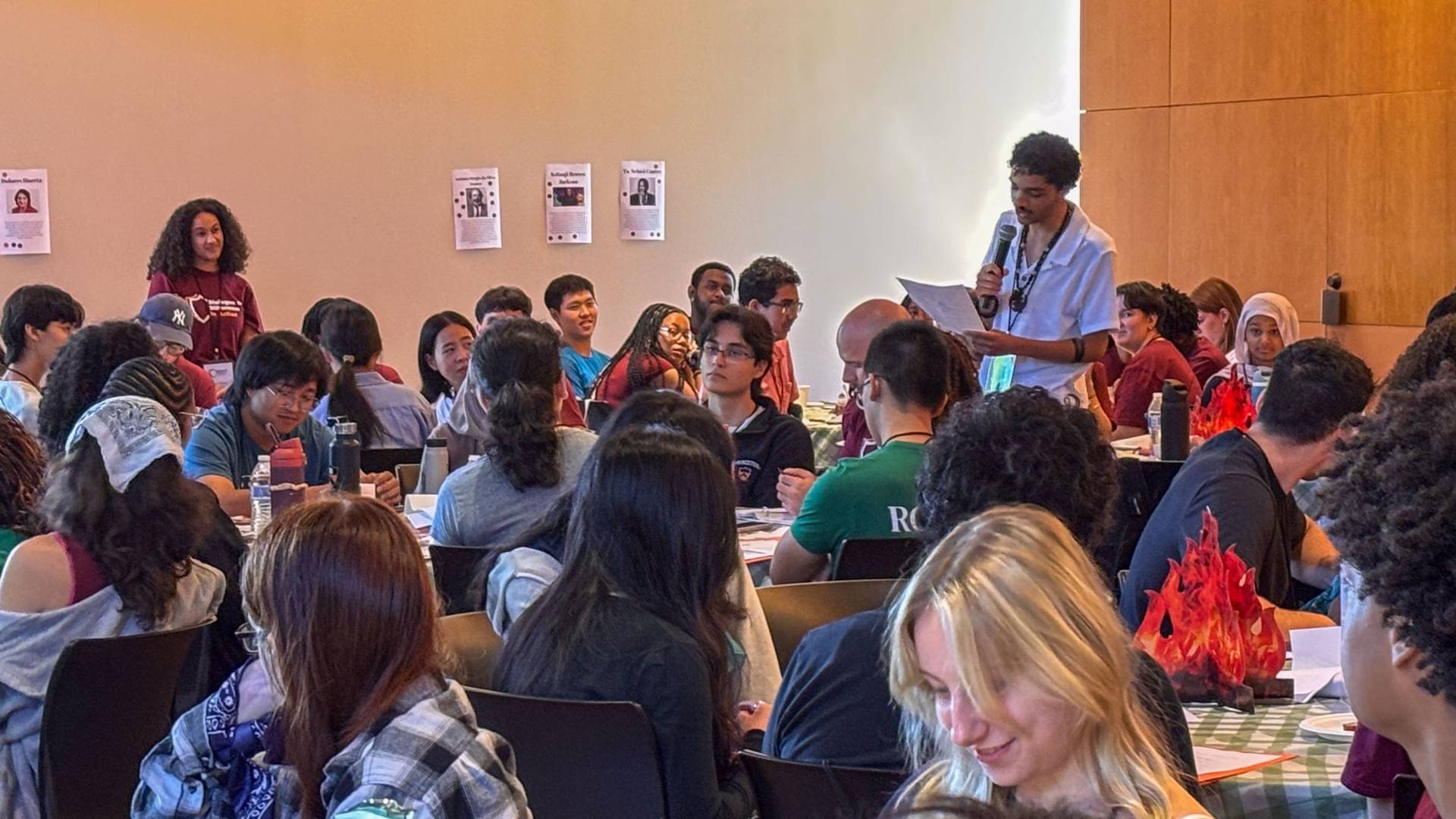
Students engage in a group activity as part of Dialogue and Difference in Action.
