


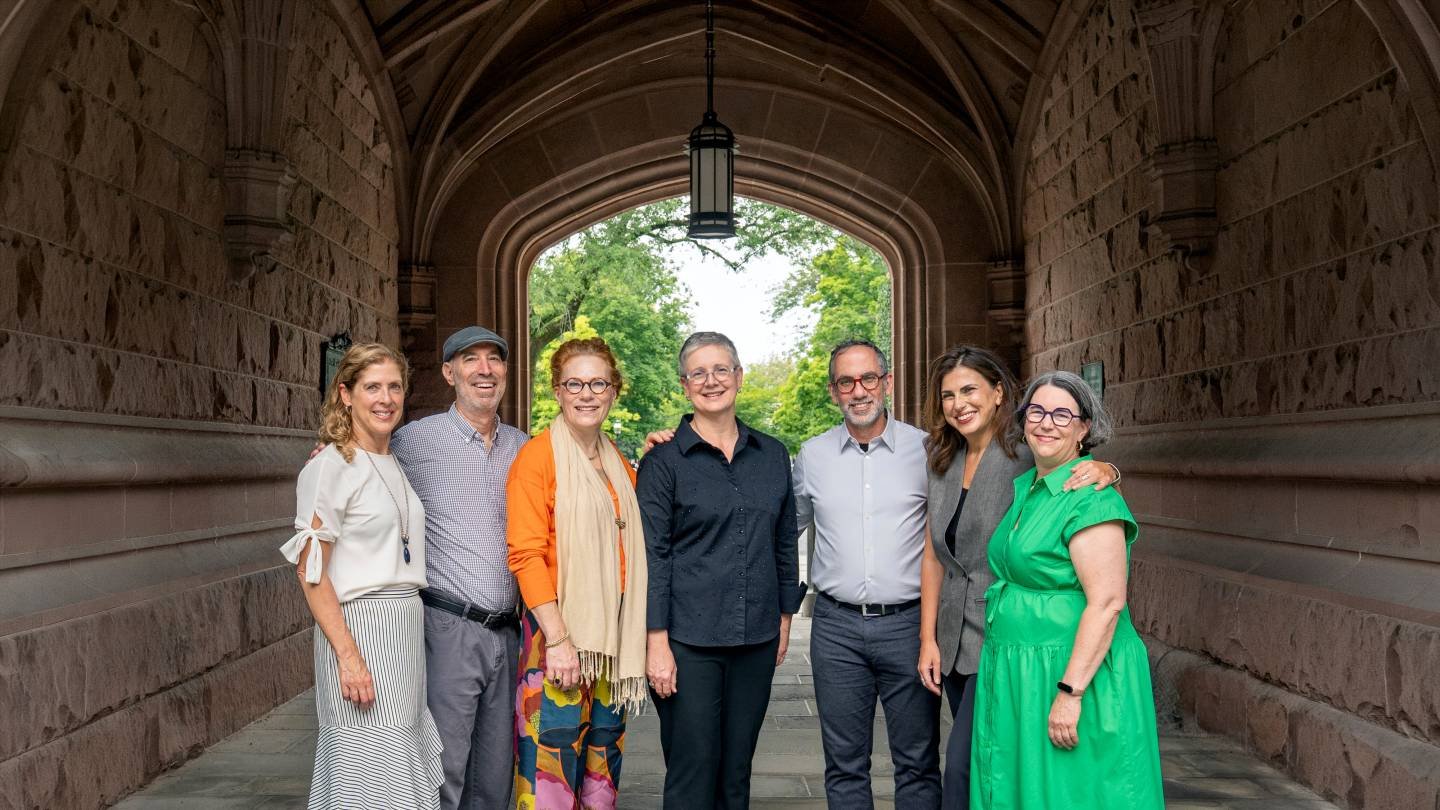
Claire Gmachl, the Eugene Higgins Professor of Electrical and Computer Engineering, says serving as head of Whitman College — one of Princeton’s seven residential colleges — is among the best jobs on campus.
“Academic and residential life are closely linked at Princeton and residential college heads help nurture that connection,” Gmachl said. “Every one of our students has a superpower of sorts and I’m inspired by getting to know so many talented, curious, creative and kind students inside and outside the classroom.”
Princeton’s residential colleges provide a close-knit community where undergraduates live, eat, study and socialize. Heads of college are tenured faculty members who live in nearby college houses and work with college staff, student peer leaders and faculty advisers to nurture undergraduates’ intellectual, social and personal development. Professors continue to teach and do research while serving in the roles.
“We’re here to support students and we’re invested in their success,” said Head of Yeh College Yair Mintzker, professor of history. “And by success, I mean not just great scientists, writers or thinkers, but people with strong character.”
Dean of the College Michael D. Gordin said one of the things he most appreciates about college heads is how they work together as a team to provide a holistic experience for all undergraduates.
“Each head has their own domain in their individual colleges, but together we think about how to make the system as a whole work even better,” Gordin said. “To that end, having faculty who represent disciplines across the University is crucial to getting the necessary perspectives in the room.”
Below, Princeton’s residential college heads explain their unique roles, share how faculty foster community in the residential colleges, and reflect on how serving as college heads enriches their own work and lives.
Welcoming students to their homes away from home
Head of Butler College Elizabeth M. Armstrong describes Princeton’s residential colleges as a true home away from home.
“The residential college is meant to be both safe harbor and launching pad, especially for our newest students,” said Armstrong, associate professor of sociology and public affairs. “We want Butler to be a place where students feel comfortable returning home after a busy day of classes as well as a community that gives them the confidence to go out and make other connections across campus.”
Undergraduates are randomly assigned to a residential college and typically live there for at least their first two years at Princeton.
“When I welcome new students and their families on move-in day, I tell them that the beauty of the residential college system at Princeton is that it allows for significant individual attention. Each student feels like a part of a small community where they’re known by name, and that enables this feeling of home,” said Head of Forbes College Maria Garlock, the Daniel Tsui Professor in Engineering and professor of civil and environmental engineering.
Each fall, college heads host small groups of first-year and transfer students for a meal at their homes. The faculty and students get to know each other on a personal level, discussing favorite books, music and movies and sharing more about their backgrounds and interests.
“It’s a moment to slow down, relax and enjoy each other’s company after the whirlwind of the first couple weeks,” said the new Head of Mathey College Effie Rentzou, professor of French. “It’s my opportunity to start meeting new students individually, learn about their lives, their plans and make them feel welcome.”
Faculty say these small, informal gatherings help ease students’ transition to Princeton.
“I think what my role really comes down to is signaling to students, ‘I’m here for you. I live here too and I want you to feel at home in your residential college. I’m interested in who you are and I care for your well-being,” said Head of Huo College AnneMarie Luijendijk, the William H. Danforth Professor of Religion.
Cultivating community and extending learning beyond the classroom
Much of a college head’s work focuses on cultivating the living-learning communities that are central to the Princeton undergraduate experience. Students are affiliated with a residential college for all four years and may participate in college activities even if they live elsewhere on or off campus.
“I believe what makes the Princeton experience unique are the many opportunities for close interactions: a mind-opening discussion over lunch with a graduate mentor, a chat with a professor at the common room, or an unexpected encounter with a fellow student in a hallway — moments like these can be more life-altering than a class,” Rentzou said.
Adam Finkelstein, the Phillip Y. Goldman ’86 Professor in Computer Science, was a longtime faculty adviser in Rockefeller College before becoming college head in July.
“I have seen generations of students thrive here, and I hope to bring that same sense of belonging and possibility to everyone who calls Rocky home,” Finkelstein said earlier this year.
Garlock said college heads have the freedom to shape community in their own distinct ways. At Forbes, she hosts cooking nights with students where they learn to make sushi, empanadas, dumplings and other treats. At Whitman, Gmachl started service study breaks where students assemble care packages for local churches and community organizations in Princeton and Trenton.
At Yeh, Mintzker launched the “Becoming” series where Princeton faculty and staff share their career journeys with students. Speakers have included Gen. Mark Milley, the retired 20th U.S. Chairman of the Joint Chiefs of Staff and the Charles and Marie Robertson Visiting Professor at the School of Public and International Affairs (SPIA), and former Ambassador to Egypt and Israel Daniel Kurtzer, a professor of the practice in international relations and the S. Daniel Abraham Professor of Middle East Policy Studies at SPIA.
Mintzker also enjoys organizing field trips that expose students to new places and resources on campus. Last year, he took a group to Princeton University Library’s Department of Special Collections to view archival material related to America’s 250th anniversary. “We had students from all majors — engineering, physics, math — who may not get to visit Special Collections through their classes and I wanted to give them the opportunity to see the amazing treasures there.”
Having faculty embedded within residential life helps break down barriers between professors and students in many ways, Gmachl said.
“Princeton professors are passionate about undergraduate teaching,” she said. “By getting to know me as college head, I hope students feel more comfortable approaching their professors, going to their office hours and reaching out to them with questions.”
Enriching the Princeton experience
Faculty say serving as college heads also enriches their own Princeton experience.
“The residential community connects me with students I might not otherwise meet, across departments, interests and walks of life. That’s one of the real joys of this role,” Finkelstein said.
Armstrong agreed. “Our students lift me up and give me so much hope for the future. Their abundant creativity, energy, curiosity, dedication, their obvious love and fondness for each other, their sense of humor — it’s all such a joy to be a part of,” she said.
Rentzou became interested in serving as a college head after directing the University’s Humanities Sequence. “I followed a tight-knit group of students for a full year, traveled with them, visited museums, had dinner together and generally saw them a lot outside the classroom,” she said. “As head of Mathey, I hope to build this kind of connection with our students, a connection that extends outside of the classroom and makes for a true academic community.”
Luijendijk stays in touch with many college residents after they graduate and looks forward to seeing them during alumni Reunions.
“What I enjoy most about teaching is getting to know students and hearing their perspectives,” she said. “Being head of the college provides a different way to connect with undergraduates. I’m not grading them. I’m running into them in the dining hall or talking with them over tea and cookies at my home.”
Gmachl feels boosted when she returns to Whitman after a busy day, joining students for s’mores in the courtyard or enjoying dinner with residential college advisee (zee) groups at her house.
“For a professor who is energized by intellectually stimulating discussions with students, being head of the college is perfect,” she said.
