


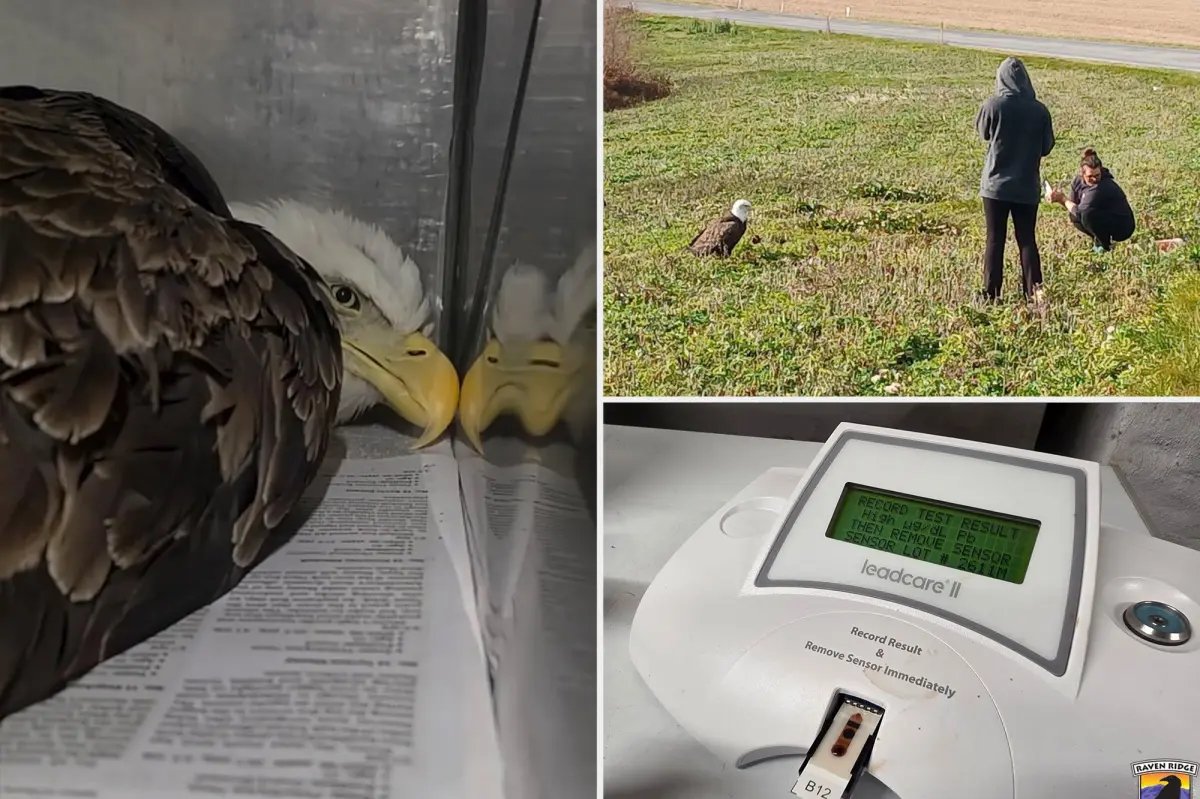

A bald eagle with severe lead poisoning had to be euthanized after it was found in a Pennsylvania state park — where dopey visitors took selfies with the bird instead of calling for help, a wildlife group said.
The distressed raptor was recently rescued by a wildlife center at Codorus State Park after a passerby called to report the bird was spotted along a roadway and unusually allowed parkgoers to approach, the Raven Ridge Wildlife Center shared on Facebook.
“If you can walk up to a bald eagle within arm’s reach, something is seriously wrong,” the group said. “Bald eagles are wild animals that naturally avoid human interaction.”
“Allowing people to approach so closely is a major warning sign that the bird may be injured, ill, or otherwise in distress,” the organization warned.
By the time the sickly bird was rescued, it was left gasping for air and struggling to breathe with damage deemed “irreversible,” the center said.
Bloodwork confirmed the bald eagle had “dangerously elevated” levels of lead in its system which “exceeded what the testing machine could register,” according to Raven Ridge.
“There was no longer a chance of recovery, and the decision was made to humanely euthanize this beautiful bald eagle to end its suffering,” the organization explained.
The center believes the sickened bird may have been “grounded for days” and was left questioning “how long it had been struggling without anyone reporting it.”
“Rather than contacting someone who could help, numerous individuals were approaching the bird to take pictures and selfies, seemingly more interested in how close they could get than in recognizing that something was wrong,” the wildlife center fumed.
Purposely disturbing or harassing wildlife can constitute a violation of wildlife protection laws, according to the wildlife center, which contacted the Pennsylvania Game Commission to assist in the bird’s rescue.
“Wild animals should never be treated as a photo opportunity,” the organization blasted.
The wildlife group believes the poison may have originated from lead ammunition inside a deer carcass which the ill-fated bird had been seen feeding on alongside another mature raptor and two young bald eagles — likely all from the same family group.
However, nothing was left of the deer remains by the time the group responded and experts were unable to test the carcass for traces of lead.
“Now, we are left hoping the other three eagles do not become victims of lead poisoning as well,” the center said.
The group has now called upon hunters to use lead-free ammunition and stressed the importance of recognizing the warning signs of animals in distress.
“The next time you see wildlife in distress, please put the animal’s well-being before the photograph. Don’t gather around it or approach it. Make the call. Report what you see,” the center urged.
Raven Ridge pleaded with parkgoers to “give wildlife a chance” and stressed that, “Sometimes, one phone call can mean the difference between life and death.”
“We cannot change the outcome for this beautiful bald eagle, but we can use its story to educate others and hopefully prevent this from happening again,” the group added.
