


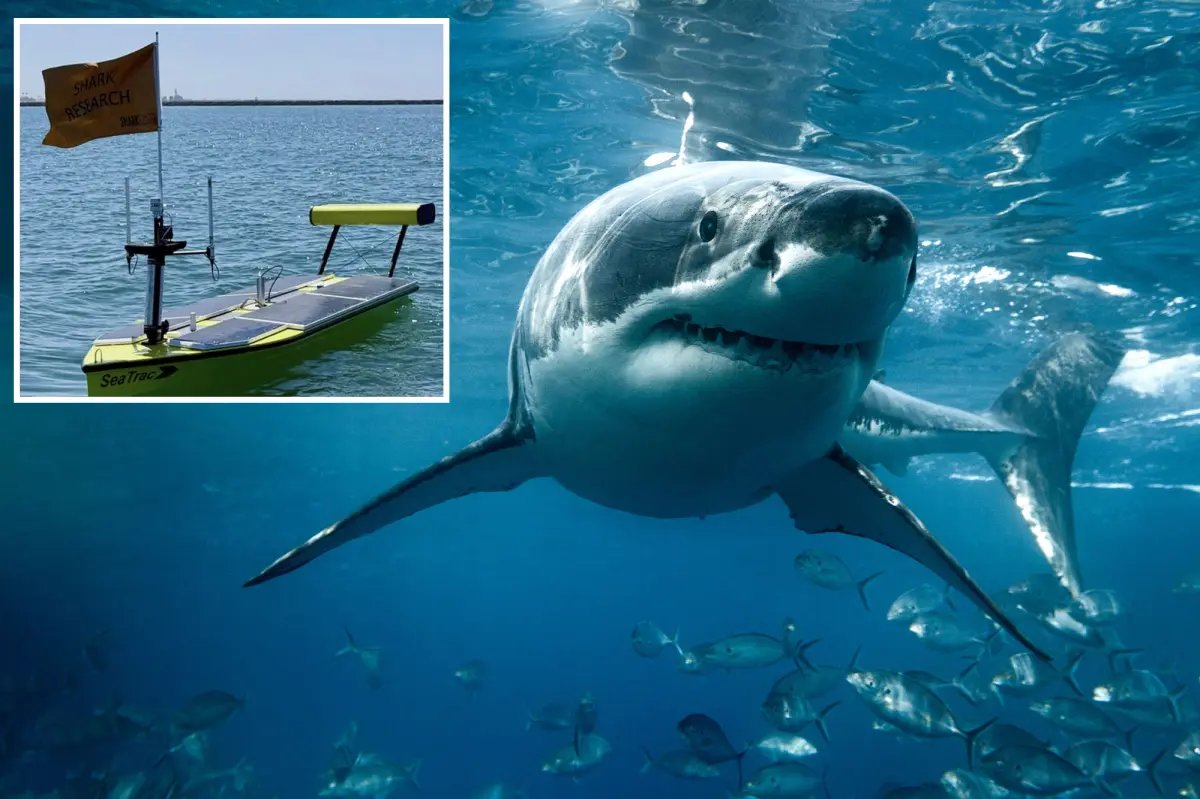

California beachgoers already spend enough time scanning the waves for fins. Now, scientists are working on a robot that could do shark-spotting for them.
Researchers at California State University, Long Beach’s Shark Lab have unveiled a futuristic semi-autonomous shark surveillance robot that looks like it belongs in a sci-fi movie but has one very practical mission:
It will be keeping tabs on great white sharks before they become the main character in someone’s beach day.
The floating prototype, nicknamed the Shark Surveillance Bot (SSB), is designed to patrol just offshore while collecting real-time information about sharks swimming nearby. The goal isn’t to fuel panic, it’s actually the opposite.
“Our data suggests that there are sharks around our beaches all the time without incident,” Shark Lab Director Christopher Lowe told KTLA. “Knowing what sharks, and how many are out there helps lifeguards make better decisions in beach safety operations and in advising the public.”
Translation? The sharks have probably been there all along. You just didn’t know it, which is somehow both comforting and mildly terrifying.
Once the high-tech gadget is fully operational, researchers hope to station it near individual beaches for up to a week at a time. The robot will “listen” for great white sharks that have been fitted with tracking tags while also collecting water samples to search for shark environmental DNA, genetic traces left behind through skin cells, blood and other biological material.
Because apparently simply looking for sharks wasn’t ambitious enough.
The robot also comes with its own aerial sidekick. A drone will sit on its back and launch into the air to capture a bird’s-eye view of the water while 360-degree video and shark data stream back to the Shark Lab over Wi-Fi. Scientists say the project could eventually provide lifeguards with near real-time information about shark activity along the coast.
The project is funded by the Seaver Institute in collaboration with New York University’s Center of Robotics and the Monterey Bay Aquarium Research Institute.
The Shark Lab admits there’s still plenty of work ahead, writing on Instagram that the technology requires “lots of research and development,” but added they’re “off to a great start.”
The timing couldn’t be better.
Scientists expect an increase in great white shark activity along the California coast later this summer as warming ocean temperatures push sharks north from Mexican waters. Lowe recently told WBAL that this year is shaping up similarly to the powerful 2015-16 El Niño, when unusually warm waters brought an influx of great whites and even unexpected visitors like hammerhead sharks.
That historic season also marked California’s first recorded hammerhead shark attacks, involving a spear fisher and a kayaker. Both survived.
So while this new shark-hunting robot won’t stop sharks from showing up, it could give lifeguards a valuable heads-up before anyone accidentally stumbles into the ocean equivalent of an uninvited pool party.
