


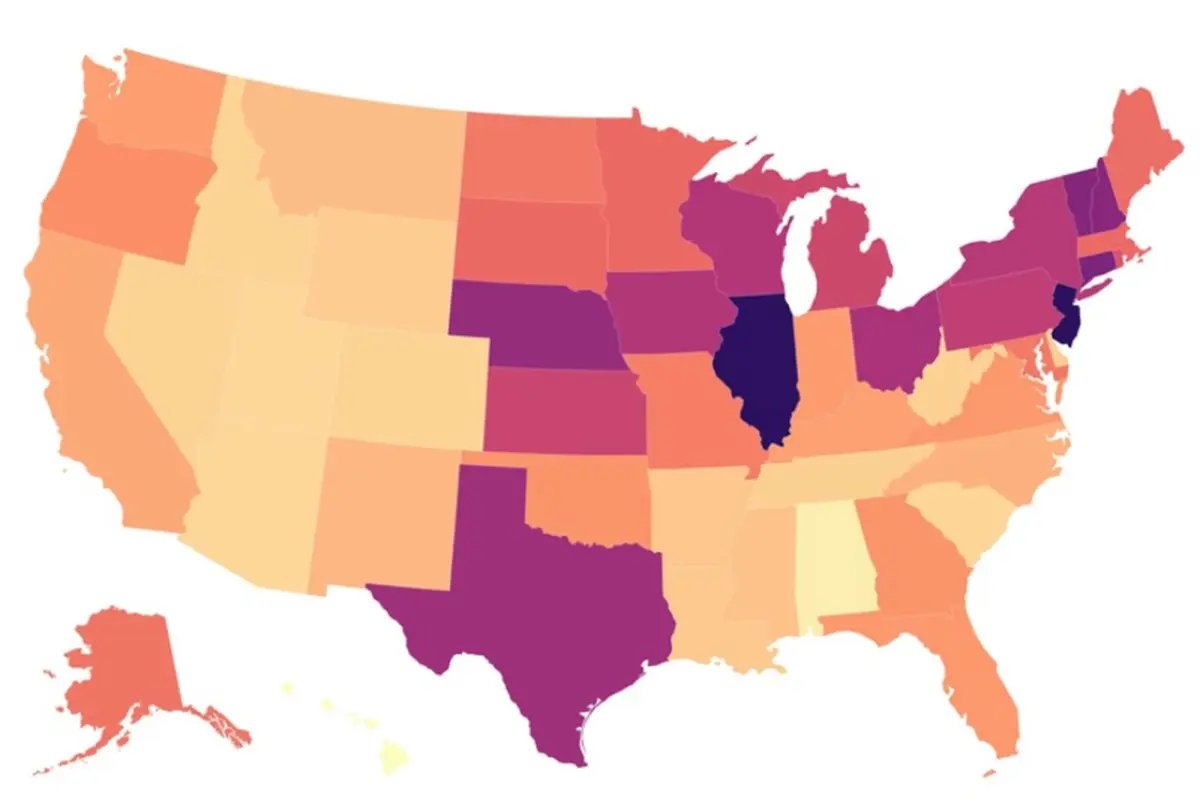
As the costs associated with owning a home keep rising, property taxes have become so unpopular that there is a long list of states trying to reduce or reform them.
Property tax relief bills will hit ballots this November in Florida, Louisiana, North Carolina, Oklahoma, Tennessee, and Wyoming.
Then there are the five states where the effective property tax rate on owner-occupied property falls below half a percentage point, or less than 0.50%. Those states are: South Carolina (0.49%), Arizona (0.48%), Utah (0.48%), Alabama (0.37%), and Hawaii (0.29%).

According to a Tax Foundation report, these five states have the lowest effective tax rates of the 50 states for 2024 (the most recent data available) and all, except Alabama, were even slightly lower than they were the year before.
This doesn’t necessarily mean that these states will always have the lowest property tax bills, which are tied to the value of a property. Higher assessments can mean higher tax bills, even with a lower tax rate.
“Since home values vary significantly across counties, it is also important to compare effective tax burdens (the median property tax paid divided by the median value of owner-occupied housing units),” writes Janelle Fritz in the report. “Because property taxes are assessed as a percentage of home values, it follows that higher property taxes are paid in places with higher housing prices.”
Low tax rates and low tax bills
Property taxes, which fund infrastructure and services such as schools, police, and fire departments, are set not only by cities and counties, but also by school boards, fire departments, and utility commissions, says the report.
Just because valuations rise, that doesn’t mean that tax rates do as well. “If homes in a community doubled in value but nothing else in the economy changed, local government wouldn’t necessarily need to capture twice as much revenue,” says the report.
Additionally, tax rates across counties can differ dramatically. For example, the median property tax bill in Buchanan County, VA, is about $404 compared to more than $10,000 in Falls Church City, VA, which is considered part of the Washington metropolitan area. Urban cores tend to have higher property taxes.

The state that ranks lowest for property tax rates is Hawaii. Yet, Honolulu County’s median annual property tax bill is $2,553, much higher than Buchanan County’s $404, despite Virginia having a higher effective tax rate of .78%.
Due to Hawaii’s generally high property valuations, tax bills don’t tend to be a bargain. Still, an expensive home in Honolulu is typically going to have a lower tax bill than a comparable one in New Jersey, which has the highest effective tax rate in the country at 1.88%.
New Jersey is tied with Illinois, then followed by Connecticut (1.54%), Vermont (1.54%), and new Hampshire (1.50%). Even Texas—considered a low-tax state due to having no personal income or corporate income tax—ranks high at No. 7 with an effective property tax rate of 1.40%.
As home prices throughout the country have soared in the past five or so years, so have property tax bills, even in places with low effective tax rates.
According to the Federal Reserve Bank of St. Louis, the median sales price for a home has reached $410,700 in the second quarter of 2026—a nearly 30% increase since the second quarter of 2020.
How low taxes are affecting real estate
Low tax rates help lure buyers to an area—especially from states with higher taxes, say experts.
South Carolina, ranked No. 46 in the country, with one of the lowest effective tax rates, brings in buyers from New York, Connecticut, and California, says Charleston County real estate agent Leslie Turner, cofounder of Maison Real Estate.
“Many buyers who are moving to South Carolina from other states mention that the property taxes are much lower here versus their home state,” she tells Realtor.com®. However, the broker says she has to “educate” most buyers on the Southern state’s “two-tiered property tax system,” where primary residences are taxed lower than non-owner-occupied homes such as vacation homes or rental properties.
“A property in downtown Charleston with an assessed value of $1,000,000 would have annual property taxes of approximately $4,584, if classified as a primary residence,” she says. “If the same $1 million property was classified as a second home or investment property, the annual property taxes would be about $16,246.”
She also says some counties have seen exponential tax rate increases. “Our property values have been increasing steadily for many years, with many areas seeing an 80%-90% increase in the past six years,” she notes.
However, the broker stresses that since values are so much lower than in states like New York, “buyers feel they are getting a good value for their investment.”
She notes that since property taxes are lower, the money to fund local services needs to come from somewhere else—and in Charleston County’s case, that is sales tax, which is around 9%.
“The beauty of a higher sales tax here is that tourists contribute a fair amount to the state, and the tax burden is not just on residents,” she says.
Another South Carolina broker, Justin Winter of Forbes Global Properties, says that the lower tax rate is helping push home values up.
“Low property tax rates drive interest which results in sales,” he tells Realtor.com. “Sales result in higher prices.”
And he notes a correlation between the lower property tax rate and who is moving in state, especially with the No. 2 ranked state, Illinois.
“The state that sends us the greatest number of transplants is Illinois,” he says. “We often hear from those relocating from Illinois that taxes are one of the top reasons for their defection.”
Meanwhile, in Arizona, where the .48% effective tax rate is just a hair below South Carolina’s, local agent Shawna Warner, founding partner at RETSY Forbes Global Properties, says it isn’t just mild winters and plentiful golf communities that have attracted migrants to Arizona, but the low tax burden. (The state also has a flat individual income tax rate of 2.5%.)
“Buyers are increasingly focused on the overall cost of homeownership, and Arizona’s relatively low property taxes are a meaningful advantage,” she tells Realtor.com. “For many buyers, it’s not just about finding the right home—it’s about the long-term value of living here.”
The Scottsdale-based broker also reports seeing an influx of buyers fleeing higher-taxed pastures, mostly California, Washington, Oregon, and Chicago.
She notes some millionaires have fled from Washington due to its new 9.9% tax on income over $1 million in a single year. (The law goes into effect Jan. 2028.)
“Tax considerations are increasingly part of the conversation for some high-net-worth buyers,” she says. “Arizona’s relatively low property taxes are another appealing factor.”
