


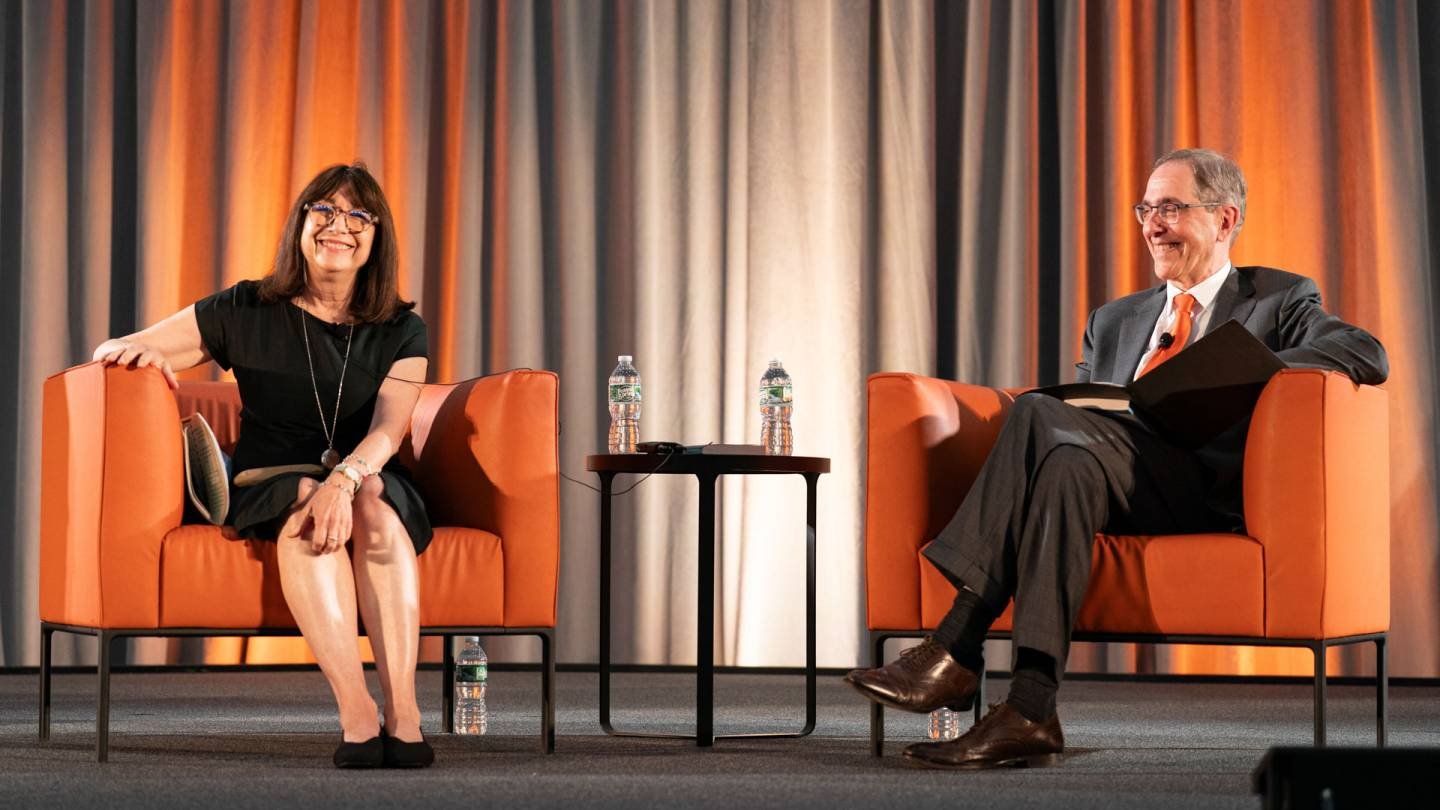
At this year’s Pre-read Assembly, the scholar, author and literacy advocate Maryanne Wolf described the sophisticated neural circuitry that we call on — and continue to strengthen — when we read deeply from difficult texts.
Deep reading reinforces the brain’s circuitry for knowledge, inference, empathy and critical thinking, Wolf told incoming Princeton transfer students and members of the Class of 2030. “The more you read, the more the circuit’s connections are strengthened and widened.”
Conversely, shortcuts like skimming, digital scrolling and reliance on AI summaries can throw a wrench in the works. “When you farm it out, as it’s so easy to do, you are literally short-circuiting the development of your own brain,” Wolf said.
Wolf is professor-in-residence at the UCLA School of Education & Information Studies and the John DiBiaggio Professor of Citizenship and Public Service at Tufts University.
This year’s Pre-read Assembly Sunday in Jadwin Gymnasium focused on her book, “Reader, Come Home: The Reading Brain in a Digital World” (HarperCollins, 2018), which Princeton University President Christopher L. Eisgruber selected for incoming students to read over the summer as their introduction to the intellectual life of the University.
‘A question of vital importance to every entering student’
Organized as nine letters to the reader, Wolf’s book interweaves her expertise in literary studies, cognitive neuroscience and developmental psycholinguistics to illuminate the importance of deep reading and critical thinking as our brains adapt to the seismic shift from print culture to digital culture.
“Deep, immersive reading is at the heart of a Princeton education,” Eisgruber writes in his foreword to the special Pre-read edition of the book. “I chose ‘Reader, Come Home’ as this year’s Pre-read because it addresses a question of vital importance to every entering student: Why should we continue to read long, challenging books when artificial intelligence agents can quickly summarize them for us?”
At the assembly, Dean of the College Michael Gordin welcomed the students to Jadwin Gym.
“Now we get to my favorite thing, which is talking about a book,” he said, introducing Wolf as “one of the foremost voices in this country to foreground the cognitive and the moral aspects of being a reader.”
Eisgruber and Wolf then dived into a lively, wide-ranging conversation that touched on topics including the connection between deep reading and empathy, the impact of AI on reading and writing, and what it means to have “a good reading life.”
‘Reader, beware — and test yourself, and choose’
Early in the conversation, Wolf suggested a self-test for students to gauge whether they are reading books deeply or habitually skimming, as they might on a digital device. “Now this is tricky,” Wolf said, “because you can skim, and skim well — you know that you do it all the time.
“One obvious symptom is when the denseness of something almost stops you cold,” she said. It can be useful to “find for yourself a book that you read and loved four years ago, two years ago, and see how you read it now” to check whether time spent on screens is affecting your reading brain.
“Reader, beware — and test yourself, and choose,” she said, encouraging the students to think of their college years as “four years of building the most sophisticated reading circuit for the rest of your life.”
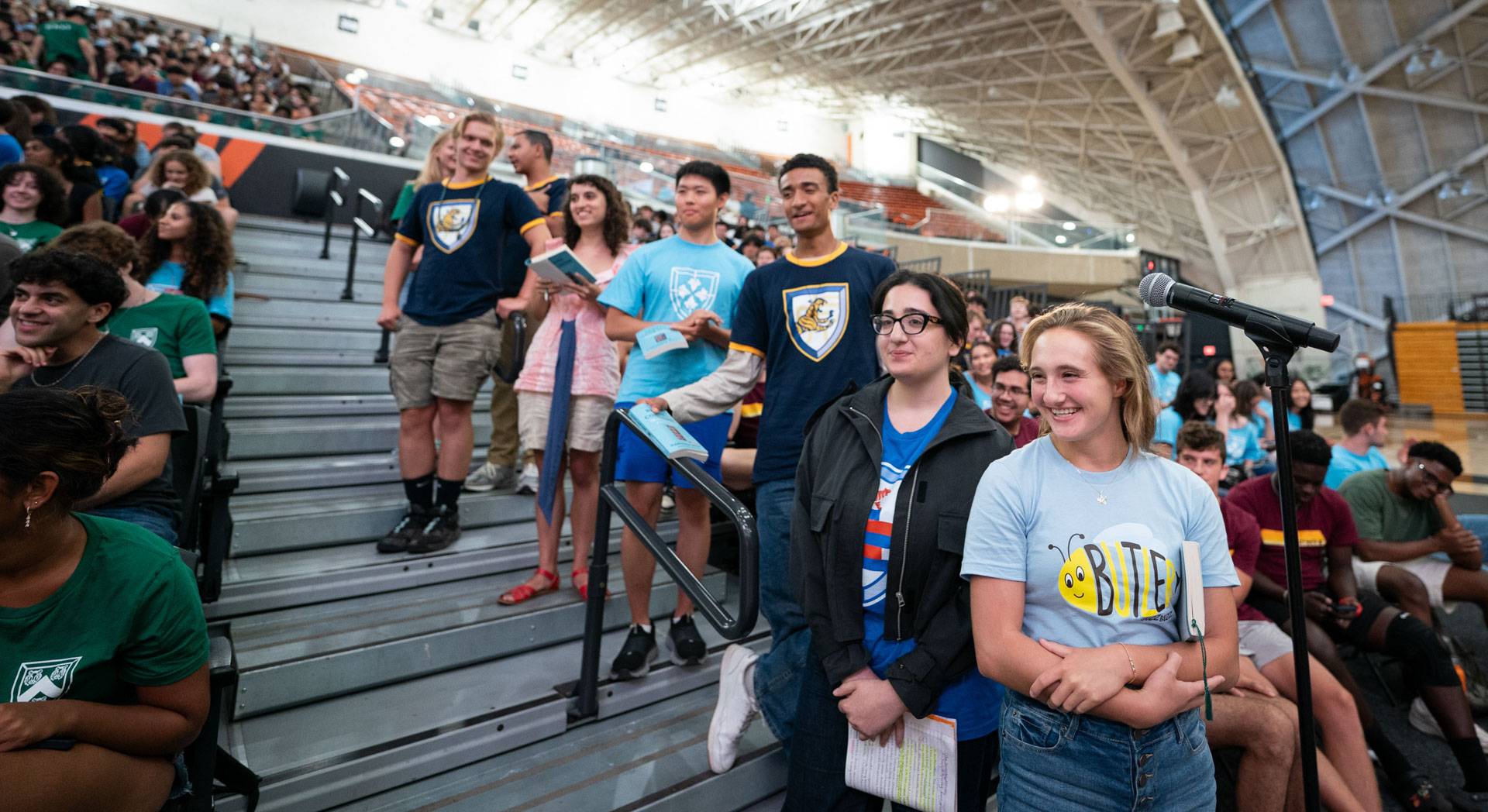
After the Pre-read discussion, students had the opportunity to ask questions. They lined up at microphones stationed around Jadwin Gymnasium.
Later, at Eisgruber’s invitation to elaborate on “what it means to have a good reading life,” Wolf recalled a conversation with the columnist and podcaster Ezra Klein, who had asked her a similar question during an interview: “How do we preserve the reading life?”
“I will tell you that I began, thanks to Ezra … to develop the concept of ‘book-ending’ my days,” Wolf said, calling the practice her variation on the philosopher Byung-Chul Han’s emphasis on the quiet power of lingering.
“All of you know the benefit of reflection, of thinking, of lingering,” Wolf said. “Book-ending is lingering in the morning and the end of the day” with a good book, preferably on paper.
“I want you to enter another world. I want you to feel what it feels like to think about really tough ideas, and simple ideas … to enter the intellectual world,” Wolf said. “Books give you that chance much more than a screen. They force you to go slowly. … You slow yourself down to allow your best thoughts to happen.
“That’s what we want for every person,” Wolf said. “The reading life gives us a chance to think your best thoughts, insights that go beyond anybody else’s ideas.”
Before opening the floor to questions from the students, Eisgruber asked Wolf her views on AI. “Are you willing to say a bit about how you do and don’t use AI in your own work?”
Wolf said she uses AI in her work “very carefully,” for example, to help develop a digital literacy program tailored for children at different reading levels, but that AI is only ever used as “a germ of an idea,” never a final product.
She emphasized that books, not AI-generated content, are critical to developing empathy and critical thinking. “You can be the author of your own brains, or you can be the lazy recipient of other people’s thoughts,” she told the audience. “I want you to be in charge.”
Thoughtful questions from the incoming class
After the discussion, students lined up at microphones to ask questions.
Juan Revolorio Ventura, of Lawrence, New Jersey, who participated in Princeton University Preparatory Program as a student at Lawrence High School and in the Freshman Scholars Institute (FSI) this past summer, kicked off the Q&A.
“Dr. Wolf, you argue that children should master physical books before transitioning to digital mediums as your ideal vision for a child’s reading development,” Ventura said. “As Princeton students … how do you think we should navigate college utilizing your ideas?”
Wolf recommended reading as many texts in print as possible, in part to tap into the brain’s capacity for spatial reasoning.
If someone asks you where something is in a book, she said, “you know that it’s on the left side, maybe a third of the way down,” and studies show this spatial awareness affects comprehension. “We are able to consolidate knowledge better with print than we are on the screen.”
Another student noted that the latter chapters of Wolf’s book focus on developing deep reading skills in children and wondered how adults, who have greater agency, can “take ownership over our own messed-up reward systems from endless doomscrolling” to develop a “deep reading mind”?
Wolf said the question of agency speaks to the necessity of reading books, and reading deeply, as “a civic responsibility” to counterbalance what online algorithms send to our social feeds, often from unknown sources.
Asked by another student to consolidate her advice and her book into “a Hemingway six-word story,” Wolf offered a compact seven: “Read deeply, long, with courage and effort.”
Eisgruber weighed in when another questioner asked how students might maintain a deep focus given the “many, many pages of reading each week” assigned in Princeton courses.
He answered that it helps to develop strong planning skills. “You know how rapidly you read or don’t,” he said. “I’m a very slow reader.
“You need to make sure you allocate that time and don’t find yourself rushed, and that will allow you then to really get the full benefit of the text.”
Eisgruber, who is also the Laurance S. Rockefeller Professor of the Princeton School of Public and International Affairs and the University Center for Human Values, added that when he assigns readings for a course he is teaching, “I always do the reading that week along with the students.”
The conversation between Eisgruber and the Class of 2030 around “Reader, Come Home” will continue in coming weeks during smaller roundtable discussions in each of the residential colleges.
-

Princeton student Juan Revolorio Ventura of Lawrence, New Jersey, kicked off the Q&A.
-
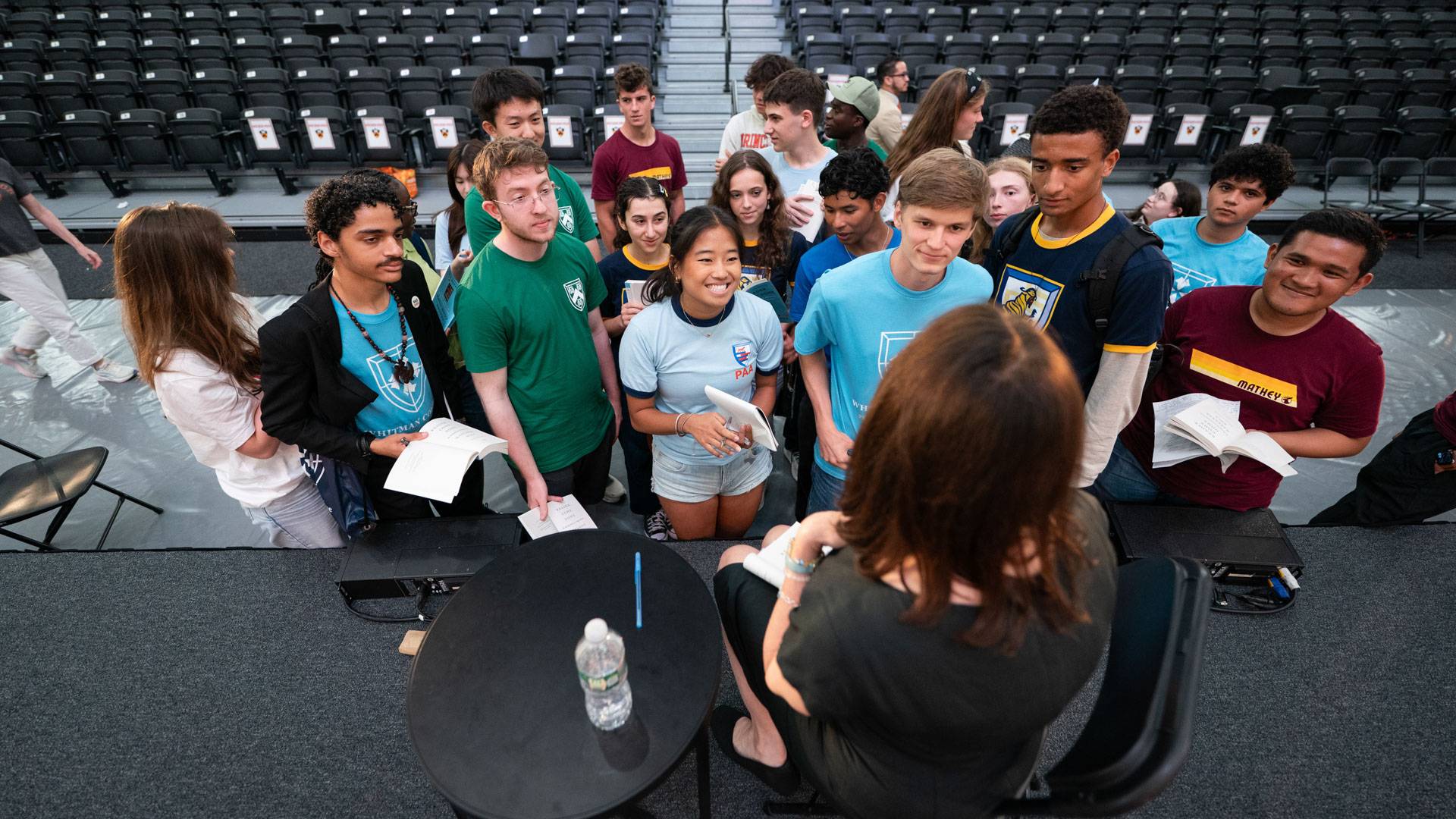
After the event, students enthusiastically gathered around Wolf to ask more questions and have their copies of the book signed.
-
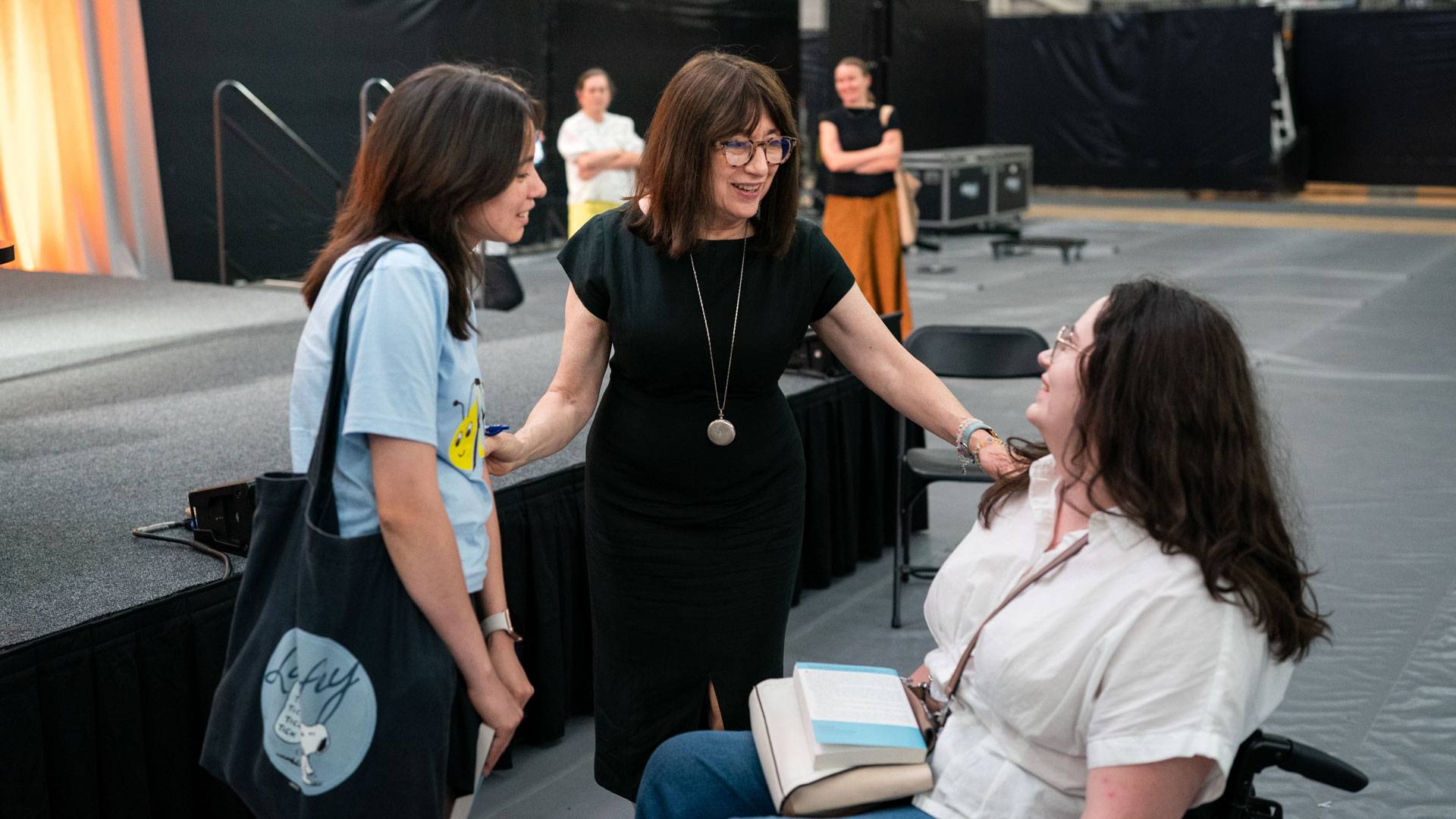
Wolf stayed to answer every student’s question.
