



Princeton has established a new academic unit, Data and Intelligent Systems (DaIS), to help accelerate the pace of discovery in artificial intelligence and data science and to support transformative research and teaching across disciplines.
As part of the University’s robust AI ecosystem, the nimble, interdisciplinary initiative builds on the deep links between AI and data science at Princeton while creating space for continued rapid progress in each of the fields.
“Artificial intelligence is evolving at an extraordinary pace, creating new opportunities for discovery across every field of scholarship,” said Provost Jennifer Rexford, the Gordon Y.S. Wu Professor in Engineering. “By advancing both foundational work in AI and its application to important questions across disciplines, DaIS will help accelerate research, teaching and innovation throughout the University.”
Rexford said DaIS will allow Princeton to seize opportunities that the fast-moving technology presents — and help to shape its course — accelerating scholarship within a wide range of fields and fostering collaboration across the sciences, engineering, social sciences and the humanities.
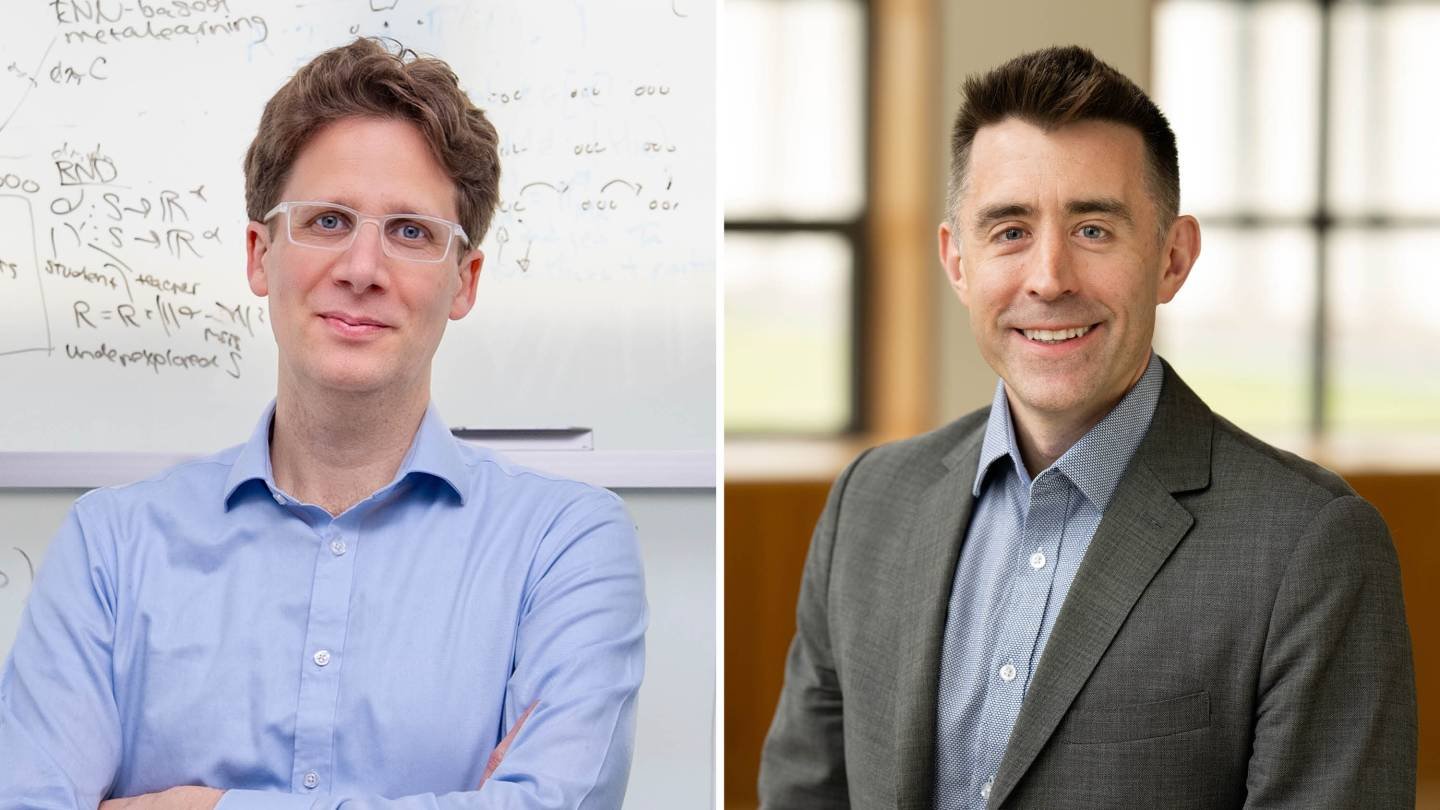
DaIS will encompass two related research pillars, Princeton AI and Princeton Statistics and Data Science, which represent the evolution of the AI Lab and the Center for Statistics and Machine Learning. The new academic unit will be co-led by Tom Griffiths, the Henry R. Luce Professor of Information Technology, Consciousness, and Culture of Psychology and Computer Science, and Arthur Spirling, the Class of 1987 Professor of Politics.
Griffiths and Spirling said DaIS was intentionally created to evolve with rapid developments in AI and data science. “This nimble new structure will allow Princeton to continue to lead in these areas and enable us to grow in response to all of the exciting advances that are happening in the world of AI and data science today,” Griffiths said.
Spirling added that incorporating data science as an equal partner to discovery in AI builds on the University’s traditional interdisciplinary strengths, enabling Princeton to respond “quickly but thoughtfully to the coming revolution in research.”
DaIS will support innovative research projects, connect scholars across academic departments, support undergraduate and graduate education, and assist faculty, graduate students and undergraduate students, utilizing cutting-edge AI and data science tools for research in all fields.
“We want to connect people from different disciplines to collaborate in new ways to tackle really big questions,” Spirling said. “We think of DaIS as a platform for supporting our faculty and students as they pursue ambitious interdisciplinary projects that impact our world.”
DaIS includes the Princeton AI research initiatives already underway — AI for Accelerating Invention, Natural and Artificial Minds, and Princeton Language and Intelligence — and will launch two new initiatives this fall that explore important questions related to AI’s impact on humanity. The AI Alignment and Safety initiative will be led by Elad Hazan, professor of computer science and director of Google DeepMind Princeton, and the Princeton Societal AI initiative will be led by Janet Vertesi, associate professor of sociology, and Matt Jones, the Smith Family Professor of History.
“These are great examples of the kind of interdisciplinary work DaIS supports,” Griffiths said. “We are not just thinking about how we innovate on the core technologies, but how we do so in a thoughtful and responsible way that grapples with the very real impact these technologies are having on our society. We want to make sure these developing systems are beneficial for humans in the long run.”
Vertesi said she is excited to grow the Princeton Societal AI project through DaIS.
“We have an interdisciplinary research team of humanists, social scientists and computer scientists across multiple departments,” said Vertesi, who also serves as director of the program in design at the Keller Center for Innovation in Engineering Education. “What is exciting about DaIS is that we will have a place for these interdisciplinary conversations under a single umbrella. We will get to really supercharge innovation — and I mean that broadly on all fronts — by bringing scholars together in conversation in one place.”
Under the Princeton Statistics and Data Science pillar, DaIS will encompass the Princeton Institute for Computational Science and Engineering (PICSciE), the Data-Driven Social Science Initiative, and the graduate certificate and undergraduate minor programs in statistics and machine learning. DaIS will also provide services previously offered by the Survey Research Center. Like the AI pillar, the Statistics and Data Science pillar will continue to evolve to best support faculty and students conducting data-driven research across a range of disciplines.
“DaIS will continue to support the University’s robust educational offerings around data science, machine learning and AI,” Griffiths said. “Another part of our work is to think about introducing learning opportunities that allow us to take new ideas into all of the disciplines to prepare Princeton students to go out into the world as future leaders in whatever fields they choose.”
Michael E. Mueller, the Donald R. Dixon ’69 and Elizabeth W. Dixon Professor of Mechanical and Aerospace Engineering, said DaIS will be a tremendous resource for both faculty and students. Mueller is the former director of PICSciE, now led by Professor of Mechanical and Aerospace Engineering Luigi Martinelli.
“Clear boundaries between computational science and engineering, data science and AI are no longer apparent. Now and in the future, it would be unnatural for there not to be a unified community of researchers and resources deployed to support this broad discipline,” Mueller said. “Anything that we can do to better coordinate this work and facilitate an exchange of ideas will only accelerate progress.”
The launch of DaIS is the latest development as Princeton continues to grow its AI ecosystem through faculty-led research initiatives and collaborations with industry, higher education and government leaders across the region, including the University’s partnership with the State of New Jersey, Microsoft and CoreWeave in the NJ AI Hub.
