


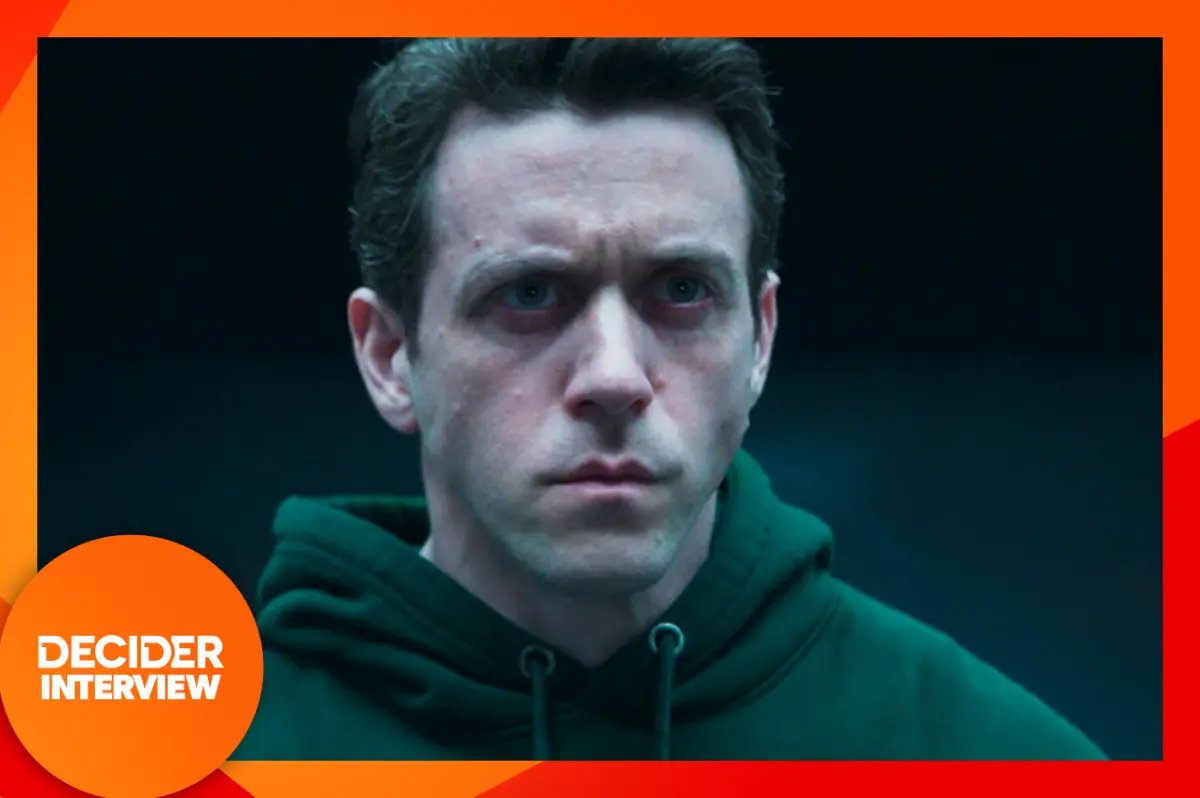
As Ashley Zukerman brought Congressman Daniel Keene from page to screen over 10 gripping Silo episodes, he had his finale character, Troy, on the brain every step of the way.
“I had my eye on Troy through the whole process, because there’s something the founders see in Daniel. And I thought that was important to track,” Zukerman told DECIDER over Zoom.
After Season 3’s superb penultimate episode went out with a nuclear bang, forcing parents-to-be Daniel (Zukerman) and Helen (Jessica Henwick) to seek shelter in separate silos, the finale leapt forward hundreds of years, revealing only Daniel’s fate. Though he’s still alive and hasn’t visibly aged a day, he’s clearly not the man he used to be…
A 24-minute cold open introduces us to Troy, a memory-wiped Daniel who’s preserved through cryotechnology and only awakened on rare occasions to manage silo rebellions. Joining Apple TV‘s popular post-apocalyptic sci-fi series two seasons in was already a dream for a Silo fan like Zukerman. But the chance to tell such a marvelously complex story by playing different versions of a character at different points in time was an especially thrilling challenge.
“Daniel [is] a guy who’s full of life, and history, and memories, and pain. That has taught him who he is, and it’s given him a sense of justice and kindness. So for that to be stripped away and just be fed with a simple mission, I thought, was key,” Zukerman explained, reflecting on his Troy transformation. “History has just been taken away from me. In a way, playing Troy was simpler. It’s a more peaceful character, because life is clearer… To him, he’s not doing bad things. And it was a fantastic thing to meditate on over the course of those eight months that we shot.”
In celebration of Silo‘s spectacular Season 3 finale, Zukerman chatted with DECIDER about the world-altering end of Episode 9, Daniel’s mysterious transformation to Troy, Helen’s Silo 18 fate, crossing paths with Juliette (Rebecca Ferguson), the “rough” but “satisfying” stuff Season 4 has in store, and more.
DECIDER: Before we dive into the finale, we have to talk about the end of Episode 9, which was absolutely devastating. After seeing the origin story of the silos through the lens of Helen and Daniel’s love story, how did you react when you learned where they were headed?
ASHLEY ZUKERMAN: It was constantly surprising to me, because as I was reading, I think the setup and expectations for all of us were that, because of his engineering background, Daniel is going to be implicated in the building of these silos. He’s going to get recruited into this project. And I love that the way they chose to tell that story was to keep that as a red herring and then show he has been changed by Helen. He has found something in her, and a sense of life, and a sense of something else. Then for him not to be implicated in the building of the silos, but then somehow recruited in this very tragic way, was pretty surprising.
How do you get yourself to a moment where you can authentically portray reactions to something as intense as the world ending and your character simultaneously losing the love of his life?
Because of where we go, I observed pretty early and just felt that Daniel and I were so linked. So a lot of the work was actually putting myself in his shoes as much as I could, and linking as much of myself to it. But both the functional and dysfunctional sides of him I really connected to. And as the season progressed, I just felt like going as hard as I could into his shoes and what his life experiences were; what he knows, what he doesn’t know, what he could expect to happen. I think there’s an Occam’s razor to all of this. Jess and I kept talking about the fact that there’s no way we can expect what’s gonna happen. And the less we can expect, the better. We even spoke about the last scene they had together and what that goodbye is. It has to be a pretty innocuous goodbye, just like, “I’ll see you in a second.” There can’t be anything too heavy, which puts this creeping feeling he has throughout the episode so far in the back of his mind until it comes forward.

The revelation that AI wrote the pact really struck a chord with viewers in a way that made them both laugh out loud and feel deeply depressed.
I’m pretty sure they wrote that before this new way of writing the scene. And I think that’s one of the beauties of the show, that they’re really up to date with how much trouble the world is in, and these different vectors of apocalypse that we’re facing. The writers are really engaging with that and then using that to really tell the story.
Were all of the real-life parallels this season present in the back of your mind while filming? Did they fuel the performance in any way?
Oh yeah. It also gave incredible meaning to the work. And it’s a lovely thing [as an actor], but it’s horrible. It’s tough to live in the world right now and be constantly faced with what we’re dealing with. So it was nice to go to work and work on something that is talking about that.
In Episode 8, Per Stensen (Colin Hanks) describes this end-of-the-world event as inevitable, but the timing of the blast feels eerily convenient. What can you tease about us getting eyes on Per — who wasn’t in the finale — in Season 4, and will we be exploring the origins of that disastrous event any further?
I think what the show constantly does well is present ideas as one thing, and then keeps recontextualizing what you’ve seen. I think people refer to it as a mystery box show that keeps revealing things, but what I love about it is that it’s never for effect. It’s not just to shock. It’s actually just to make you think something about a person and then go deeper into what’s driving that person. And I think it’s going to be very satisfying.

After playing Daniel all season, how did you prepare to flip the switch to Troy? Did you find it challenging to distinguish the two in your head?
We shot all of the Daniel/Helen sequence out of order, but we did end up shooting the Troy stuff right at the end of the season. I had my eye on Troy through the whole process, because there’s something the founders see in Daniel — even though he’s not necessarily part of building the silos, they did see something in him. And I thought that was important to track. What are his qualities that will be useful to them in the project? So I was looking for ways to ramp that up, like his inability to deal with complicated emotional situations, but to look for mechanical solutions to things. Then, ultimately, it was a question of Daniel being a guy who’s full of life, and history, and memories, and pain. That has taught him who he is, and it’s given him a sense of justice and kindness. And for that to be stripped away and just be fed with a simple mission, I thought, was key. Like, history has just been taken away from me. In a way, playing Troy was simpler. It’s a more peaceful character, because life is clearer to him.
In terms of physicality, you’re giving some of the greatest facial expressions on television right now as Daniel. But when Troy carries out those horrendous attacks on Silo 17, he feels devoid of emotion.
I imagine it can be seen as a coldness, but he’s just uncomplicated. He’s a guy trying to solve a problem because he believes the problem needs solving. And that’s scary in itself, and the show does a good job of telling us how scary and tragic that is. But for me, it was just important that we see how simple this was for him… To him, he’s not doing bad things. And it was a fantastic thing to meditate on over the course of those eight months that we shot. What does it actually mean to not have history? And I think the talk was, “Wow, Troy’s so evil.” But from the inside, he just doesn’t know any better. He’s just been filled up with different stories. I honestly expected Daniel to be a much more joyful character to play, and Troy to be dark. And it was the opposite. Daniel was full of anxiety and fear, and because everything had stakes, to him, everything mattered so much. Helen. His sister. And then Troy had a dogma. He had a very clear path. Every decision had a very clear compass of yes or no.

Those cryopod scenes were so unsettling. I’ve read that the engineer in you likes to research to better understand complex subjects before you take on a project. Were you deep-diving into stuff like that and nanotechnology for Silo, or you took a break for this one?
[Laughs] Not nanotechnology. Nanotechnology was one I needed to just give over to the gods of TV. But we did talk a lot about what that [cryo] process would be. And because we were establishing that sequence — which we may or may not see a bunch more of in the next season — we talked a lot about developing what that process might be coming out of it, and the pain on the body. It’s interesting, because we experienced the cryotech only through Daniel in this episode. And yet Daniel’s experience with the cryo is very unique. He’s the one person who gets woken up for just three days at a time. He’s constantly in this post-cryo shock. And that begs another question: “Is that helpful for them? For him to be able to be effective?” They keep him in a state of shock all the time. Like a shock-and-awe type thing. So we did talk a lot about that and the pain you have to go through upon waking up.
Related to that, when faced with this reality of having to kill nearly 10,000 people, we see Susan/Charlotte’s (Jessica Brown Findlay) conscience kick in, but we don’t see that in Troy. What do you make of their different responses or loyalties to The Directive?
Great question. It is the question. What does it take to make someone forget their humanity? And is it a question of nature or nurture? Is there something deep in Susan that couldn’t face this, and is Daniel or Troy lacking that?

Given the fact that he’s having dreams of Helen and flashes when he looks at his scar, I was a little surprised that being in Charlotte’s physical presence didn’t jog memories of her. Can you say if we’ve seen the last of their sibling dynamic?
At the end of 10, we do see something happen to Daniel. To Troy. And we see the emergence of Daniel a little more. And I think we experienced with the rest of the show how the memory process unravels itself. So I think we can expect that, in Daniel coming more forward, that comes with it a bunch of other memories.
Before Troy ever interacts with Juliette, he senses how smart she is, and after their conversation, we see him staring into her eyes in fascination. What do you think is going through his mind in that moment? Does he sense something familiar or intriguing about her?
I think he’s a guy who loves to solve a problem, and this is a problem. And it’s someone at his level. I think no one else is really at his level in terms of dealing with this. So he has an interesting puzzle ahead of him.

This applies to everyone in that elite Silo 1 group, but I’m going to apply it to Anna (Morven Christie), because we don’t actually see her in the finale, but she’s mentioned as still caring deeply about Charlotte/Susan.
Oh, you picked up on so many great things.
While we wait to learn her whole deal, how do you think Anna justified the massive betrayal of Charlotte and the lack of agency she’s given her?
There has to be so much cognitive dissonance going on for these people to do what they do. But I think what we saw with Sims, with Bernard, with Camille, is that everyone is doing something because they think it’s right. And that can be so powerful, and it can also be so dangerous and have a cost. But just because people do things because they’re right doesn’t mean it’s not painful.
About a month ago, Apple TV released a free Silo companion book in the Apple Books app.
Oh, that’s real? I thought that was a joke!
No, it’s real! It’s an adaptation of Sims’ handwritten journal that talks about relics like the Pez dispenser and a sonogram. There’s been a lot of fan theories about which relics and Silo 18 descendants can be traced back to Helen and Daniel. Will Season 4 explore those answers, and Helen’s Silo 18 experience, in a satisfying way?
It depends on what your definition of satisfying is. It’s all pretty profound. Fuck — [Laughs] What I love about every great season of television is that the final episode of a season makes you feel like everything that’s come before is just a prologue. And this last season is actually the show now. Everything that we’ve set up means all the rules are different, and you get to tell that whole new story. But knowing that Daniel caught up to the Juliet timeline and it’s been hundreds of years [since the end of Episode 9]. Knowing that he doesn’t look that different from how he looked when he went into the silo, and knowing that Silo 18 doesn’t have cryo technology, there’s some pretty rough stuff [ahead].
That last scene when Troy hears and repeats Helen’s name is so heartbreaking. Talk to me about that facial journey he goes on and bringing humanity back into him.
Something like this memory technology — Daniel has gone through so many hard resets, and it’s done something more extreme to him; it’s like they got it right with him. They figured out how to do this as best as they could with him, yet there’s something undeniable inside him. That thing being Helen. That thing being this thing he’s had the most connection to in his life. And the fact that we shot that other story for seven months and then did this, it was all just right there. It wasn’t too far away [to access]. And missing that story and going on that journey was pretty big. Then playing Troy, which is just burying everything, it felt like the name did a lot to bring it back.

Since so much of Silo Season 3 is about memory, is there one memory you’ll always cherish from your experience on set?
I’ve got a vivid memory of every single day that we shot. I know we shot for months, but it was a very special, very cool experience with Jess, Matt, and the rest of the gang. This group of eight people. There was one day that we were all together on this airfield. There were only three days that the eight of us were together, and this one day on the airfield, we just couldn’t stop laughing. We all could not stop making fun of each other. We were taking the piss out of each other constantly. That was the language, just being mean to each other. [Laughs] And it’s so rare to be in a company of people like that and to have that kind of experience.
Before we wrap, any final Season 4 tease?
All I’ll say is I really think the show and the promises in Episode 1 of Season 1 come back in Season 4. That’s the beauty of it. Everything was there. Everything had a purpose. Everything had meaning. There was no wasted moment. I think people will be satisfied.
This interview was edited for length and clarity.
Silo Season 3 is now streaming on Apple TV.
