


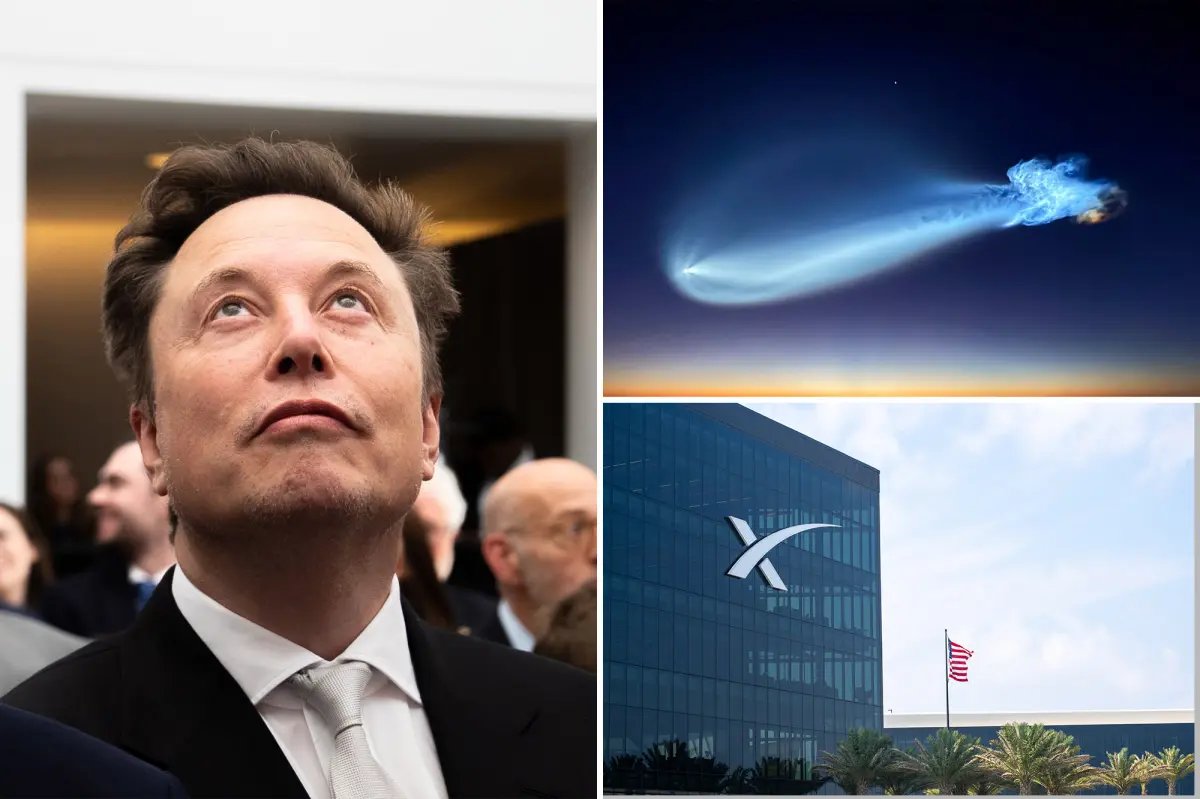

SpaceX shares surged in after-hours trading Tuesday after the rocket and satellite giant reported a whopping 161% jump in quarterly revenue — fueled by an AI business that has overtaken its Starlink internet service as the company’s biggest moneymaker.
The results came as rumors of a possible SpaceX-Tesla merger have been percolating — and Elon Musk, the CEO of both companies, said on an earnings call that the businesses have formed special committees of independent directors to discuss a possible union “at the request of shareholders.”
The multi-billionaire, who said he cannot participate in the talks because of conflicts of interest, nevertheless voiced support for a deal.
“Do I think it would be a good idea? Yes,” Musk said, adding that shareholders would ultimately have to approve it.
SpaceX raked in $14.58 billion in third-quarter sales, including roughly $7.6 billion from its fast-growing AI division, according to its latest results.
That compares with about $5.2 billion generated by its Starlink-led connectivity business — a dramatic shift from 2025, when the division accounted for 61% of the company’s revenue.
SpaceX also swung to a net profit of around $4.4 billion from a $541 million loss in the previous quarter, while adjusted earnings before interest, taxes, depreciation and amortization climbed to roughly $8.8 billion.
SpaceX shares jumped 4% to $154 in after-hours trading Tuesday, following a regular-session close of $147.79.
The earnings blockbuster came four months after SpaceX completed its historic June initial public offering, which raised about $85.7 billion in net proceeds and valued the company at roughly $1.75 trillion.
At Tuesday’s closing price, SpaceX commanded an estimated market capitalization of $2.01 trillion — making it worth roughly 13 times as much as Boeing and 16 times as much as Lockheed Martin.
The latest results underscore how quickly SpaceX has evolved beyond its traditional rocket-launching business since acquiring xAI in February.
The company’s AI division, which includes the Grok chatbot, social media platform X and a rapidly expanding cloud-computing operation, accounted for about 52% of third-quarter revenue.
That was up from $2.56 billion in the second quarter and just $818 million in the first three months of the year.
Much of the explosive growth has come from leasing computing capacity to outside customers, transforming AI infrastructure into the company’s fastest-growing revenue source.
SpaceX CEO Elon Musk told investors following Tuesday’s earnings release that “the constraint on deployment of superintelligence is more in power and cooling and infrastructure than it is in chips.”
He likened SpaceX’s ability to build out that infrastructure to “the New York Yankees playing in Little League,” boasting that his team could eventually move faster than all its competitors combined.
Musk said he has been spending “often four days a week, night and day” in Memphis, the home of a massive AI hub, working to bring the company’s second supercomputer cluster online.
SpaceX previously disclosed $14.1 billion in contracted AI cloud sales, although that figure includes certain revenue already recognized and isn’t equivalent to its remaining backlog.
Starlink, meanwhile, continued to deliver robust results despite losing its position as the company’s largest revenue generator.
Connectivity revenue climbed about 69% from a year earlier, while operating income reached roughly $2.4 billion.
Starlink’s subscriber base swelled to 13.6 million, up from 12 million at the end of the second quarter.
The satellite internet service has emerged as a highly profitable operation, generating $4.42 billion in operating income on $11.39 billion in revenue last year — an operating margin approaching 39%.
Musk told investors he expects Starlink to have “about a hundred times the bandwidth of the current Starlink constellation” within roughly three years as SpaceX deploys more powerful satellites.
He said the company’s latest Starship mission, which carried 26 Starlink satellites into orbit, delivered the equivalent bandwidth of 10 Falcon 9 launches.
But the company’s staggering growth has come with an equally eye-popping price tag.
SpaceX spent about $19.6 billion on capital expenditures during the third quarter, including roughly $16.4 billion devoted to AI infrastructure.
Musk said SpaceX expects to attempt to catch both the Starship booster and spacecraft during Flight 15 next month — a feat he described as “a massive technology milestone.”
“I’d say it’s more likely than not that this succeeds next flight,” the tech titan told investors, adding that SpaceX has additional Starship launches planned through the end of the year.
He predicted the company could begin launching Starship weekly in the first half of next year, potentially accelerating to twice a week in the second half.
