


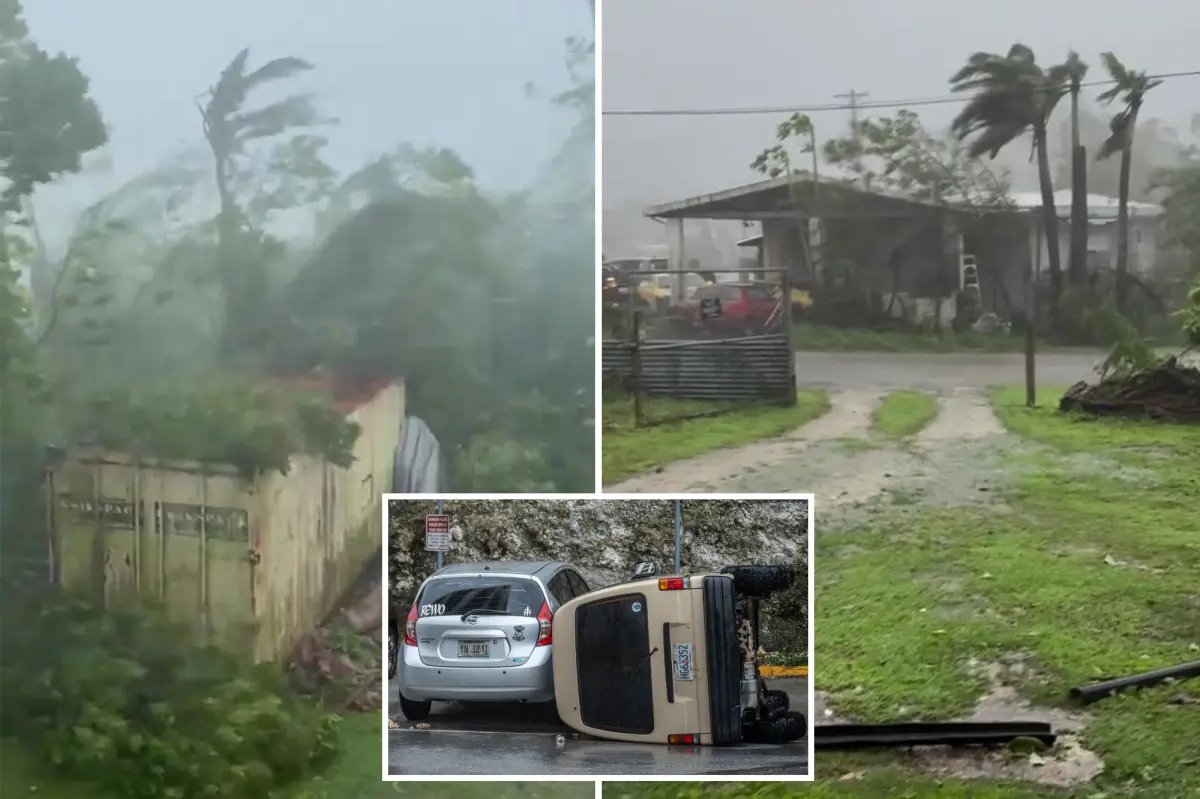

One of the strongest super typhoons on Earth this year tore across U.S. Pacific islands Monday, battering communities with winds topping 180 mph as forecasters warned of catastrophic damage, life-threatening flooding and prolonged power outages.
Super Typhoon Bavi, equivalent to a Category 5 hurricane, passed directly over the Northern Mariana Island of Rota, home to about 2,000 people.
Sustained winds exceeded 180 mph, and gusts above 150 mph were expected across the island, according to KCRA.
The National Weather Service warned that the storm’s extreme winds could destroy buildings, down trees and power lines, and leave residents without electricity for extended periods.
Heavy rain was expected to cause major flash flooding, and strong downpours could persist even after the storm’s center moved on.
Forecasters also warned of life-threatening coastal flooding as powerful onshore winds drove storm surge onto shorelines, while enormous waves and dangerous surf created hazardous marine conditions.
Rota lies about 50 miles north of Guam, home to some of the United States’ most important military bases in the Pacific.
Andersen Air Force Base regularly hosts rotating deployments of B-1, B-2 and B-52 bombers, while U.S. Naval Base Guam serves as the homeport for five Navy attack submarines.
More than 7,000 active-duty military personnel are stationed on the island, which has a population of more than 150,000.
Early Monday, the U.S. military on Guam said it had reached its highest level of storm readiness as strong winds approached. The National Weather Service also warned that Guam could still face hurricane-force winds and heavy rain.
About 75 miles north of Rota, residents on Saipan and Tinian hunkered down as the second super typhoon to threaten the region this year approached. Both islands were forecast to experience Category 1-strength winds exceeding 74 mph.
The latest storm comes just months after Super Typhoon Sinlaku slammed the Northern Mariana Islands in April as a Category 4 storm with sustained winds of around 150 mph and gusts reaching 185 mph.
Sinlaku dumped more than 20 inches of rain across parts of the islands, causing widespread flooding, prolonged power outages and extensive damage to homes and infrastructure on Saipan and Tinian.
Parts of both islands remained without electricity as recovery efforts continued.
Unlike Sinlaku, which stalled over the islands and prolonged the destruction, Bavi was expected to move through more quickly before leaving the Marianas by Monday afternoon and continuing west at 10 to 13 mph.
Tinian, which served as the launch point for the B-29 bombers that dropped the atomic bombs on Japan during World War II, is also home to North Field, a former wartime airbase that is being renovated into an alternate military hub as the U.S. works to disperse its assets across the Pacific.
