


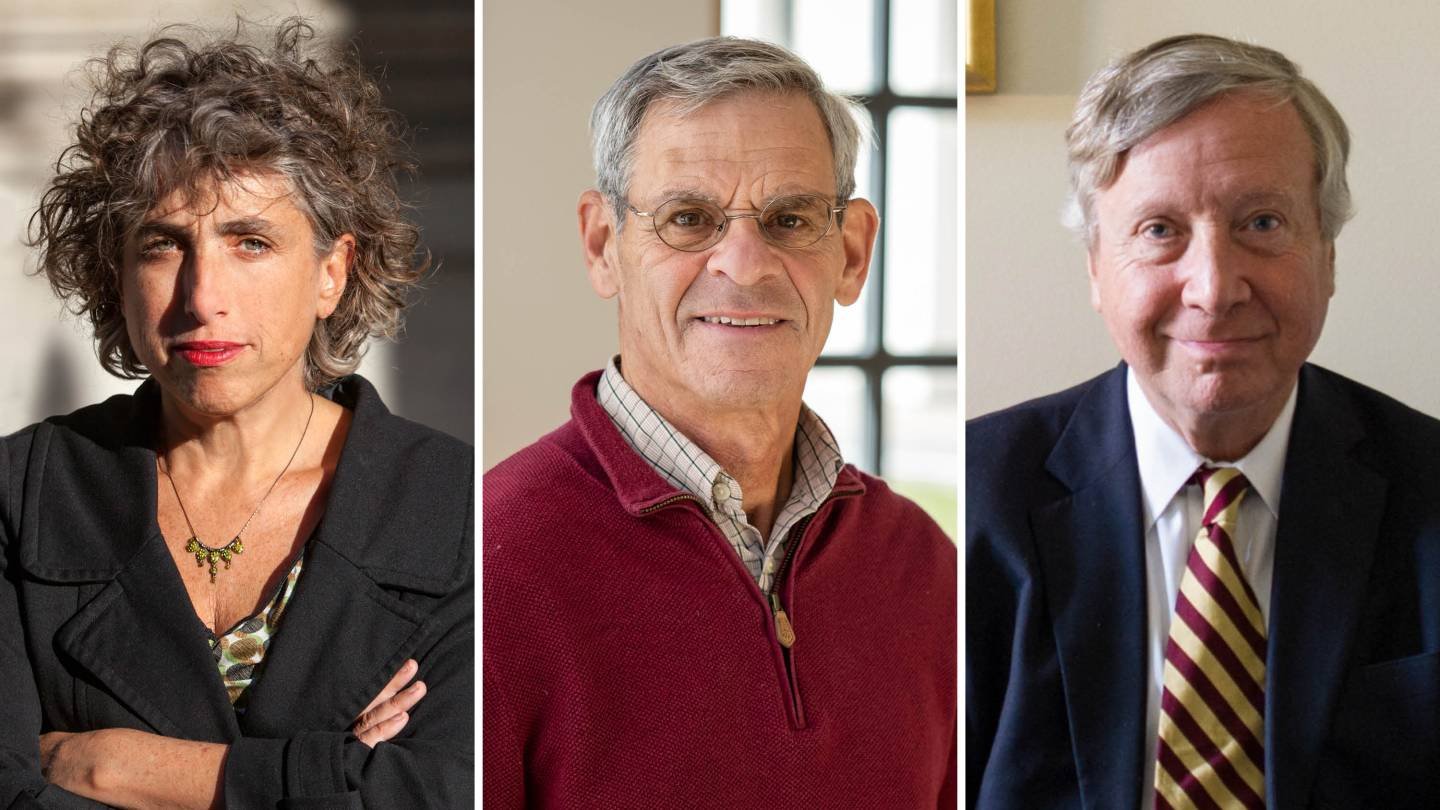
Princeton professors Andrea Bernstein, Ethan Kapstein and Sean Wilentz are among 24 recipients of this year’s Berlin Prize fellowship.
The prestigious fellowship is awarded by the American Academy in Berlin to U.S. scholars, writers, composers and artists. Awardees “represent the highest standards of excellence in their fields, from the humanities and social sciences to journalism, public policy, fiction, the visual arts and music composition,” the academy said in its announcement.
Fellows spend a semester at the Academy’s Hans Arnhold Center in Berlin’s Wannsee district, where they participate in public programs in addition to pursuing their scholarship. Bernstein and Kapstein received fall 2026 fellowships and Wilentz received a spring 2027 fellowship.
Andrea Bernstein
Bernstein, an investigative journalist and author, first came to Princeton as a Ferris Professor of Journalism in spring 2025 to teach a course on investigative journalism. She will return in spring 2027.
Her fellowship supports her book project “The Uses of Memory: Hannah Arendt, Walter Benjamin, My Parents, and Me.”
Bernstein’s father, who died in 2022, was a scholar of Arendt, and her mother, before her retirement, was a scholar of Benjamin. She describes her own book as “part memoir, part intellectual history, part investigative reporting” on issues including the origins of totalitarianism and “the danger of truth being relegated to opinion and not facts.”
“Arendt and Benjamin grappled with these issues almost a century ago,” she said. Her project explores “what these two thinkers, through the lens of my parents who studied them, would say to us now about the lessons they learned from some of the worst moments of the 20th century.”
Bernstein said that Berlin is the perfect place to do this work, where history “is very much a living conversation and to walk in the city where Hannah Arendt and Walter Benjamin walked. As a journalism professor, I always tell my students, ‘You’ve got to go there, to show up in person.’ So what an unparalleled opportunity for me to go to Berlin and immerse myself in it, in the physicality of the history.”
Ethan Kapstein
Kapstein is a lecturer with the rank of professor in the Princeton School of Public and International Affairs and executive director of Princeton SPIA’s Empirical Studies of Conflict Project. His research and teaching focus on the political economy of development, especially in countries facing conflict. A retired U.S. Navy Reserve officer and a member of the Council on Foreign Relations, he joined Princeton in 2017.
At the academy, he will pursue a research project, “The Future of European Security,” which he calls “a wicked problem at a time of growing threats and a more uncertain American commitment to the continent’s defense.” The project may lead either to a book or to a series of articles, Kapstein said.
The research project builds on Kapstein’s forthcoming book, “The Political Economy of Military Alliances: Managing Economic Conflict” (Cambridge University Press, 2027). It will also help guide him as he develops a new undergraduate “policy task force” for SPIA juniors in spring 2027, he said.
Kapstein has deep familiarity with the European security landscape, having served as a U.S. Navy Reserve officer at the U.S. Embassy in Paris and as a principal administrator at the Organisation for Economic Co-operation and Development (OECD) in Paris, where he worked on Russia policy.
While at the academy, he said he also looks forward to “engaging with German and European scholars, policymakers and industrialists who are working on this topic.”
Sean Wilentz
Wilentz is the George Henry Davis 1886 Professor of American History and professor of history. He joined the Princeton faculty in 1979.
His fellowship supports his book project “The Fall of American Slavery,” a companion to his 2005 book “The Rise of American Democracy.” Together, he hopes they will comprise a “complete American political history” from the nation’s founding through the end of the Civil War and the ratification of the 13th amendment. The book in progress is based on extensive original research as well the scholarship of the last 60 years.
“There are many wonderful books written about aspects of American antislavery — for example, the history of the abolitionist movement, or on segments of time, like the 1830s,” he said, but his new book will cover “the whole story … including the politics behind the fall of American slavery.”
He said the two books together “argue that there were two great revolutions that made the modern world, both originating in America. The first revolution was the rejection of monarchy and aristocracy and the rise of this new democratic world, and the second was the antislavery revolution. Without the democratic revolution, the revolution against slavery never would have occurred, because slavery is essentially a monarchical institution. But without the antislavery revolution, the democratic revolution was incomplete.”
Wilentz said he is looking forward to returning to the American Academy in Berlin, where he was a fellow in 2015, and that the best gift it offers is time. “Four months of total peace and quiet dedication to thought in an idyllic, beautiful place. It’s custom-made for writing. But it’s also filled with stimulating conversations because it’s an extraordinary institution that brings together scholars, policymakers, musicians and artists.”
Katie Kitamura, a 1999 Princeton graduate, writer and clinical professor of creative writing at New York University, also received a Berlin fellowship, for her sixth novel.
Mary Cate Connors at the Humanities Council and Tom Durso at the Princeton School of Public and International Affairs contributed to this story.
