


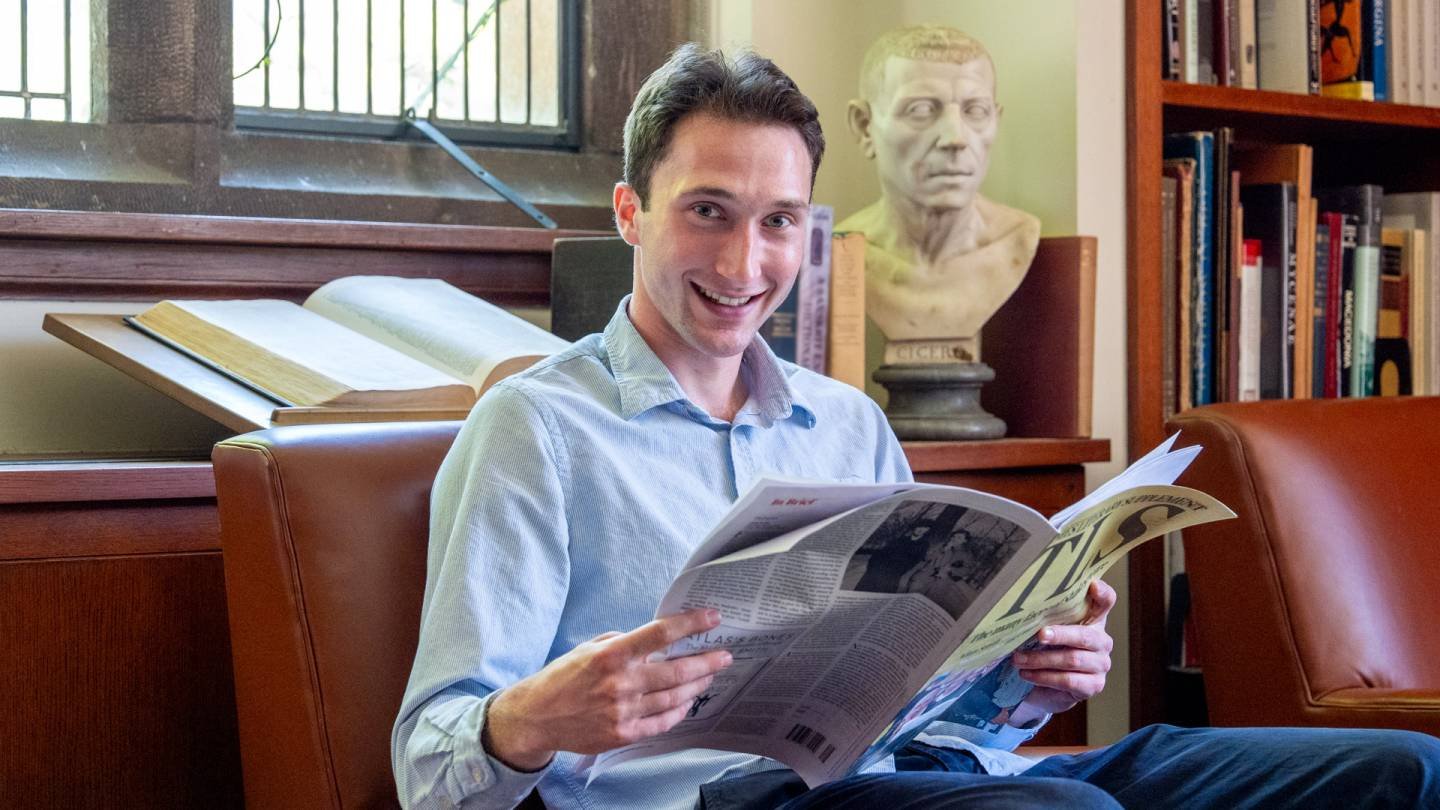
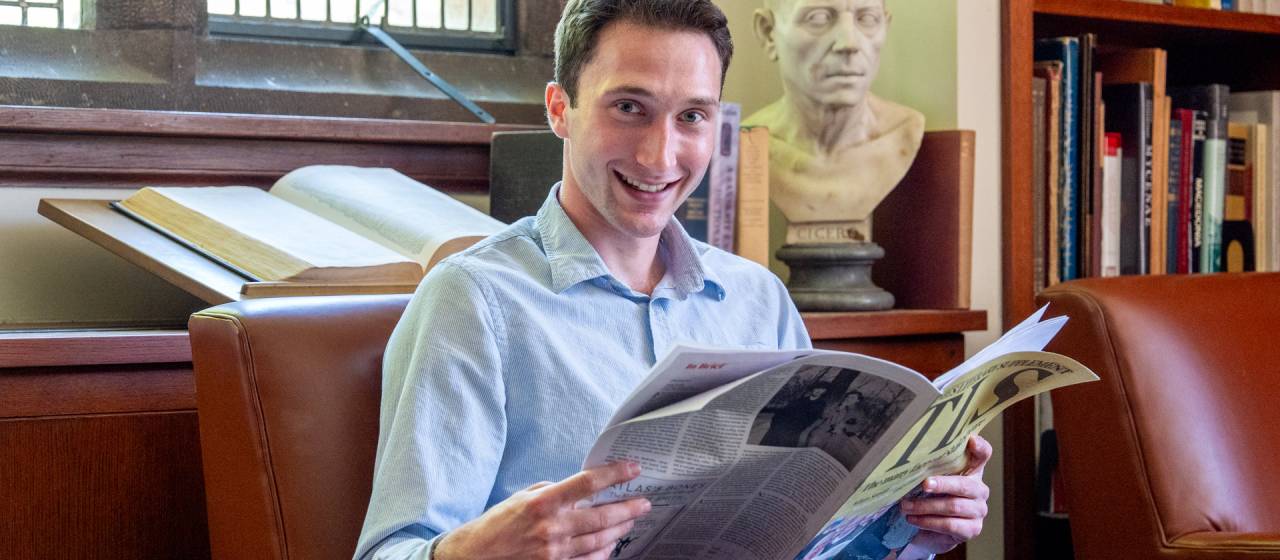
Gabriel Duchovny is drawn to work that rewards close attention.
As a classics major at Princeton, he spent four years learning to read ancient texts slowly and carefully. As an investigator in the Brooklyn public defense office, he scoured the borough for surveillance footage after alleged crimes occurred and interviewed witnesses. And as a midfielder on the Princeton men’s soccer team, he won recognition for his tactical precision and ability to connect play down the field.
For Duchovny, all three pursuits share something fundamental: the practice of connecting scattered details into a meaningful picture.
That instinct began early in Brooklyn, where Duchovny grew up in a household shaped by teaching, language and soccer. His mother teaches at Saint Ann’s School, which Duchovny attended alongside his twin brother, Luca, now a political science major and manager of the men’s basketball team at Colorado College. His father introduced the boys to soccer when they were toddlers.
“When we were very little, we’d play two-on-two in the park, me and my mom versus my dad and my brother,” Duchovny said. “And I’d be yelling at my mom, ‘Pass the ball, pass the ball!’”
Another formative passion arrived in eighth grade through Saint Ann’s mandatory half-semester of Latin. Duchovny discovered he loved the logic and structure of the language.
“I liked how reading a Latin sentence felt like putting together a puzzle,” he said. “You look at all the cases and tenses and you piece it together to extract a meaning.”
At Princeton, those interests evolved in increasingly ambitious directions. A member of one of the most successful men’s soccer teams in Princeton history, Duchovny simultaneously developed his interests in criminology, public service and classical studies. These academic interests would converge in his thesis, “Ancient Roman Banditry: A Modern Criminological Analysis,” which applies modern criminological theory to ancient Roman accounts of organized crime and earned Duchovny the John J. Keaney Prize, the classics department’s prize for the best senior thesis.
How the ancient world illuminates our times
The project reflected Duchovny’s broader conviction that the ancient world can illuminate contemporary life.
“Classical studies, at its best, can also further our understanding of modern circumstances,” Duchovny said. “My key finding is that Roman authors more or less invoked some of the same explanations for crime that we do today.”
Duchovny’s thesis arose from the convergence of his Princeton experiences. He became fascinated by criminology after taking sociology courses, including one taught by Patrick Sharkey, the William S. Tod Professor of Sociology and Public Affairs. Through Princeton Internships in Civic Service, he later worked as an investigator for Brooklyn Defender Services, deepening his interest in how crime develops within society. Back on campus, he volunteered with the Second Chance Project under SPIA Faculty Fellow Joe Krakora ’76, former New Jersey Public Defender and a Princeton soccer alumnus.
Throughout it all, Duchovny drew on the intellectual habits he had developed in classics: patience, thoroughness and attention to detail.
“The most rewarding thing classics has taught me is how to really scrupulously read,” he said. “Arguments in classics courses always felt like they had legs, because they were born from a real fidelity to the text.”
Those habits extended far beyond antiquity. As an investigator, his work involved traversing Brooklyn in search of the granular evidence defenders use to build their cases. During his sophomore summer, he received a grant from Princeton’s Program in Translation to translate two scholarly papers written in Italian about the strategies of soccer coach Roberto De Zerbi, who leads the English football club Tottenham Hotspur. Duchovny had grown up hearing his father speak the language, and two semesters of Italian at Princeton opened a new world of academic engagement.
“It’s just a scrupulous method of analysis,” he said of the experience. “When you translate something, you go so slowly. Every word, you double, triple check. Every sentence, you double, triple read.”
Such thoroughness also shaped Duchovny’s thesis work. His adviser Yelena Baraz, the Kennedy Foundation Professor of Latin Language and Literature, said the project succeeded on the strength of his analytical skills.
“The turning point for me was when I realized that Gabriel was going to work at multiple levels, both synthesizing the patchy and difficult evidence and close reading particularly important texts,” Baraz said.
Baraz also helped Duchovny refine the project’s scope. Early versions relied too heavily on military history, Duchovny said, and Baraz encouraged him to become more methodical about his argument and structure.
“Leveling up,” in academics and athletics
That process of refinement mirrored Duchovny’s broader Princeton experience. He describes his four years at the University as a continual process of “leveling up,” academically, athletically and intellectually.
“Coming in freshman year, I was very proud of the first essay I wrote, because it was a new level,” he said. “There were new standards about what constituted good writing.”
His coaches recognized the same drive on and off the field, with Princeton Athletics calling Duchovny “the embodiment of what it means to be a true student-athlete.” Besides back-to-back Ivy League Tournament championships and scoring the TopDrawerSoccer 2024 Goal of the Year, Duchovny also earned CSC Academic All-District and Academic All-Ivy honors.
Duchovny says his passions for sports and scholarship reinforce each other.
“Soccer teaches you that you always want to improve your game and play at a higher level,” he said. “And that’s the same in school.”
After graduation, Duchovny returned to New York as a paralegal in the organized crime unit of the U.S. Attorney’s Office for the Southern District of New York. For him, the position represents another opportunity to engage the habits of mind he cultivated at Princeton.
“The SDNY pursues high-profile cases that demand meticulous and scrupulous casework,” Duchovny said. “That’s meaningful to me coming from classics, which teaches you to be meticulous and scrupulous in your reading and analysis.”
