


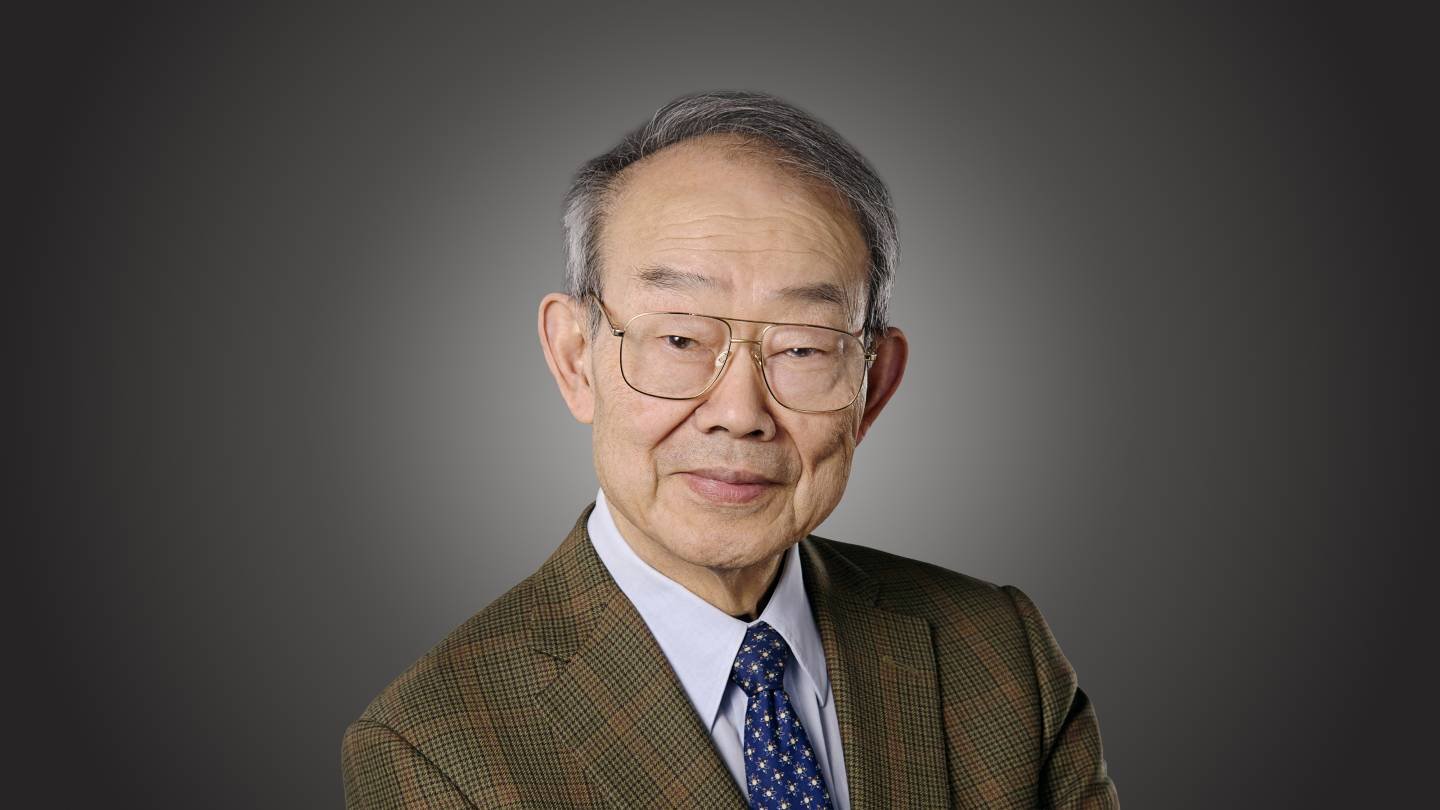
Bede Liu, an emeritus professor of electrical engineering and a pioneer in digital signal processing, died on May 7. He was 91.
Liu’s pathbreaking research aided the transition from analog to digital processing of sound, images and video. Along with the 53 Ph.D. students he mentored, he developed methods of filtering and compressing digital signals to mitigate errors and dramatically reduce the computation needed for signal processing. These techniques have led to now-ubiquitous technologies for storing and streaming media.
“He was a highly impactful scholar and teacher — always thinking ahead of future needs and changing technologies,” said colleague Peter Ramadge, the Gordon Y.S. Wu Professor of Engineering, Emeritus.
In the 1990s, Liu turned his attention to media integrity and copyright issues. He created techniques for digital watermarking — hidden signals that could identify a genuine copy of a song, image or video and prevent unauthorized distribution or tampering.
Lessons learned from Liu’s work have guided industries in identifying suitable settings and applications for watermarking. For example, each copy of a Hollywood film given to a critic or theater now carries a unique forensic watermark to prevent unauthorized redistribution, said Min Wu, a 2001 Ph.D. alumna who worked on digital watermarking with Liu.
Former students and colleagues remembered Liu for his humility, humor and generosity. For Ken Steiglitz, the Eugene Higgins Professor of Computer Science, Emeritus, “cheer” is the word that first comes to mind when thinking of Liu. He was “always ready with a positive remark, a quick smile, or, maybe, some tips on the right way to cook a duck.”
Liu loved to organize dinners with colleagues and students at Chinese restaurants — both in the Princeton area and when traveling for conferences, said H. Vincent Poor, the Michael Henry Strater University Professor of Electrical and Computer Engineering.
“He would go in advance and talk to the chef about what to serve us — it wouldn’t be what was on the menu. Rather, it would be some kind of fabulous dishes that he knew of,” said Poor. “It was always fantastic to go out to dinner with him.”
Liu’s Ph.D. students went on to become leading figures in academia and industry. Among them are many professors at major universities, two deans of engineering, and several executives at companies such as IBM and Google.
Liu’s first Ph.D. student at Princeton, co-advised with professor John Thomas, was Robert Kahn. While working at the U.S. Defense Advanced Research Projects Agency (DARPA), Kahn created an early computer networking protocol that paved the way for the internet. Princeton honored him with the James Madison Medal in 2022. With his colleague Vinton Cerf, in 1997 Kahn was awarded the National Medal of Technology from President Bill Clinton.
“[Liu’s] former students were very successful, and I think that’s a testament to his skill as a mentor. But he also mentored the younger faculty,” said Poor, who earned his Ph.D. in electrical engineering at Princeton in 1977 (mentored by Thomas) and in 1990 became Liu’s colleague when he joined the Princeton faculty. Liu modeled the importance of continuing to support his students well beyond their graduation, said Poor.
Fred Mintzer, a self-described “working-class kid,” left his job at a phone company to pursue a Ph.D. with Liu in the 1970s. Liu enabled him to become “a successful researcher … with ambitions to do more than just behind-the-scenes work,” said Mintzer. His research with Liu “gave me a lot of confidence and encouraged me to follow my dreams,” said Mintzer, who retired from IBM after 35 years as a research manager and director.
An inspirational spirit of adventure
Liu inspired students and colleagues with his “spirit of adventure,” said Mintzer. At IBM, this spirit led Mintzer to take on ambitious, unconventional projects to digitize collections for the Vatican Library, the U.S. National Gallery of Art and Russia’s Hermitage Museum.
Mintzer is among 25 of Liu’s former Ph.D. students to be named fellows of the Institute of Electrical and Electronics Engineers (IEEE) — a high honor bestowed by colleagues in the field. Mintzer and other former students have also led the IEEE’s Signal Processing Society and contributed to the IEEE in myriad ways. Liu instilled in students a sense of responsibility and service to the community, said Mintzer.
Liu joined Princeton in 1962, an early occupant of the newly completed Engineering Quadrangle, and served on the faculty for 53 years until he transferred to emeritus status in 2015.
Along with Thomas, Princeton professor Stuart Schwartz and others, Liu helped establish the Information Sciences and Systems group in the electrical engineering department. Today, this research area continues to thrive as the Data and Information Science group.
Liu chaired the department from 1994-97, and his dedication and care made him “part of the soul of the department” for six decades, said Poor. “Even after he retired, he would be in the department a lot, and continued to organize dinners for us. He was always taking care of the people in the group and in the department and making sure that we had what we needed.”
Abe Peled, a 1974 graduate alumnus, said that Liu “demonstrated an openness to new ideas and a willingness to challenge the orthodoxy of the EE department at that time that leaned heavily towards more theoretical information theory.”
With Peled, he co-authored the 1976 textbook “Digital Signal Processing: Theory, Design, and Implementation,” which became a standard reference for engineers. Published before digital signal processing had fully emerged as a distinct discipline, it helped define the subject for practitioners and students around the world.
A legacy of life-changing mentorship
Liu’s legacy in the Department of Electrical and Computer Engineering has been recognized since 2007 with the Bede Liu Fund for Excellence in Electrical Engineering, and since 2016 with the Bede Liu Best Dissertation Award. Both support graduate students, representing the gratitude of those who were fortunate to learn from Liu.
Minerva Yeung, a 1996 graduate alumna, helped organize a 60th birthday celebration for Liu during her time as a student; she also returned to Princeton to host colleagues and former students for Liu’s 70th and 80th birthdays.
Yeung spent a decade as a director at Intel and now focuses on philanthropy and startup investment. Her husband, Boon-Lock Yeo, also Liu’s graduate advisee, is now vice president of engineering at Google. Liu and his wife, Maria, served as witnesses for Yeung and Yeo’s civil marriage ceremony while they were graduate students, and visited them in California after their daughter was born. “These are the types of things that last forever in your mind,” said Yeung.
At each of Liu’s birthday celebrations, “people came back out of their respect and out of their love for [Liu]. All these people who were already very high up in their careers came back just to celebrate his birthday and enjoy another hour or two with him,” she said. “We learned a lot about how Bede changed their lives and how Bede guided them to where they were.”
After Min Wu earned her Ph.D. in 2001, she was wavering between industry opportunities and an academic career. “[Liu] gave me the room to struggle to make that decision, even though I know he had his own opinion,” said Wu, who is now a professor and associate dean at the University of Maryland’s engineering school.
Part of her hesitation about academia was the dearth of women faculty members. The environment has improved greatly since then, she said, but as a young female professor, “having support from people like Bede really meant a lot.”
Wu and Liu patented the watermarking method for image authentication that Wu developed with Liu during her graduate work — one of 12 U.S. patents that Liu received during his career. His first patent in 1976, with Peled, was for a hardware design that processed bits in parallel, rather than in sequence, greatly increasing computing efficiency for data like sound and communication signals.
“We stream music, we stream video. We take photos with our phones; we send them around. We don’t even think about it.” said Poor. “But it’s all because of the signal processing and image processing and video processing that’s been developed over the years. Of course, it also can be attributed to other technologies that have grown up beside it and enabled it, like semiconductors and so forth, which Bede was not part of. But the development of those advances was what Bede was a major part of.”
Born in Shanghai in 1934, Liu moved with his family to Taiwan, where he earned a bachelor’s degree at National Taiwan University in 1954. After emigrating to the United States, he earned master’s and doctoral degrees in electrical engineering at the Polytechnic Institute of Brooklyn (now the New York University Tandon School of Engineering). His father, Henry Liu, also attended Poly and received his M.E.E. in 1956 at the same commencement as his son. Bede Liu worked briefly at the Western Electric Co., DuMont Laboratories and Bell Laboratories before joining Princeton in 1962.
In recognition of his achievements, in 2018 Liu received the IEEE Jack S. Kilby Signal Processing Medal “for sustained contributions to the analysis and the development of low-complexity realizations of digital signal processing algorithms.” He also received the highest awards from two IEEE societies, Circuits and Systems and Signal Processing. He was a member of the U.S. National Academy of Engineering, an academician of China’s Academia Sinica, and a foreign member of the Chinese Academy of Sciences.
Liu is survived by his wife of 67 years, Maria; his daughter Beatrice (and husband Philip Lovett); his sister, Jane Jernow (and husband Stanley Jernow); his brother, Hal Liu; and two grandchildren, Charles and Emily Lovett. He was predeceased by his sister, Lucy Liu, and his parents, Henry and Shan Liu.
A memorial and celebration of Liu’s life, open to the public, will be held at Chancellor Green Library at 4 p.m., Thursday, Nov. 12.
