


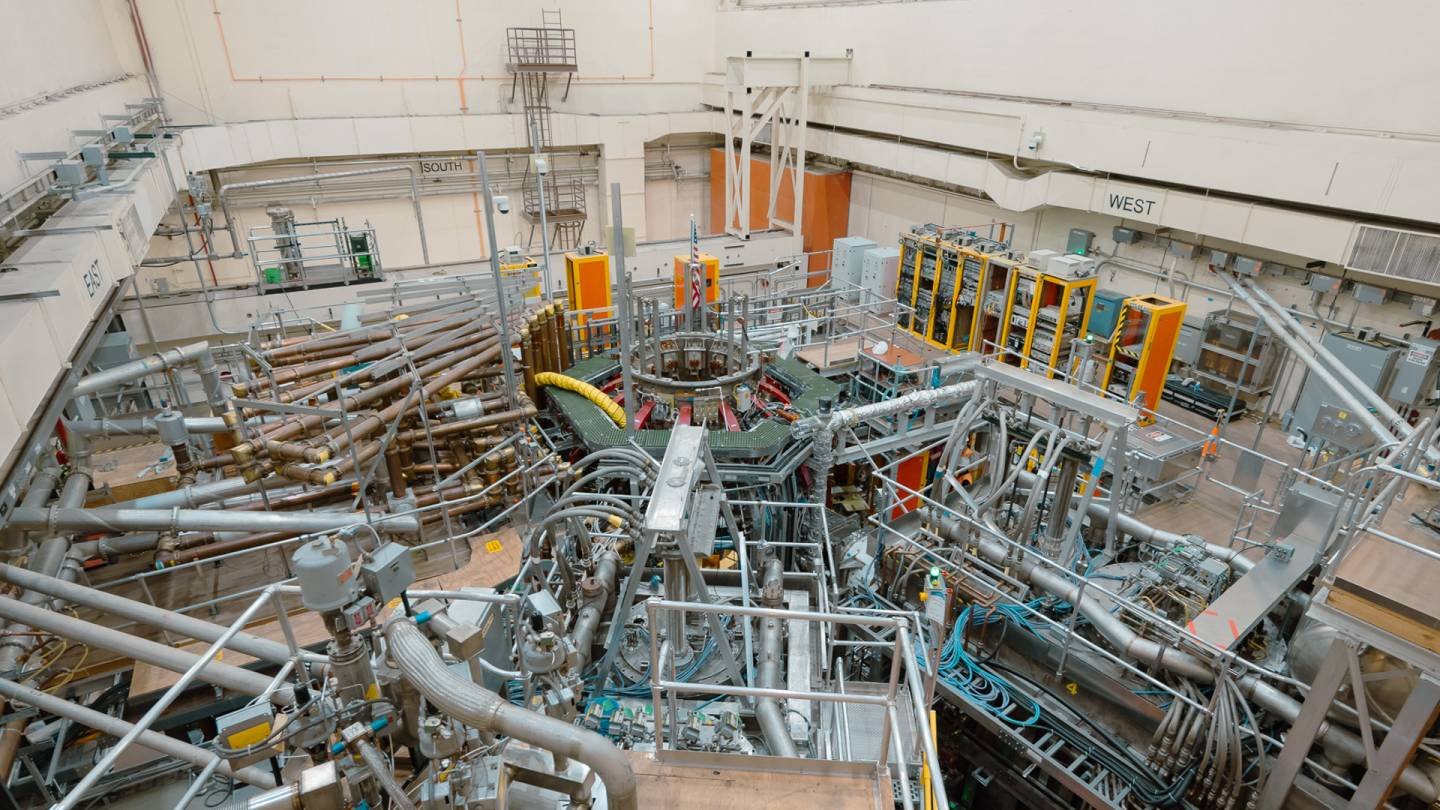
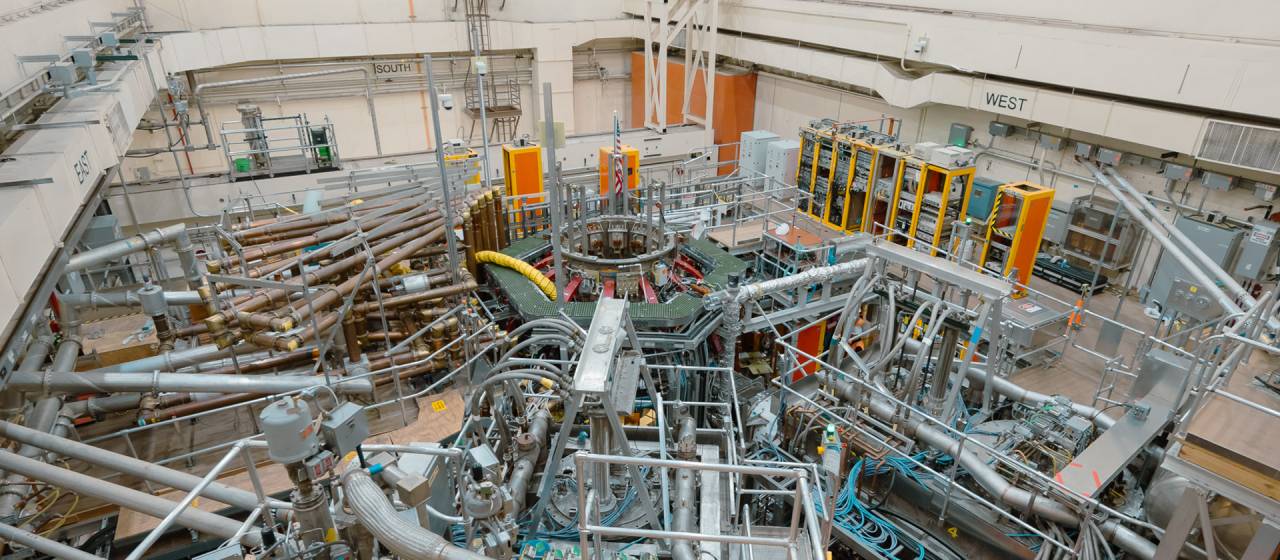
On June 3, a flatbed truck arrived at the front gates of the U.S. Department of Energy’s (DOE) Princeton Plasma Physics Laboratory (PPPL) carrying a piece of machinery that could influence the course of energy innovation in the United States — the central magnet bundle for the National Spherical Torus Experiment-Upgrade (NSTX-U), a compact fusion system designed to be the most powerful of its kind in the world.
“This is truly a momentous occasion,” said Dave Micheletti, PPPL’s associate laboratory director for engineering and NSTX-U project director. “Now our full focus is on finishing machine reassembly and bringing this device to the world.”
NSTX-U will provide important information about the viability of the spherical tokamak concept for fusion power plants and provide data to train artificial intelligence systems that can improve the operations of fusion machines. It will also play an important role in the DOE’s Fusion Science & Technology Roadmap, which targets actions and milestones to provide the scientific and technological foundation to support a competitive U.S. fusion energy industry.
One of NSTX-U’s most crucial components, the bundle is both substantial and important. It weighs 23,000 pounds and measures about 20 feet long — about the size of a school bus. And it consists of parts of two magnet systems. One, the toroidal field (TF) magnet system, creates the bulk of the magnetic fields that confine the plasma. The other, the ohmic-heating magnet system, helps heat the plasma by creating an electric current.
Once installed in NSTX-U, the magnet bundle will enable plasma operations by creating two separate sets of magnetic fields. One, the toroidal magnetic field, circles the device’s apple-shaped vacuum circumference and stabilizes the plasma. The second magnetic field circles the device from top to bottom and is known as the ohmic-heating magnetic field. As this magnetic field’s strength changes over time, it creates an electric current that flows through the plasma. This current, in turn, provides both heating and a magnetic field to confine the plasma.
Advancing humanity’s understanding of plasma and fusion energy
The bundle’s delivery means that very soon, a new generation of plasma physicists, engineers and technicians will have access to a brand-new fusion research system that will take its place as one of the premier systems in the world. “I welcome all fusioneers everywhere to this amazing research opportunity and encourage them to use this facility to help advance humanity’s understanding of plasma and fusion energy,” said Jonathan Menard, PPPL’s deputy director for research. “What a thrilling moment — for PPPL, the nation and the world.”
Compact fusion systems like NSTX-U produce energy more efficiently than conventional tokamaks, making them easier and cheaper to build and replicate. When fully assembled, NSTX-U will allow scientists to conduct experiments demonstrating whether the spherical tokamak concept — a fusion device shaped more like a cored apple than the doughnut-like shape of conventional tokamaks — could be an ideal design for a future fusion power plant.
“NSTX-U has capabilities found in no other plasma device anywhere in the world, and it will play a critical role in determining the future of commercial fusion,” said Steven Cowley, PPPL director. “This is truly a moment to celebrate.”
PPPL’s primary fusion system, NSTX-U is a DOE national user facility, a large-scale scientific research machine like a supercomputer or particle accelerator that scientists around the nation can use to conduct experiments after submitting research proposals.
A culmination of years of work
Initially installed horizontally on a piece of equipment known as a “tilt fixture,” the magnet bundle will be slowly raised into a vertical position after PPPL engineers perform routine adjustments over the next two months.
The magnet will then be connected to power systems and other key components and thoroughly tested. “We need to do the work safely and efficiently and with good quality,” Micheletti said. “Now that it has been completed and delivered, we can see our way to the finish.”
“I was thrilled to see the bundle brought into the building where it will be put to work,” said Stefan Gerhardt, senior managing research physicist. “This is the culmination of years of work, and I’m eager to start doing some science!” Experiments using NSTX-U are expected to begin in 2027.
Read the full backstory of the machinery’s manufacture and installation at PPPL.org.
