

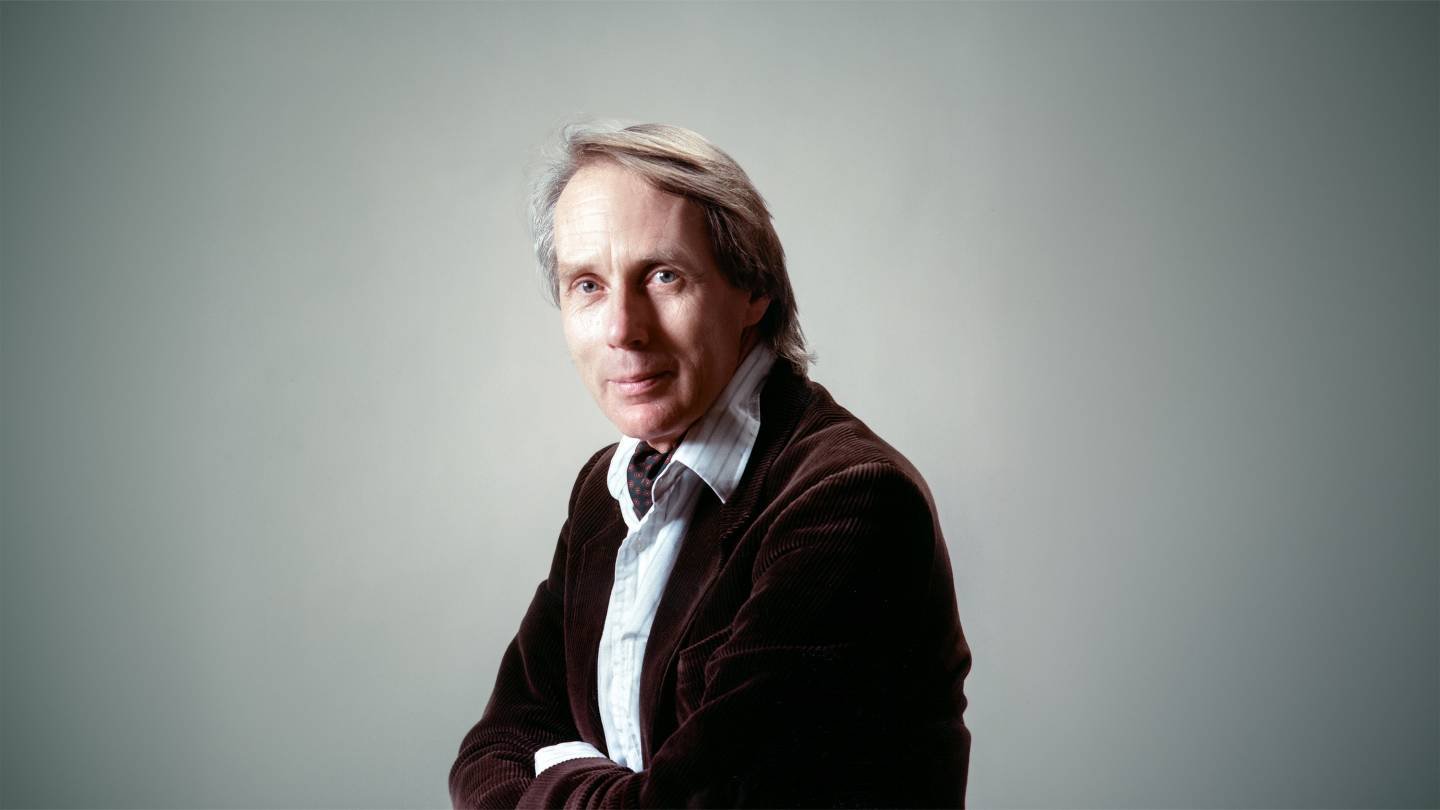

Princeton professor Antony Jameson, whose groundbreaking research transformed how modern aircraft are designed and tested, died on June 11. He was 91.
Jameson, the James S. McDonnell Distinguished University Professor of Aerospace Engineering, Emeritus, and professor of mechanical and aerospace engineering, emeritus, was widely regarded as a founder of computational fluid dynamics. He revolutionized aerospace engineering by showing that computers could precisely model airflow around an aircraft design — work that emerged during the jet age as commercial aviation was rapidly expanding and the need to design safe, fuel-efficient aircraft became urgent.
Prior to joining Princeton’s faculty in 1980, Jameson taught at New York University’s Courant Institute of Mathematical Sciences. At Princeton, he also served as director of the Program in Applied and Computational Mathematics from 1986 to 1988, and transferred to emeritus status in 1997.
Beginning in the early 1970s, Jameson developed a succession of computer programs to analyze and predict how air would flow around an airplane without building a physical model, essentially creating a virtual wind tunnel. The computational methods Jameson pioneered remain fundamental to the design of virtually every modern commercial aircraft.
“He discovered new theories, he developed new methods, and he enabled a whole new generation of aircraft that you and I fly in, and that has arguably had as much impact as the first aircraft that the Wright brothers flew in 1903,” said Juan J. Alonso, who received his Ph.D. studying under Jameson in 1997 and is now chair of aeronautics and astronautics at Stanford University.
Jameson’s fascination with flight began in childhood in England and India. Born on Nov. 20, 1934, in Gillingham, England, he spent much of his early childhood in India, where his father served as an officer in the British Army. After serving in the army himself, Jameson graduated with first class honors in engineering from Trinity Hall, University of Cambridge, in 1958.
Throughout his 60-year career, he pursued a single question: How does air move around an airplane, and how can that knowledge improve design?
“When Antony started doing his work, there were no real good methods to design aircraft via simulation. It was all done in the wind tunnel,” Alonso said. “Antony began to think about how to do this completely on the computer.”
In 1966, after receiving his doctorate from the University of Cambridge and working briefly as an economist and a mathematician, Jameson was recruited by Grumman Aerospace Corporation in Bethpage, New York. Initially, he worked on control theory for stability augmentation systems before shifting focus to computational methods for aerodynamic design. In 1970, he developed his first two fluid dynamics software packages, also called codes: FLO 1 and SYN 1.
FLO 1 allowed engineers to calculate airflow around a wing, improving aerodynamic performance and fuel efficiency. SYN 1 approached the problem from the opposite direction, allowing engineers to begin with the desired airflow and calculate the wing shape needed to produce it.
Moving to New York University’s Courant Institute, Jameson began pioneering the methods that helped establish computational fluid dynamics. Working with David Caughey, who earned his Ph.D. in mechanical and aerospace engineering at Princeton in 1969, Jameson developed FLO 22, one of the most influential aerodynamic simulation codes of its era. For the first time, engineers could accurately predict airflow around the full shape of an airplane wing on a computer rather than relying on physical testing.
While at Princeton, Jameson developed many of the computational methods that transformed aircraft design.
“The years at Princeton were special,” said Todd Mitty, one of 57 students who received their doctorates under Jameson and is now the senior vice president of global business operations for the programmable mobile platform provider, OXIO, Inc. “It was a period when his seminal work was explosively expanding with innovation and pervasive academic and commercial impact. I was incredibly fortunate to be part of that formative time with him and my colleagues.”
As computing advanced, so did the capabilities of Jameson’s software. About a year after arriving at Princeton, he created FLO57, one of the first programs capable of predicting how high-speed airflow, including shock waves, moved around an airplane wing. Rather than replacing wind tunnels, FLO57 made them far more effective by allowing engineers to evaluate hundreds of designs before selecting a few for testing.
Building on FLO57, Jameson developed a code called AIRPLANE with Timothy Baker, a senior research scholar who Jameson hired to join the Princeton faculty in 1982 (he died in 2006) and Nigel Weatherill, a visiting research fellow in 1986, both in the Department of Mechanical and Aerospace Engineering. Unlike earlier programs that primarily modeled wings, AIRPLANE could accurately simulate airflow around an entire aircraft. Organizations including McDonnell Douglas, NASA, Mitsubishi, and the European Aeronautic Defence and Space Company adopted AIRPLANE as the foundation for their own aerodynamic design software.
A revolutionary innovator sought by industry, academics across disciplines and students
“Who wanted to work with Antony? Anybody that was in the field. As simple as that,” said Luigi Martinelli, a professor of mechanical and aerospace engineering at Princeton, who studied with Jameson as a doctoral student at Princeton and earned his Ph.D. in 1987. “Computer manufacturers wanted to make sure his code would run on their machines. Aerodynamicists wanted to design better airplanes using his technology. Students wanted to learn from him. Even applied mathematicians were drawn to the mathematical elegance behind these successes.”
Former students and collaborators said industry sought Jameson out because his methods consistently solved tough engineering problems. Among them was aerodynamicist John Vassberg, who built upon Jameson’s work after joining aircraft manufacturer McDonnell Douglas in the early 1980s.
Vassberg was tasked with improving the fuel efficiency of the MD-11, a wide-body commercial airliner that was struggling to meet its promised performance. Using Jameson’s AIRPLANE code, which he further refined, Vassberg reduced aerodynamic drag by redesigning part of the area connecting the engines to the wing, called the pylon-wing fairing.
“I had one shot,” Vassberg recalled. “I designed the part, analyzed it, and it looked good.”
Flight tests confirmed the redesign, reducing drag by nearly one percent and helping the aircraft achieve its performance targets.
In the early 1990s, Jameson revolutionized aerodynamics once again by achieving the field’s ultimate goal: the automatic design of the optimal shape of a wing. Martinelli said that by combining control theory and CFD, he developed an accurate and efficient adjoint-based shape optimization method that enabled the design of the advanced transonic wings of the latest generation of aircraft.
Although modern computational fluid dynamics software no longer runs Jameson’s original code, it builds on the mathematical foundations he established. The algorithms and computational methods he pioneered remain embedded in today’s most advanced aerospace design tools, making his influence visible in virtually every modern commercial aircraft.
For those who studied under him, however, Jameson’s greatest legacy extended beyond the software he created. Former students remembered him as a relentless researcher with an insatiable curiosity, an extraordinary willingness to listen to others, and an enthusiasm for discovery that was impossible to contain.
Martinelli collaborated with Jameson throughout the 1990s before becoming a colleague at Princeton. Over time, the relationship evolved into a close friendship.
“Typically, in the summer, we would work until 7 o’clock, then play tennis on the courts on campus,” he said, adding they would usually return to coding later in the evening. “He had a wicked tennis swing that came from squash, and I could never handle it.”
Jameson also stood out for his unmistakable personal style.
“He was always well dressed,” Alonso recalled. «He always wore an ascot, or a cravat, as people also call it.”
“He would correct me,” laughed Martinelli. “In Italy it’s called ascot, you know, the proper British way is cravat.”
In 1997, Jameson joined Stanford University as the Thomas V. Jones Professor of Engineering in the Department of Aeronautics and Astronautics, a position he held until 2014. In 2018, Jameson joined Texas A&M University as professor of aerospace engineering and professor of ocean engineering. In 2020, he was appointed a Texas A&M Engineering Experiment Station (TEES) Eminent Professor before being named the Jack E. & Frances Brown Chair in Engineering later that year, a position he held until his death.
Jameson’s contributions earned many of engineering’s highest honors over a career spanning more than six decades. In 2015, he received three of the field’s most prestigious international awards: the Daniel Guggenheim Medal for transforming aircraft design through computational fluid dynamics, the John von Neumann Medal from the Association for Computational Mechanics for advances in compressible flow simulation and aerodynamic optimization, and the Royal Aeronautical Society’s Team Silver Medal, shared with Robert Mills, for the aerodynamic wing design of the Gulfstream G650. That same year, he also received the American Institute of Aeronautics and Astronautics’ Pendray Aerospace Literature Award.
His earlier honors included the Elmer A. Sperry Award for Advancing the Art of Transportation (2006), the U.S. Association for Computational Mechanics’ Computational Fluid Mechanics Award (2005), the American Society of Mechanical Engineers’ Spirit of St. Louis Medal (1995), the American Institute of Aeronautics and Astronautics’ Fluid Dynamics Award (1993), the Royal Aeronautical Society Gold Medal (1988), and NASA’s Medal for Exceptional Scientific Achievement (1980).
Jameson was elected a fellow of the Royal Society of London in 1995, a foreign associate of the U.S. National Academy of Engineering in 1997, and a fellow of the Royal Academy of Engineering in 2005. He was also named an honorary fellow of the American Institute of Aeronautics and Astronautics in 2018 after previously being elected an AIAA fellow in 1991 and became a fellow of the Royal Aeronautical Society in 2004.
Jameson is survived by his wife, Charlotte Ansted-Jameson; his children, Antonia Jameson Jordan and Ashley Jameson; his stepsons, Colin S. Ansted-Boyland and Christopher Thomas Ansted; his stepdaughter, Caroline I. Ansted-Jones; his younger brother, Graham Jameson; and seven grandchildren. He was predeceased by his brother, Andrew Jameson, and his sister, Carolyn Alexander.
Jameson was previously married to Catharina Jameson from 1964 to 1984. Catharina died in 2019.
A funeral service celebrating Jameson’s life was held June 29.
