


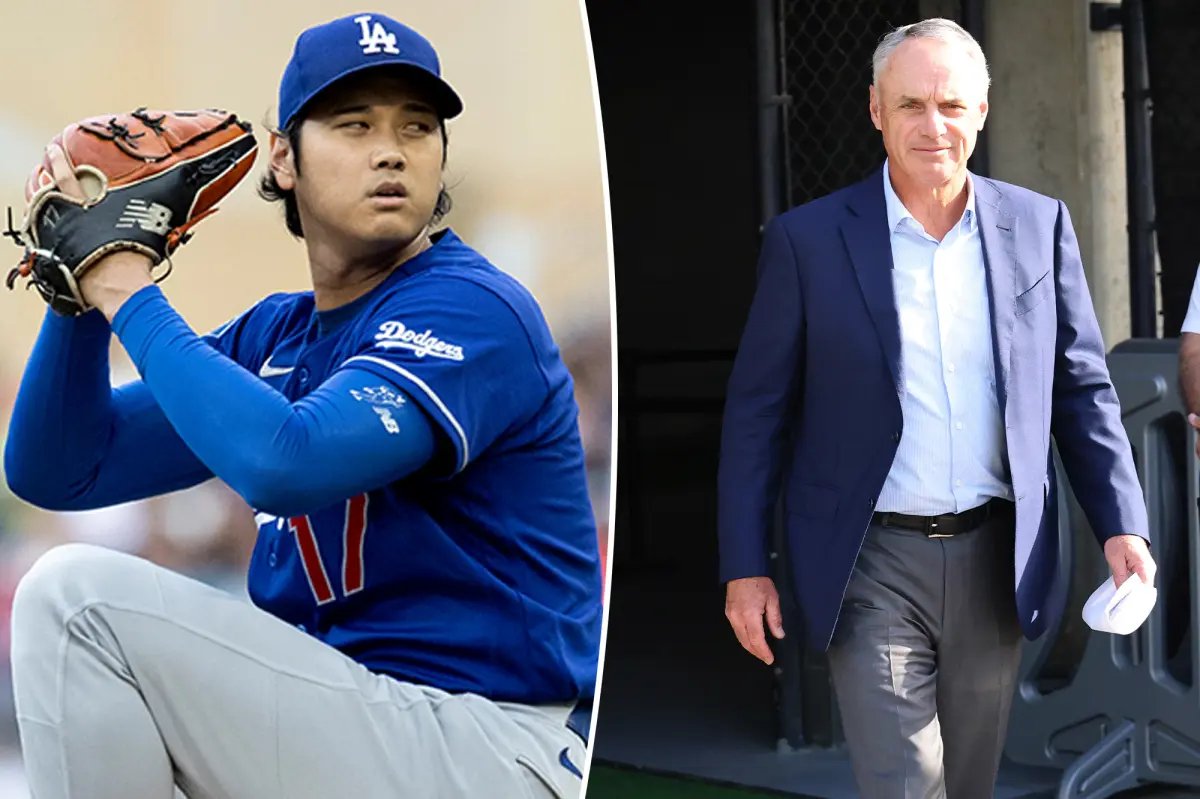
Major League Baseball made its latest proposal in the sport’s ongoing labor battle on Thursday.
And once again, some common Dodgers tactics seemed to be not-so-coincidental targets.

As part of a sweeping set of suggested changes that would put term and salary limits on individual player contracts, MLB’s proposal included de facto “max contracts” for players — similar to the system that is currently in place in the NBA — of five years and $202 million for free agents changing teams, and six years and $265 million for free agents re-signing with their previous team.
Just as notable — at least to Dodgers fans — is that the league also proposed eliminating deferred money from all future contracts, while maintaining its push for a hard salary cap.
As a tradeoff, the league offered to raise minimum player salaries, provide players earlier access to free agency and eliminate qualifying offers that can drag down the markets of top free agents.
It marks the latest flashpoint in what have been increasingly contentious negotiations over a new CBA, with the proposal having already been rebuked later Thursday afternoon by the players’ union.
It also marks yet another way the league is trying to eliminate some of the methods the Dodgers have used to build their current dynasty, going after the kind of long-term and heavily deferred deals that have helped them navigate record-setting payrolls the last couple seasons.
Currently, the Dodgers have six players on deals that would surpass the league’s new proposed contract maximums: Shohei Ohtani (10 years, $700 million), Mookie Betts (12 years, $365 million), Yoshinobu Yamamoto (12 years, $325 million), Will Smith (10 years, $140 million), Kyle Tucker (four years, $240 million) and Freddie Freeman (six years, $162 million).
They also have nine players whose deals include at least some deferred money: Ohtani (who is the most extreme example, having deferred $680 million of his record-breaking salary), Betts, Smith, Freeman, Blake Snell, Teoscar Hernández, Tanner Scott, Tommy Edman and Edwin Díaz.
For the Dodgers, stretching out contracts and deferring money has preserved the team’s short-term financial flexibility, helping them maintain options each winter as they have constructed star-studded rosters over the last several years.

For their players, such deals provide long-term security and, in some cases, tax benefits and negotiation leverage.
That’s why, as the strategy has come under scrutiny in recent years, both team executives and superstars in the clubhouse have defended it.
“There are times where [negotiating a] deal lines up in a more straightforward way. There’s times where it’s less straightforward,” president of baseball operations Andrew Friedman said at Snell’s introductory news conference last winter. “Including deferrals helps as a lever to find that overlap.”
The critique of the approach, of course, is that without regulations on contract structures, the Dodgers have been able to double down on their economic advantages.
Ohtani’s deal, in particular, has proven to be transformational. While his presence has helped boost the club’s revenues by hundreds of millions per year, he is only earning $2 million per season (the other $68 million of his annual salary will be paid out a decade into the future, after the 10 seasons it covers have concluded).
Granted, Ohtani still accounts for more than $46 million annually in luxury tax calculations — a total that is based on the present-day value of his deal.
Still, it has become the calling card for factions of fans hopeful MLB will adopt a salary cap and even out financial disparities within the sport.
On Thursday, the league’s latest proposal took that exact aim.
