


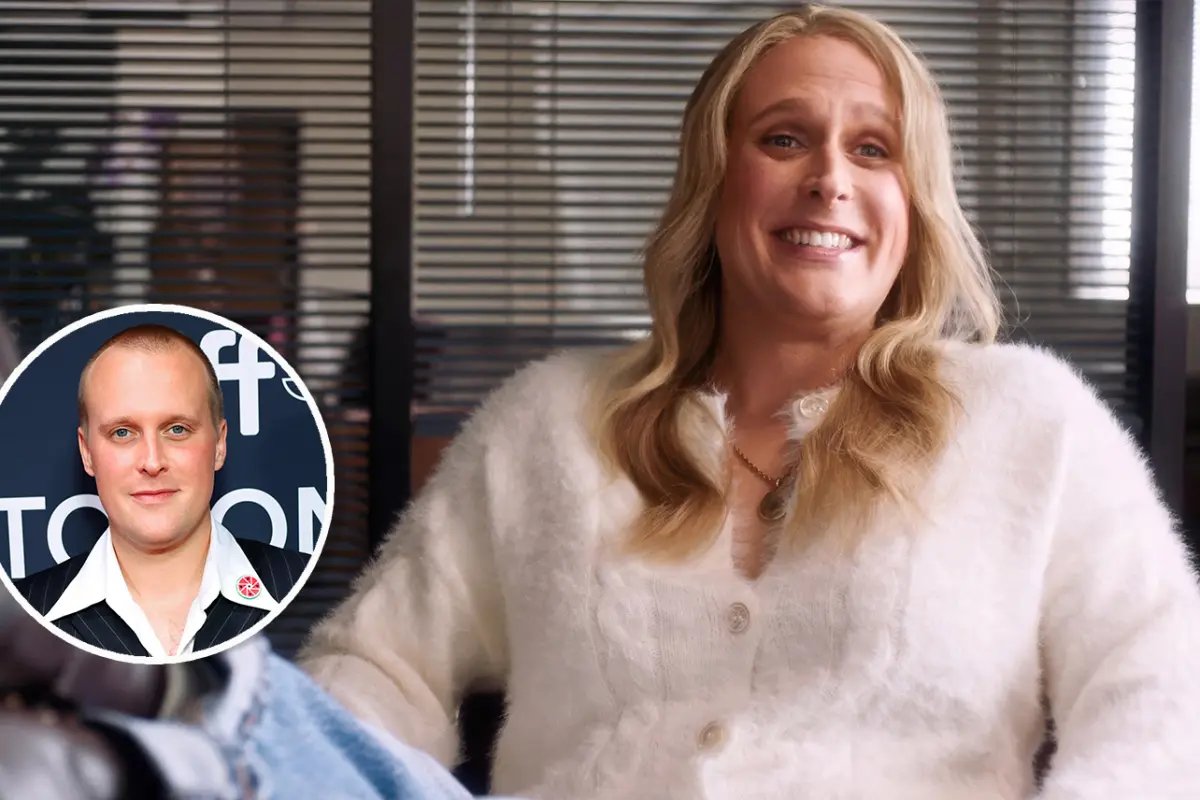
In 2016, Netflix gave a handful of rising comic performers — among them recent SNL castoff Tim Robinson and future Hacks co-creator Paul W. Downs — a budget to produce their own 30-minute sketch showcase, all to be collected on the platform under the banner of The Characters. One segment in John Early’s episode finds him in drag as a sweater-clad actress shooting a pivotal scene in a generic date flick, knocking on the unseen love interest’s door in the pouring rain to confess her devotion. Powering through the director’s vague dissatisfaction and the frigid water soaking her to the bone, the actress recites the same lines over and over again, the stilted dialogue (“Those guys were jerks, and she couldn’t defend herself. I mean, how could she? She’s blind.”) in contrast with the disarmingly real desperation mounting in a woman under acute pressure. The simultaneous impulses to laugh and wince get at a complex counterpoint between the artifice of art and the vulnerability of human feeling, revealing how playing spectator to the most painful moments of humiliation can still be tied up in honest empathy.
With greater confidence, nuance, and ambition, Early’s directorial debut Maddie’s Secret expands this delicate tonal negotiation to feature length. He stars as Maddie Ralph, whose seemingly perfect life — a loving husband (Eric Rahill, posited here as an unlikely sex symbol for the current moment), a stalwart lesbian bestie named Dina (Kate Berlant), and a career as an on-camera food influencer finally taking off — begins to unravel when stressors at work trigger the reemergence of her dormant bulimia. As she sinks deeper into her breakdown, Early’s fine-tuned performance of accented non-reality teases out the space between the definitions of “hysterical,” both in the feminine-psychological-turmoil sense and the uproariously-funny sense.
Branding a character who can’t stop vomiting with the surname of Ralph might seem like a joke at her expense, and raise the question of whether the whole enterprise exists just to point and snigger. That couldn’t be further from the actuality of a deeply felt portrait, its true stance given away with a single shot of purple light filtering through a thin-sliced vegetable chip onto Maddie’s eye as she holds it up to a kitchen window. The conspicuous flourish evokes the Technicolor melodramas of Douglas Sirk, placing Early in a lineage with fellow disciples Rainer Werner Fassbinder and Todd Haynes, perhaps as their more rambunctious younger sibling. They’re all united in an innate intuition of tone, digging into fakery until they unearth a wellspring of honesty. The trouble comes when the film makes it to viewers unable to tap into its frequency, as they puzzle out who’s the butt of the bit and often fear that it’s them. (This, by the way, is why Carol and May December couldn’t build serious Oscars traction.)
A few days before Maddie’s Secret began its theatrical run, Early spoke to Decider about the film’s intertwined mechanisms of irony and sincerity, the varied and telling responses of festival audiences, and that out-of-nowhere Sky Ferreira cameo.

Decider: Hey, thanks for taking th—
John Early: I have to immediately say something. Which is that I — hold on, wait, I’m going to sneeze, actually nope, never mind — which is that when I last saw you, it was at the [Maddie’s Secret] New Directors/New Films premiere, at Lincoln Center. I was so tired, I was on the verge of tears that whole day. And you came up to me afterward and told me that it reminded you of Superstar. And do you know where my brain went first? I just assumed you meant the Molly Shannon Superstar. And I was like, “That’s genius!” I don’t even have much of a relationship to that movie, surprisingly, but I thought the insight was good. Then once I got in the car, I was like, “Oh, fucking of course, he means the Todd Haynes Superstar.” But I like those as being two sides of the same influence. By the way, I just started the interview. You can feel free to wrest power back whenever you like.
I think this is the perfect place for us to start.
Alright! I was working on writing something much more serious and somber before I wrote this movie. But I wound up wanting to do something a little more outrageous and fun and cheap first before I tried to do that other script. I thought it was feeling too Todd Haynes, too derivative. Then I started writing Maddie’s Secret, and pretty deep into it, I was like, “John, you’re so stupid, this is even more all those things.” I told myself, “Well, we’ve got the Burt Bacharach-inflected score, don’t worry, that’s different.” And then I remembered, no, the Carpenters were so close to Burt Bacharach. Eventually, I just accepted that here I am again.
I wouldn’t knock it as derivative, mostly because those Todd Haynes emotional mechanisms are such a difficult thing to emulate, and so few people are even trying. So many of his films, as far back as Superstar, have worked within this register that you’re talking about right now: that space between the sincere and the outrageous. There’s commingling between pathos and arch comedy, and a lot of people have found it hard to discern the difference between laughing and laughing at.
I agree with you. I think there is some of that specific tonal tension in his work, but I also think he is obviously a much more restrained and refined filmmaker than me. I was thinking about Paul Verhoeven. Todd Haynes has a kind of delicacy to his techniques, and I really wanted to be blunt, even kind of crude and careening, you know? In some ways, I wanted it to be kind of masculine! I wanted to make a women’s picture with a certain degree of unhinged masculinity in the filmmaking or the spirit of it. And none of this was really conscious during the conception, these are just thoughts I’ve had since making it, some while we were making it.

You mention Verhoeven — it’s a matter of public record that you’re a major Showgirls fan, a movie with a reputation that’s changed over the years, and that’s also driven by who does and doesn’t “get it.”
It’s mysterious, with Showgirls, how your relationship to it changes so much over time. But the only way through that in making this movie was to be unconcerned with these distinctions. There are things that I genuinely like, that I find simultaneously very funny and very moving. But then, on different days, I feel differently about them. My guiding principle in a lot of this was to just not try to be delicate. It’s on two levels: there’s the sensitive subject matter and then there’s the tonal balancing act. I just thought the way to honor both things was to throw myself into it and to not be so worried about, like, “This scene needs to be 70% funny and 30% serious.”
If it feels right to you, it’ll probably feel right for the people watching it.
Yes, and that happened on set with the other actors. We didn’t have to talk things to death. I didn’t have to go, “Now, you guys, this part is serious.”
When I watched these kinds of movies, the eating disorder TV movies that were influences here, me and my friends in middle school and high school knew that it was funny. We were devouring it in a camp way, and we were laughing at its extremes or the ways it misses the mark. But then we were also totally fine being moved by it? We would let it pluck our heartstrings and enjoy being totally manipulated by it, too. And I know that’s something not everyone brings to movies. For some reason, it seems to me like a very gay thing. I don’t know.
Maybe it’s because my mother unsuccessfully raised me to be homosexual, but to me, receiving a movie like that — feeling the pathos and enjoying the falseness, neither contradictory to the other — is second nature. I think to the people who understand this dissonance, it’s the most natural thing in the world, but it’s really hard to put into words for someone who doesn’t.
I really have compassion for the people who might not get it. At the end of the day, I am a Southerner who believes in hospitality. Ugh, it sounds so pretentious coming out of my mouth, but my work ends up being more aggressive and confrontational than I would have ever imagined. Honestly, I don’t like to make people uncomfortable! And I think that’s part of why emotion wins out in Maddie’s Secret. The battle between what’s funny, what’s satirical, what’s true — the emotions prevail.
So I didn’t want the audience to feel confused or like they’re at gunpoint. I guess some people probably will feel confused at the end, but I also think that some people’s confusion—and I understand this completely—is a kind of resistance by the end. They see where it’s going and they don’t want it to go that way, and that’s okay. But I think the emotions are pretty pure and clear by the end.
People have asked me, “Was the vigil scene supposed to be funny?” (Spoiler, maybe, though I haven’t said who it’s for.) And when people say they got a laugh out of it, I just say, “Okay.” Because I’m happy that the movie has this kind of mercurial quality, that’s exciting, genuinely. But that scene to me, personally, there’s not a joke in sight there. That scene makes me weep. That was very intentional. When I got to that scene writing the script, I was like, “Oh, this is the only scene I have that’s not balanced by some sort of knowing joke.”

These TV movies like Death of a Cheerleader and Kate’s Secret can turn on a dime between really absurd, over-the-top stuff and moments of sincere, piercing emotion. In Maddie’s Secret, we find a good representative sample in the scene with Kristen Johnston, which perfectly encapsulates the tension we’re talking about. Could you talk about bringing her in and how you navigated that moment?
You’re the first person to ask about that scene, and thank you for that, because in a tropey sort of way, that’s the climax of the movie. What I find interesting about it — which I feel about all movies with that particular scene when the trauma is revealed and explains all the previous behavior — I experience the catharsis of that more than processing it intellectually. I think that’s true for a lot of other people, too. They don’t necessarily care about the trauma math, but they do like the feeling of release.
But about Kristen. She was my teacher at NYU, at the Atlantic Theater Company. And she is why I went to that studio, because I think she’s like one of the greatest actresses of all time. I was in high school, and I saw that she was an alum of the Atlantic Acting School, so that’s why I went there. She totally embodies everything that I love about acting, which is that she is unapologetically expressive and comedic, but with so much pain and feeling in her voice, and it’s all totally integrated. She can do goofy and Greek tragedy at the exact same time. Kate [Berlant] and I put her in 555, and I’m always looking for opportunities to work with her. Despite being on a big Netflix sitcom at the moment on Netflix, she was able to find one free day in her schedule to do this, and I was so grateful to her. I told her, “I want to do a barnburner scene. I want to do it like the last scene in Marnie. I want to do it like the therapy scene with Mariah Carey in Precious. I want to do the Suddenly, Last Summer therapy scene.” I needed someone like Kristen, who I felt safe going there with.
Someone who knew what that meant without needing it explained to them.
I sent her a long email about Beverly, and my thoughts on who this character was, to look at Beverly more charitably. She wants her daughter to be more like a friend. And it’s fundamentally inappropriate, but that’s a real type of person.
“If my daughter’s my peer, that means I’m young.”
Exactly. Maddie just wants her to be her mother. So they have these directly opposing desires. And Kristen fully saw that. When I was editing and looking at the two-shot of us sitting there together, I was like, “This is actually quite deep.” I don’t think I realized how symbolic this scene was, how significant it was. It embodies so many things in this movie, and it started as me honoring a trope. You have Maddie, and that’s me revealing the gooey and vulnerable part of myself, and then you have Kristen, who’s cracking up and can’t keep a straight face when her daughter says she was the only middle schooler with gout. Kristen goes, “Hm.” There’s the tension of the movie. There is always a part of me that is aching, yearning, sincere, a hurt child. And then there’s also this little devil that’s always trying to balance things, cut through whatever might be maudlin or pretentious or saccharine with humor.

The other collaborator I wanted to ask you about is the pop star Sky Ferreira, who appears in one scene, in the background, without any lines. She’s kind of elusive, hasn’t released new music in forever — what’s she doing in this movie?
[Laughs.] One thing I’m very proud of in how we made this was the ethos of not going through a background casting agency. I thought if we need background, let’s send out a call to our friends. There were certain people in the crew and cast that would just send an email out to our friends, like, “You want to make $200 on this day?” I wanted the set to have as much of a friends-and-family atmosphere as possible. Plus, background actors who are total strangers can be a little strange and unwieldy. So we were shooting that scene, that one with the line around the pizza restaurant which is actually called Naughty Pie Nature, by the way. That’s not in the script, but it was so in line with the jokes in the movie. God blessed us with that one. But Sky — I just asked her, “Do you want to stand in line? Do a cameo?” And and she was just like, “Yeah.” Once she showed up, I realized, “Oh, I need to feature her a little more.” So we decided to make her Dina’s girlfriend. I told her, “Very quickly, before we shoot: You’re straight. You’re in a relationship with a man. You might even be married. And Dina has dive-bombed into your life, and she’s now rocking you sexually. You haven’t eaten in three weeks because you’re a nervous wreck. You have no idea what’s going on, but you know this is the most transformative thing that’s ever happened in your life.” She’s on camera for a split second, but she’s completely immersed in this world. And I told Kate, “This is not some random girl. It’s Sky Ferreira. She’s not playing someone. That’s Sky, and that’s the degree of Dina’s sexual power. She can get anyone.”
You mentioned 555, but to go even farther back in the archive, Maddie reminds me so much of one sketch from your episode of the Netflix anthology The Characters, the one with the actress who keeps playing the scene over and over again. You even get the abusive mother. Is that Maddie? How long have you lived with her?
That’s the crude, brush-stroke version of her. I’ve always wanted to play a girl in the doorway who goes, “Hey.” You know? “Hey.” It’s Felicity. There’s a supercut of characters on Felicity saying “Hey.” I think The WB even released it as a promo, because people really understood what was secretly funny about that.
I get my “hey” moment when Emily comes with the tiny chocolate chip cookies. I come out and I go, “Hey, Emily.” It’s not even a joke, there’s nothing funny about it, but it still kills me. That’s always been a kind of energy I’ve wanted to perform, and that sketch in The Characters absolutely contains the DNA of Maddie. But this is the beauty of film, how it’s long enough that you can push it outward until it deepens and becomes more mysterious.
Maddie’s Secret is in theaters now.
Charles Bramesco (@intothecrevassse) is a film and television critic living in Brooklyn. In addition to Decider, his work has also appeared in the New York Times, the Guardian, Rolling Stone, Vanity Fair, Newsweek, Nylon, Vulture, The A.V. Club, Vox, and plenty of other semi-reputable publications. His favorite film is Boogie Nights.
