


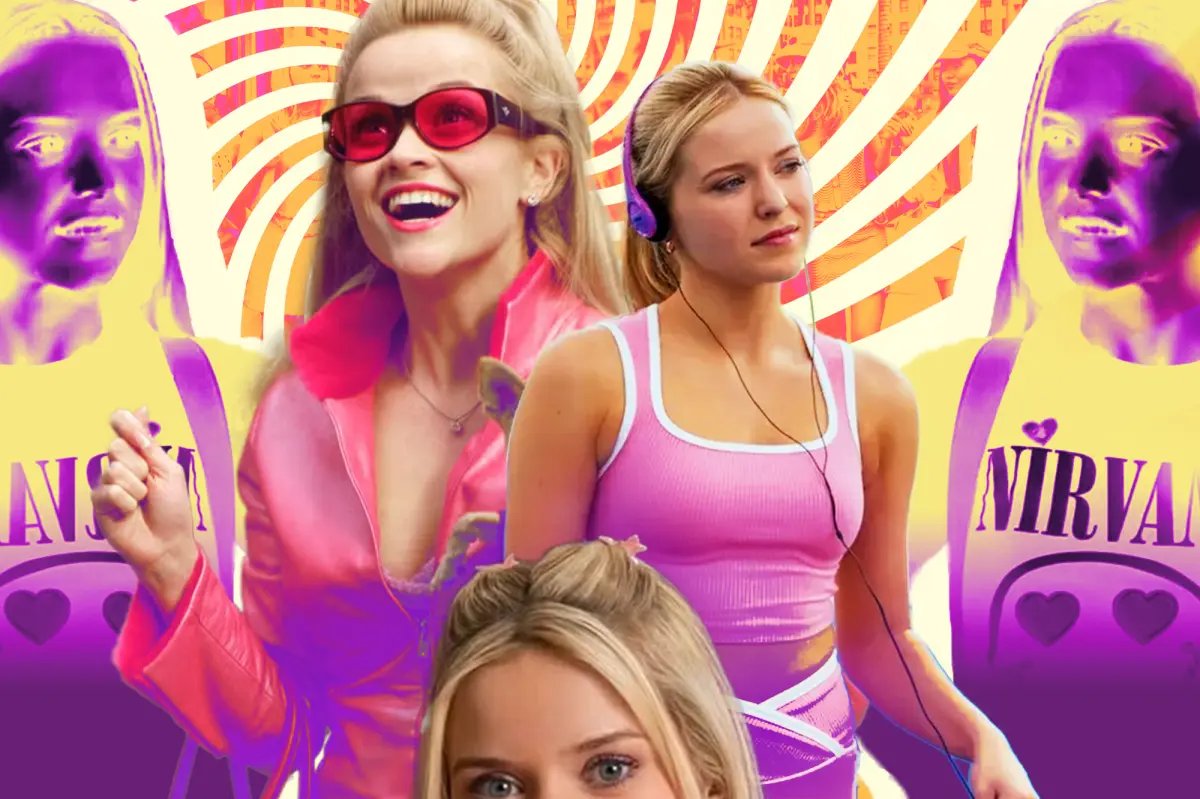
When I first received access to episodes of Elle, Prime Video’s pink-splosion of a Legally Blonde prequel series, I made a promise to myself that I would give it a fair shot. I had seen the teasers and photos of Lexi Minetree — the Hollywood newcomer tasked with playing Elle Woods 24 years after the role made Reese Witherspoon a household name — and thought that it genuinely looked fun, if not slightly confusing.
The show follows Minetree’s pampered character having to uproot her life in Bel Air and move to Seattle after a mishap involving one of her father’s (Tom Everett Scott) plastic surgery clients. In the Pacific Northwest, Elle struggles to find her scene as grunge and counterculture movements take hold of the mid-90s, much to the dismay of this very blonde, very peppy teenage girl.
At face value, the concept behind the series is not a bad one. A perfect girl with a perfect life has to reevaluate everything after becoming an outsider through no fault of her own. Who doesn’t adore a fish out of water story, right? Especially one where the protagonist must rise to the occasion and find her way without completely compromising her own values to fit in where she doesn’t belong. It’s a classic trope in film, television, and media!
That’s the whole problem.
By making Elle, a show about a beloved character from a beloved movie series, you would think that the show’s producers would want to do something new and creative with pre-existing IP, something that adds value to the character’s depth and overall worldview. The struggle of a show like Elle is that it tries to completely rewrite the narrative we all know and love. Legally Blonde is an undisputed classic for so many reasons. It is already is a fish-out-of-water tale, empowering for women. It teaches the audience the value of hard work and staying true to oneself, reminding us not to judge others.
So naturally, I started Elle by asking: What is the reason for this prequel? What is Elle adding to this conversation? And the answer is…I’m not sure, honestly.

Perhaps it’s because they were too afraid to stray from the original formula that made Legally Blonde a success in the first place, but watching a teenage Elle Woods — the same girl who would one day go on to experience isolation and adversity less than a decade later in an unfamiliar place — experience isolation and adversity in a cloudy and unfamiliar place just comes across as head-scratching. What makes Legally Blonde so endearing is that we get to watch a young woman who has never been the sore thumb that sticks out put her whole self, intelligent mind included, out there. We want to cheer on the underdog, the person who is immediately counted out; it’s humanistic. But if Elle is about a younger Elle Woods experiencing everything she will just have to go through again in a few years time in Legally Blonde, then the original film’s effervescent, underdog charm is immediately undone.
My frustration was simmering pretty low below the surface for much of the first few episodes — that is, until I reached Episode 3 (“You’re Not the Girl I Thought You Were”). Elle goes to a “pool party” wearing a bright pink bikini, only to discover that the pool has been drained and is being used by the cool Seattle kids as a skateboarding venue. If the general sentiment behind that situation (minus the skateboards and pool, of course) sounds familiar at all to you, it could be because a nearly identical thing happens to Elle in Legally Blonde as she shows up to a “Halloween party” in an exposing Playboy bunny costume, only to find everyone else fully dressed and heavily judging her. Surprise, surprise: the copycat scene in the show also leads to a turning point in Elle’s quest to finally make a place for herself in her new home. In the show, that means Elle finally realizes that she just has to be her bold, unabashed self, which translates to singing No Doubt’s “I’m Just a Girl” karaoke-style at the pool party as the entire crowd watches and then joins in.

It’s dramatic, for sure, but by canonically having Elle Woods learn the same brutal and embarrassing lesson twice, felt like a dismissal of this character’s growth and intelligence. Elle Woods is not stupid — that is saliently clear to anyone who has watched Legally Blonde, Elle, or both. Spoiled? Yes. High-strung? Absolutely. But an idiot? Hell no. It’s why watching this particular scene, and the show in general, felt incoherent. Is this show assuming that the Elle Woods of tomorrow is so undiscerning or careless that she would not exercise a little more judgement or caution as she goes about the world, especially at something like a Halloween party for Harvard Law School students? Obviously, it’s not meant to be offensive to the original character — Elle is, by definition, a celebration of a character people worship — but it feels impetuous to have the power of her character arc in Legally Blonde weakened with such choices.
For me, it all goes back to the basic concept behind improv: i.e. “yes and.” To make a cohesive and enjoyable prequel or legacy sequel, you have to be able to hold the core truth of the original project close while also expanding the world based on what the audience is already aware of. It should never be an attempt to rewrite history or rehash stories that have already been told. When making a project built on another (beloved) film or TV show, you have to have a strong enough concept that does not alienate or confuse the people who love the original. If even one fan is sitting there telling you that something does not make sense, it probably is worth hearing them out, especially if that “one fan” is really the thousands of people online who have said since the logline of the show was released that the premise is nonsensical. How could Elle be the person we see her as in Legally Blonde after experiencing something like a major move in a formative period of her life, and it not have a lick of an impact on her character? And for anyone whose immediate retort is that Elle is a resilient person, as displayed in the film, resilience has bounds.

Why couldn’t Elle have been an exploration of a college-aged Elle Woods, navigating life in Delta Nu and finding Warner? Sure, there is less conflict in that idea than seeing a high school student forced to move more than 1,000 miles away to a place she does not know or understand, but if there’s one thing this character is built on, it’s the absence of such struggles. So why would they put forward a show that carbon copies a storyline we’ve already seen for a character we already know? And why would they set it an inexplicable number of years out from when we first meet the character in the original movie? That, to me, feels like a clear indication that the people in charge care more about stretching out content than they do preserving the integrity of the movie and building off of it. And while the series certainly has cute moments and a stellar performance from Minetree, at the end of the day, to quote the musical that did do Legally Blonde justice, Elle Woods deserves “so much better.”
Elle is now streaming on Prime Video.
