


“Shut it down. Shut it all down. It’s starting….Close the port. Shutter the businesses. Sound the siren….You refuse to accept our history, to accept the truth, and I’ve lived with that for years, but now it’s gonna get people killed….The island has lain dormant, but she’s waking up, and that’s when bad things happen. You think the fog out there is natural? No, it ain’t natural. It already took Shep and it will take the rest of us tonight. It’s a haunt!”
It may not look like it to read it, but this is some of the funniest dialogue I’ve heard on TV all year. Delivered by the legendary character actor Stephen Root as Wyck, the eccentric old harbormaster of a quaint New England fishing village called Widow’s Bay, it’s a warning about impending death and damnation…and I got no further than the third sentence in the speech, “It’s starting,” before bursting out laughing. A guy who talks only in the voice of bad Stephen King knockoffs from the 1980s? Why, he’s speaking my language!

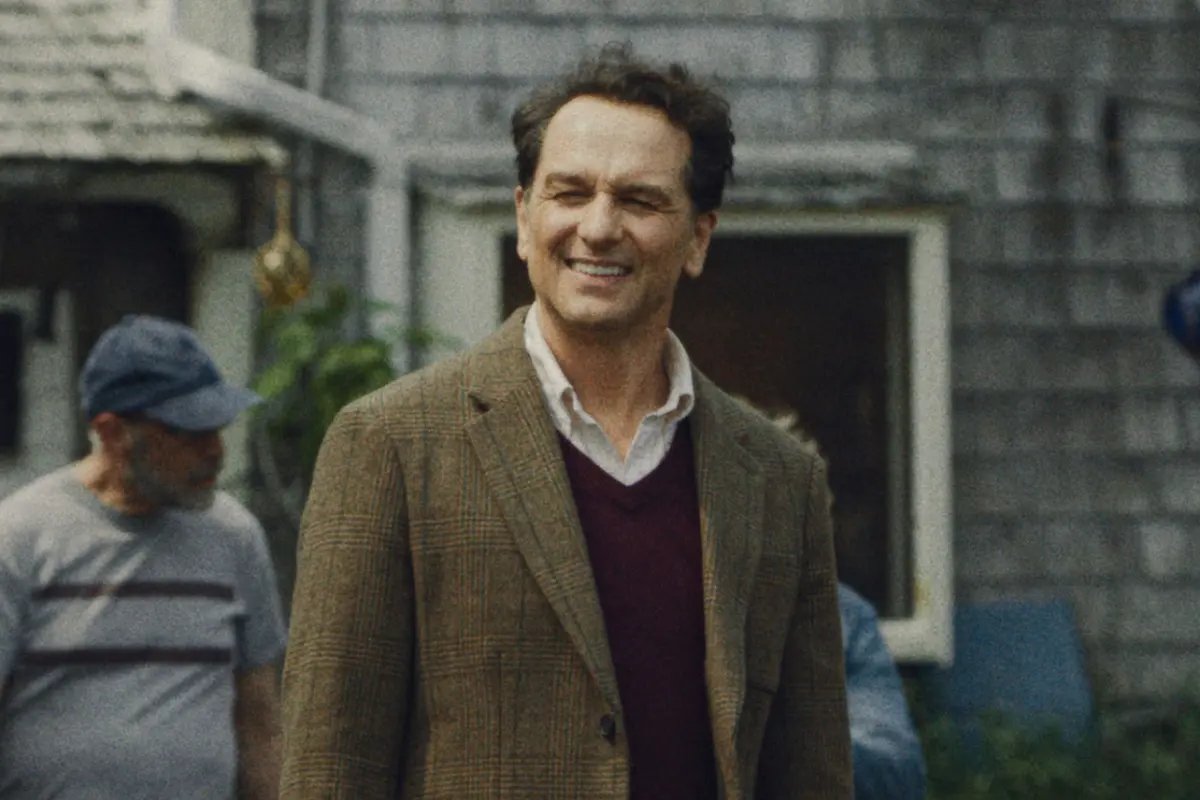
Written by creator Katie Dippold (Parks and Recreation) and directed by Hiro Murai (Atlanta), the aptly titled series premiere “Welcome to Widow’s Bay!” introduces us to Tom Loftis, mayor of the titular town on an island off an unspecified stretch of New England coast. A former summer tourist himself — he had a shotgun wedding with a townie, leading to the birth of his son Evan (Kingston Rumi Southwick) — Tom is convinced Widow’s Bay has the potential to be “the next Bar Harbor.” He’s invited a New York Times travel writer, Arthur Lloyd (Bashir Salhuddin), to check the place up in hopes of driving up business.
In the process receives virtually no help worthy of the name from any of the assistants on his staff: dolorous Patricia (Kate O’Flynn), gossipy Rosemary (Dale Dickey), ancient Ruth (K Callan), or nebbishy Dale (Jeff Hiller). His mildly delinquent pothead son Evan adds to his agita, and to that of the slightly run-down town’s sheriff, Bechir (Kevin Carroll). Between an anomalous earthquake and a strange fog bank rolling in off the ocean, even nature is refusing to cooperate.
But that’s nothing compared to the consternation caused when Wyck cranks up the town’s World War II–era air raid siren to warn the townsfolk about the coming fog. It seems Widow’s Bay has a long, long, looooooong history of “bad things” happening, things Tom is determined either not to learn about or dismiss as superstition and old sailor’s tales. I mean, surely there’s nothing to the legend of “The Fog That Stole Souls,” or the zombies of shipwrecked sailors out to avenge a drowned captain’s young bride. (Wyck and Patricia have a brief disagreement about age-gap relationships as a result.)

And all that stuff Arthur learns from town historical society worker Gerrie (Nancy Lenehan) about the cannibalism in the church, or the witch hunt? (“Great source of pride. We caught ’em, we burned ’em…”) These stories get so exaggerated over the years. And the serial killer called “the Boogeyman” whose memory still haunts Patricia, one of his survivors? “He murdered teenage girls,” Tom points out. “You’re in your 40s, you’d be fine!”
And there’s certainly nothing to the idea that those born on the island drop dead if they ever leave it, which Tom would know, since son Evan has definitely been to the mainland before, right? And it’s probably got nothing to do with why his mom’s no longer around.
But Tom’s skepticism is sorely tested when he’s attacked by Shep (Tom Kemp), a boat captain who disappears overnight and staggers ashore sopping wet hours later. In the hospital alone with Tom, his eyes roll over white just like in Wyck’s legends, and he viciously attacks Tom before collapsing again.
The event rattles Tom badly enough to make a big scene in front of Arthur the travel writer later that night, begging townsfolk not to go out into the dark. “There’s something in the fog!” he screams…moments before the lights come back on and the fog lifts. Arthur assumes he’s going for a Salem vibe and assures him his town, which could be another Martha’s Vineyard, doesn’t need the haunted-house gimmick.
Of course, Arthur doesn’t know he’s standing above several layers of tunnels and dungeons above a torture chamber and a sealed passage to the underworld or something as he says this. Neither does Tom, but I’ve got a feeling he’s gonna find out.
Widow’s Bay is like Stranger Things if it had the smarts to be satirical. Dippold’s expertlly targeted script draws on many of the same reference points as the Netflix blockbuster, though it’s more Stephen King than Steven Spielberg. But it proceeds from the idea that unless you’re a fake 1980s D&D kid, statements like “the fog took him” don’t really pass muster as an explanation for why one of your neighbors has disappeared, no matter how many horror paperbacks you’ve read. It works backwards from there: “Okay, so what would people who do find this an acceptable explanation actually look like to a normal person?” The people of Widow’s Bay are your very funny answer.

But none of this comes across as mean-spirited dunking on a harmless horror subgenre because of the superb casting of the show’s lead. Long one of the best actors on television, Matthew Rhys is exceedingly good at seeming uncomfortable. In a drama, this is a quality that generates empathy: It’s what helped sell his torment as a conflicted deep-cover spy in The Americans and a frequently roughed-up detective in Perry Mason, one of David Zaslav’s most egregious HBO casualties.
In a comedy, however, this is straight-man energy, of the increasingly frazzled sort that John Cleese used to radiate on Fawlty Towers. I’ve heard Widow’s Bay described as “a Stephen King town run by the mayor from Jaws,” but it actually does feel a lot like Basil Fawlty’s Darkplace, or a giant Halloween episode of The Office: a pasty-faced, condescending jerk who desperately wants to drum up business can’t stop getting in his own way, or stop his contentious employees from doing it for him.
Most importantly for a comedy, Widow’s Bay is funny as hell. A lot of the humor is just straight-up workplace comedy, really, but look at this exchange between Tom and Gerrie (haha):
“Remarkable story. Forty-two passengers from the mainland embarked by sea to find a settlement they could call their own.”
“Yeah, no, 43 passengers embarked—”
“I, I, I think it’s a little early for that story, Gerrie. But imagine arriving in an untamed wilderness. Blank canvas. Totally empty island.”
“Except for the teeth.”
“The…yeah, but the point I’m trying to make here is that there were no people here, you know?”
Or this one, between Dale and Tom and Rosemary:
“So I guess you don’t want me to take him to the old hospital?”
“No, I don’t, Dale, and I think you knew that.”
“It’s perfectly safe to drive by the old hospital! You just can’t stop.”
The weirdness keeps bubbling up all over the place, and Tom keeps scrambling to keep it from surfacing. It’s a great set-up for situation comedy, one as old as the chocolate factory bit on I Love Lucy. It just involves cannibalism now.

Sean T. Collins (@seantcollins.com on Bluesky and theseantcollins on Patreon) has written about television for The New York Times, Vulture, Rolling Stone, and elsewhere. He is the author of Pain Don’t Hurt: Meditations on Road House. He lives with his family on Long Island.
