


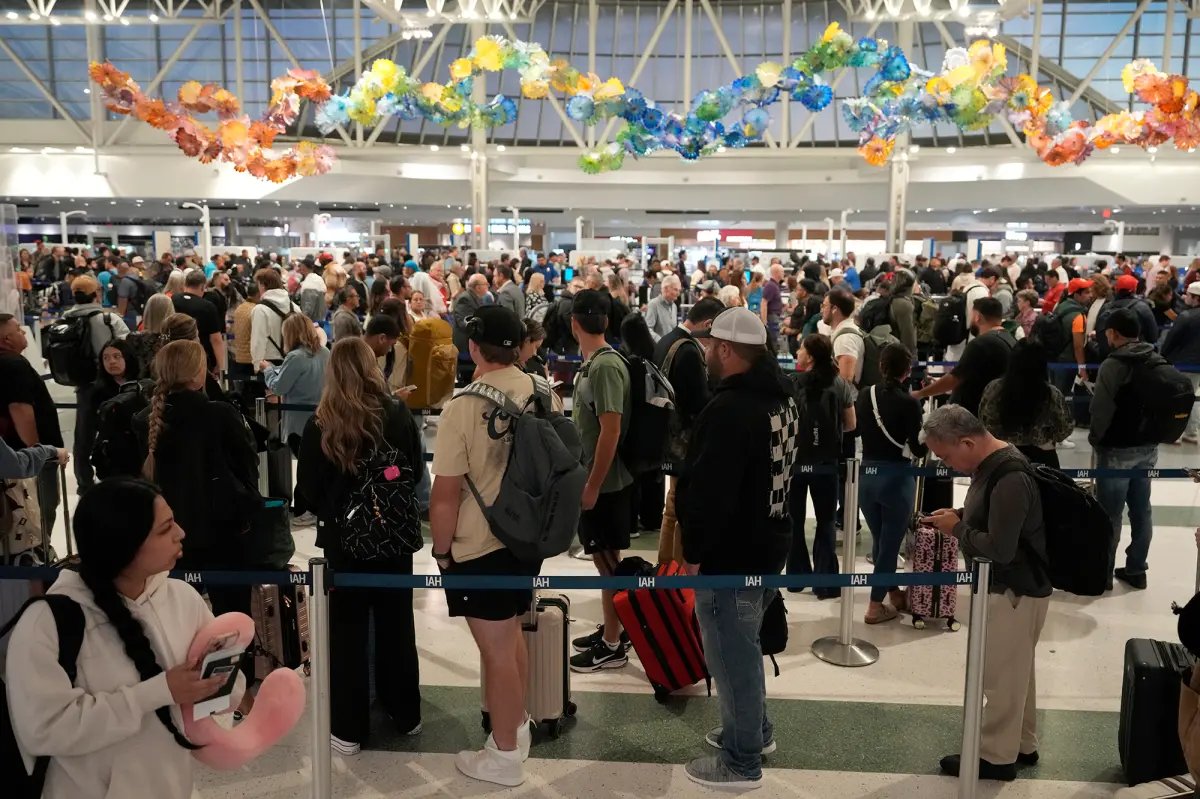

Last Thursday, Congress ended the longest Department of Homeland Security shutdown in American history. For 75 days, tens of thousands of TSA officers worked unpaid. More than 1,100 of them quit. Airport security lines stretched for hours.
The immediate fight is over. The next one is already on the calendar: this appropriation expires Sept. 30. And the battle will keep going, every funding cycle, until we change what we’re funding.
The standoff that produced this shutdown was a fight over Immigration and Customs Enforcement, not airport security. But since ICE and DHS sit inside TSA, airport security became collateral damage in a dispute that had nothing to do with it. That structural problem won’t fix itself.
Congressional dysfunction is a problem, but it’s not the only one made plain by this standoff. Another is what Congress is being asked to fund: a screening regime whose post-9/11 layers cost billions but have never demonstrated their worth.
The TSA costs taxpayers $11 billion a year, more than the entire Coast Guard budget. Most of that cost comes from security measures added after the Sept. 11, 2001, attacks. A question worth asking, in a moment of recurring crisis, is whether those measures are achieving anything useful.
After the shoe bomber in 2001, we started removing shoes. After the liquid explosives plot in 2006, we banned large bottles. After the underwear bomber in 2009, we deployed full-body scanners. Each measure responded to a specific plot. None has ever been removed.
That’s because the political logic is simple. No official will ever be blamed for keeping these measures in place, but anyone who removes them owns any subsequent attack they conceivably could have prevented. Security measures accumulate but never recede.
That’s a problem, because often they protect against threats that no longer exist.
The original danger, using an aircraft as a guided missile, was neutralized years ago. The 9/11 attackers exploited two vulnerabilities: Once aboard, they could get from the cabin to the cockpit, and they knew that passengers and flight attendants would stay passive in the event of a hijacking.
Both vulnerabilities are now closed. Cockpit doors were hardened in 2003, isolating the flight deck from whatever happens in the cabin. And knowing what happened on 9/11, those on board are now are likely to fight back. That’s what the shoe and underwear bombers both discovered: Security screening didn’t catch their weapons, but other passengers took them down, so their attacks failed.
That means that the post-9/11 additions to airport screening aren’t worth their cost.
We have direct evidence of this. During the October 2025 shutdown, and again during the 75-day shutdown that just ended, TSA officers worked unpaid and were less thorough. Lines got longer, and people missed flights, but there was no security breach. The hours of waiting that travelers endured were for nothing — because the job those officers weren’t fully doing didn’t need doing in the first place.
There’s more. In 2015, the Department of Homeland Security secretly tested its own screeners and found they missed prohibited items in 67 of 70 cases, a 95% failure rate. No subsequent published test has shown improvement. And 20 million Americans already skip parts of screening courtesy of TSA PreCheck. If removing shoes and restricting liquids were essential to safety, we wouldn’t waive them for anyone. We do — because they aren’t.
We shouldn’t abolish all airport screening. Keep the metal detectors and X-ray machines that were used before 9/11; checking passengers for weapons is settled work. But it’s time to admit that the post-9/11 additions aren’t worth the cost, especially since that cost is what makes the TSA a perennial political hostage.
Even a trimmed-down agency needs stable funding, however, which is why the government collects a dedicated security fee from every airline ticket — the September 11 Security Fee, $5.60 per one-way trip — to fund the agency.
Fun fact: Congress diverts about a third of it, $1.6 billion in 2023 alone, to the Treasury’s general fund.
We are paying for the screening, but Congress is spending it on other things.
The World Cup begins on June 11, bringing 6 to 10 million additional travelers to 11 American cities. The TSA will enter that surge with more than 1,000 fewer officers than it had in February, and replacement training takes four to six months. In March, the TSA’s acting chief told Congress the agency may have to close smaller airports for lack of staff to handle the surge.
Here’s a better solution: Sunset the post-9/11 additions that have never demonstrated their value, and stop diverting the fee that was meant to pay for what remains.
TSA officers deserve to get paid. But let’s make sure that we pay them to do things that actually matter.
Andrew Miller writes Changing Lanes, a weekly newsletter on transportation policy.
