


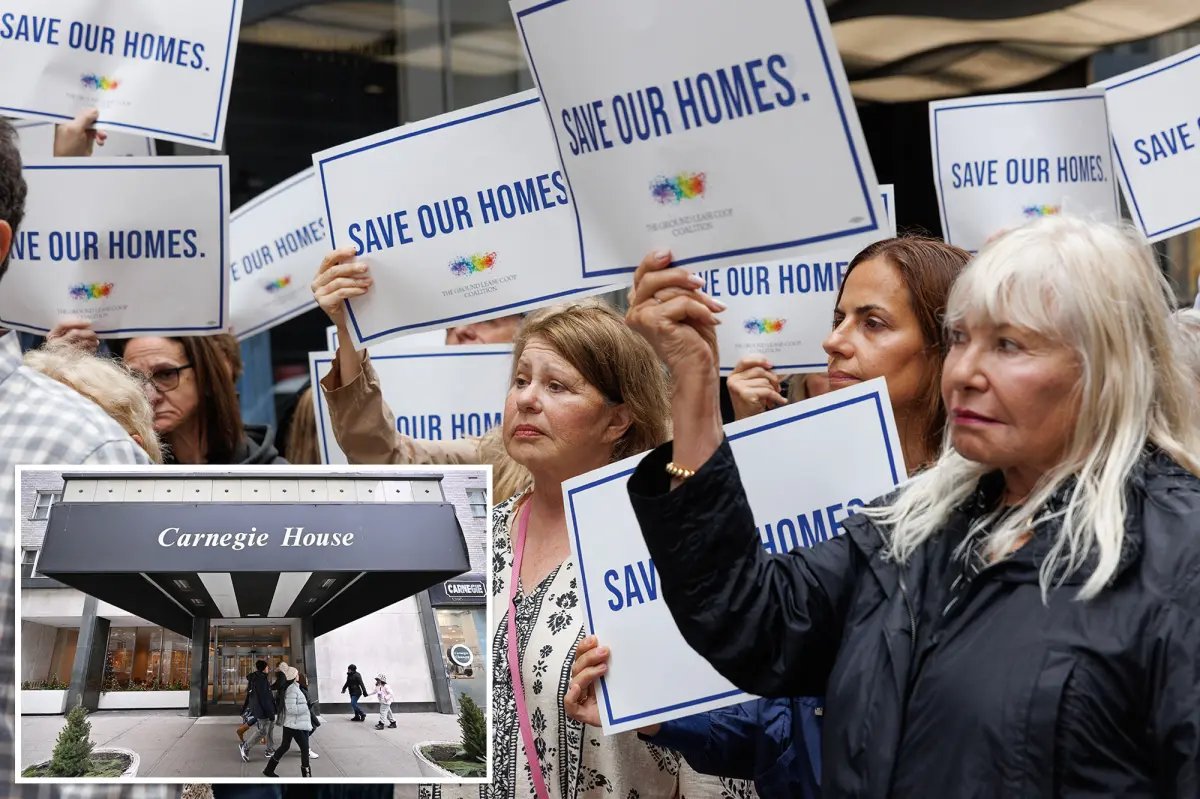

Carnegie House just bought itself another round in its fight for survival.
A state appellate panel unanimously wiped out the arbitration award that would have jacked up ground rent at the Billionaires’ Row co-op by 450%, handing the 324-unit building a rare win against the ultra-wealthy investors who own the dirt beneath it, The Post has learned.
The Appellate Division’s ruling sends the dispute back to square one on rent talks, sparing more than 300 middle-class families at 100 W. 57th St. from an outcome that board president Richard Hirsch has previously called financial ruin.
The land under Carnegie House is controlled by an entity tied to real estate investors Rubin Schron and David Werner, along with Dell Technologies founder Michael Dell.
Last summer, an arbitration panel sided with the landowners and set new annual ground rent at roughly $24 million, up from $4.36 million, a jump co-op residents said would have been impossible to absorb without triggering defaults, foreclosures and wiped-out equity across the building.
Making matters worse, the landlords then tried to collect on the increase immediately, demanding more than $10 million in back rent with only 20 days’ notice.
Carnegie House cried foul, arguing the arbitration itself was compromised.
According to the Appellate decision, the neutral umpire overseeing the case failed to properly disclose a job offer from the landowners’ co-counsel while the arbitration was still underway, an omission the court found raised a legitimate question of bias.
That was enough for the Appellate Division to throw out the award entirely.
Hirsch framed the decision as a lifeline, not a finish line.
“Today’s decision is a critical victory for over 300 Carnegie House families who have been backed into a corner by real estate tycoon Michael Dell, our other billionaire landowners, and a corrupt arbitration award,” Hirsch told The Post in a statement.
“While this ruling is a temporary stopgap, it gives us a fair shot at negotiating reasonable rent terms, or arbitrating before an impartial panel, instead of being bound by a flawed process that would have cost us our homes. We look forward to a fair process in order to reach an outcome that works for both parties and keeps our co-op intact for generations to come.”
The case is being closely watched well beyond West 57th Street.
Carnegie House is one of roughly 100 ground lease co-ops across New York City, home to an estimated 25,000 residents, many of whom bought in decades ago under land leases now colliding with sky-high 21st century real estate values.
More than half of those buildings sit in Queens, Brooklyn and The Bronx, in neighborhoods where household incomes hover close to the citywide median of $76,000.
Legislative fixes have stalled. A bill aimed at protecting ground lease co-op residents statewide cleared the state Senate last year but the Legislature adjourned in June without sending it to Governor Hochul’s desk, leaving an estimated 12,000 homes exposed to the threat of deconversion.
For now, Carnegie House gets to renegotiate, or take its chances with a new, impartial arbitration panel. But the underlying standoff between a middle-class co-op and its billionaire landlords is far from resolved.
