


May 26, 2026
— Remarks as delivered —
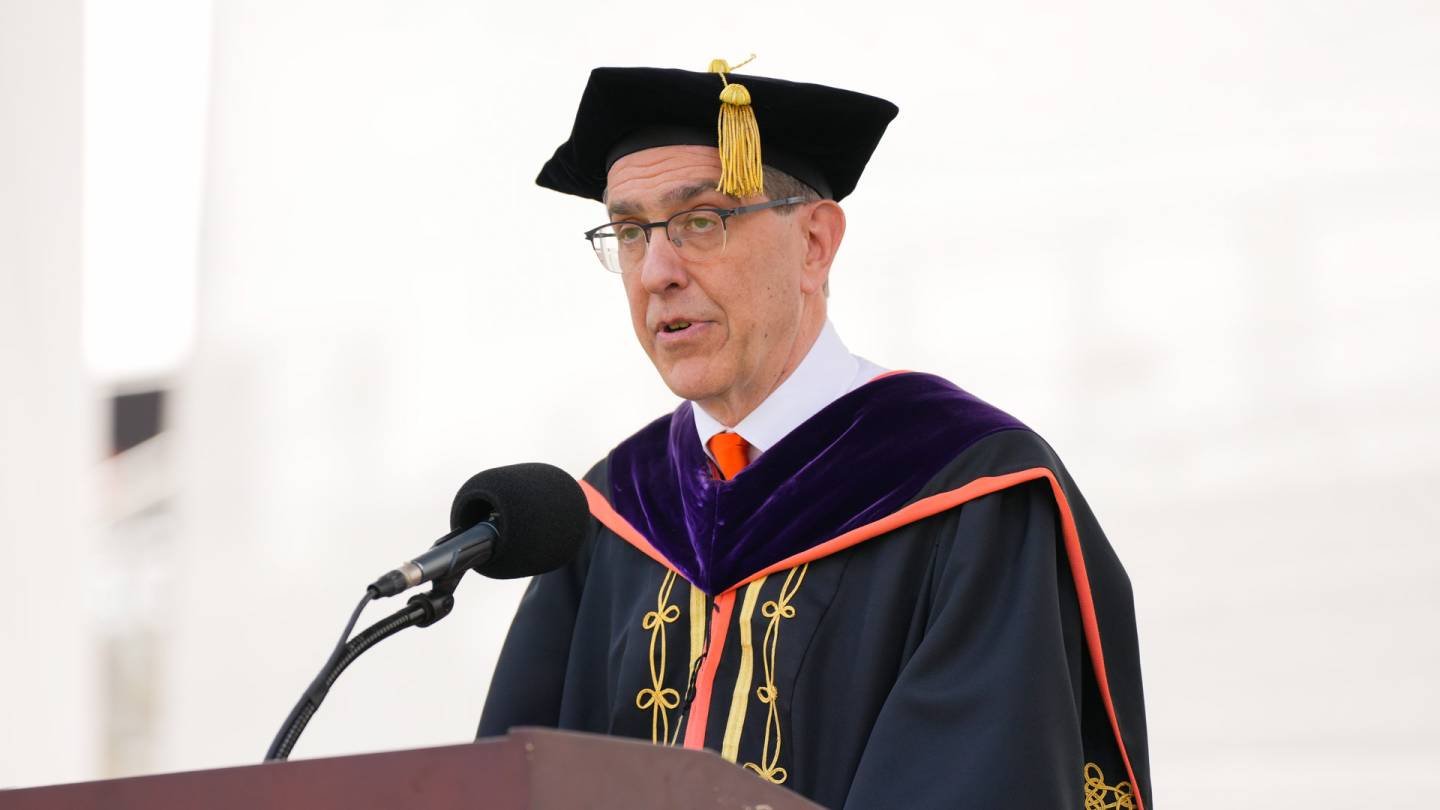
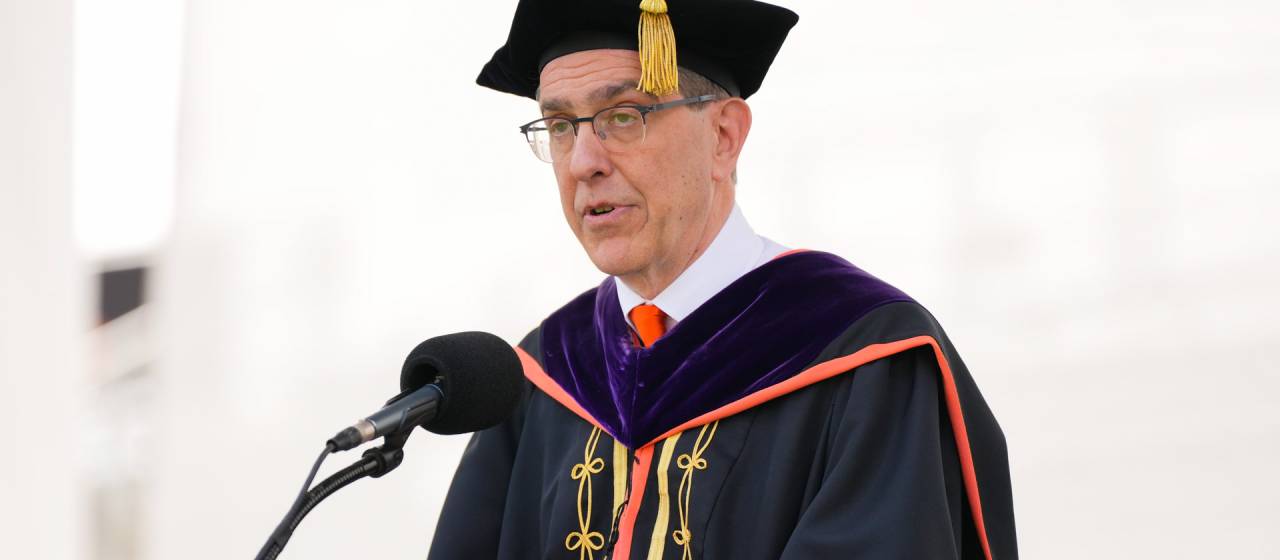
In a few minutes, all of you will walk out of this stadium as newly minted graduates of this University. Before you do, however, long-standing tradition permits the University president to offer a few remarks about the path that lies ahead.
I hope that your journeys will contain many moments of brightness, celebration, and joy, but they begin in troubled times when our world is struggling to cope with partisan divisions, political violence, and rapid technological change.
We are, of course, not the first Princetonians to confront such challenges. As I seek perspective on today’s problems, I often find it useful to consult the wisdom of our predecessors from the 1960s, another period when America, and its college campuses, experienced social upheaval.
Princeton’s leader during that decade was Robert F. Goheen. Goheen was both an undergraduate and a graduate alumnus of this University, earning his bachelor’s degree in 1940 and his doctorate in 1948, both in classics.
He became Princeton’s president in 1957, when he was 37 years old and still an assistant professor.
I do not know how the University trustees recognized that a young untenured classicist was ready to lead a great university, but they chose brilliantly. When Goheen died in 2008, two other former Princeton presidents, William Bowen and Harold Shapiro, praised him as the “architect of the modern Princeton.”[1]
Robert Goheen oversaw the long overdue admission of women to Princeton’s graduate and undergraduate programs. He increased the number of underrepresented minorities on campus. He reformed the University’s governance processes and guided the University through roiling conflicts over the Vietnam War. During his fifteen-year tenure, Princeton constructed or acquired thirty-eight new buildings and the faculty grew by forty percent.[2]
Those who knew Robert Goheen describe him with admiration, as a man of integrity, humility, compassion, and courage.
Goheen collected his thoughts about Princeton and higher education in a book titled The Human Nature of a University.[3]
In the closing paragraphs to that book, Goheen reflected “on th[e] word ‘courage’” and its connection to the mission of the American university. He observed that, and these are his words:
“Hostile forces anchoring on selfish interests, or the status quo, have in every century opposed those institutions dedicated to the advancement of learning and the betterment of human life, and we would be rash indeed to underestimate these forces.”[4]
He ended his book with these words:
“Courage, with temperance, is always needed to hold the university to its role and mission: courage on the part of men and women of good will who cherish the spirit of liberal learning and seek a better day for [humanity]. So girded, the university as a human institution can be confident not only of its past but of its present and future, ready to stand up for its aims and basic commitments, bold to make its voice heard in the land.”[5]
We often think of “courage” as a heroic virtue and associate it with risks to life or limb. On this view, its antonyms are timidity, weakness, or fear.
Goheen, however, contrasted courage with insecurity and vanity, or, more precisely, with the desire to be popular.
Here is what he says about why courage is essential to the university and its members:
“Perhaps the highest and most difficult function of the university, its most irreplaceable form of service in a free society, [is] to be willing to stand up as a judge of society’s tastes and actions. The critic and the judge are not always popular, but the greatest teachers in all ages have preferred hard truth to comfortable fiction and self-respect to popular esteem.”[6]
The Nobel Prize-winning novelist Toni Morrison, who taught at Princeton as the Robert F. Goheen Professor in the Humanities, struck similar themes in her brilliant address titled “The Place of the Idea; The Idea of the Place,” which she delivered at Princeton’s 250th anniversary convocation in 1996.
Morrison said that Princeton was founded by religious dissenters who prized “conscience … above orthodoxy,” a position she said was “so unpopular among colonial educators [that it] must have seemed reckless.”[7]
Near the end of her speech, Morrison, like Goheen, called for courage. She hoped that Princeton’s origins in unpopular dissent would inspire Princetonians to maintain “a fierce commitment to … virtues such as integrity and honor and fair play and courage.”[8]
In a famous Supreme Court opinion, Justice Louis Brandeis defended the American people’s right to free speech by arguing that:
“To courageous, self-reliant [people], with confidence in the power of free and fearless reasoning applied through the processes of popular government, no danger flowing from speech can be deemed clear and present unless the incidence of the evil apprehended is so imminent that it may befall before there is opportunity for full discussion.”[9]
For many years when I taught this passage to my students, I treated its reference to courage as a mere rhetorical flourish. I regarded it as patriotic praise that flattered readers but was largely irrelevant to the point that Brandeis was making.
Only as our society became more turbulent did I perceive what Brandeis meant, and what Robert Goheen recognized amidst the tumult of the 1960s: namely, that civic and personal courage are essential if we are to have the “full discussion” that is required to rebut dangerous tendencies and corrosive ideas.
Dissenting from a popular opinion—in politics, in a committee meeting, or in a discussion among friends—will often feel uncomfortable. There is an inevitable temptation to remain silent so as not to hurt other people’s feelings, forfeit their affection, or risk retribution.
If we are to live up to the ideals of citizenship and scholarship, we must sometimes speak anyway. We must be faithful to the standards of truth-seeking inquiry and civic responsibility even when they lead us down difficult paths.
As Louis Brandeis, Robert Goheen, and Toni Morrison all emphasized, self-government, freedom, and learning cannot always be comfortable. They require independence, and independence by definition entails the strength to stand alone, to be respectfully and when possible politely, but nevertheless unabashedly, unpopular.
Courage is necessary not only to assert dissenting opinions but also, and equally importantly, to admit error or change one’s mind. That, too, is an essential part of learning, in life generally and especially on a college campus.
To quote again from Robert Goheen’s book, students and faculty “should be constantly in the process of making up their minds and then unmaking them.”[10] On a healthy college campus, he wrote, “there should be controversy and arguing and a great deal of churning of matters of mind and spirit.”[11]
I know that all of you who receive your degrees today have earned them fully by working hard, deepening your knowledge, and acquiring new skills.
I hope that you have also not only experienced but enjoyed and been formed by what President Robert Goheen called the “millrace of jostling and tumbling ideas.”[12]
Our world needs not only your knowledge and your skills but also your courage. I accordingly hope that in the days and years to come you will, in Goheen’s words, prefer “hard truth to comfortable fiction and self-respect to popular esteem.”[13]
I wish, in short, that you will always carry with you the spirit of this place as Robert Goheen and Toni Morrison have exemplified and described it.
I hope, too, that as you venture forth to meet the opportunities and challenges that lie ahead, you will always consider this campus one of your homes and that you will return to it often.
Those of us on this platform will greet you then as we cheer you today, wishing you every success as Princeton University’s Great Class of 2026! Congratulations!
[1] Bowen said Goheen was “the architect of the modern Princeton”; Shapiro called Goheen “the first architect of today’s Princeton.” Ruth Stevens, “Robert F. Goheen, 16th president of Princeton, dies at age 88; service set for April 27,” Princeton University, March 31, 2008, https://www.princeton.edu/news/2008/03/31/robert-f-goheen-16th-president-princeton-dies-age-88-service-set-april-27.
[2] “Former University President Robert Goheen ’40 dies” The Daily Princetonian, March 2008, https://www.dailyprincetonian.com/article/2008/03/former-university-president-robert-goheen-40-dies; Douglas Martin, “Robert F. Goheen, Innovative Princeton President, Is Dead at 88,” April 1, 2008, https://www.nytimes.com/2008/04/01/nyregion/01goheen.html.
[3] Robert F. Goheen, The Human Nature of a University (Princeton University Press, 1969).
[4] Goheen,The Human Nature of a University, 115.
[5] Goheen,The Human Nature of a University, 116.
[6] Goheen,The Human Nature of a University, 116.
[7] Toni Morrison, “The Place of the Idea; The Idea of the Place,” as delivered at Princeton’s 250th anniversary convocation, October 25, 1996, https://pr.princeton.edu/news/96/q4/1025spch.htm.
[8] Morrison, “The Place of the Idea; The Idea of the Place.”
[9] Whitney v. California, 274 U.S. 357, 377 (1927) (Brandeis, J., concurring).
[10] Goheen, The Human Nature of a University, 52.
[11] Goheen, The Human Nature of a University, 59.
[12] Goheen, The Human Nature of a University, 59.
[13] Goheen, The Human Nature of a University, 116.
