


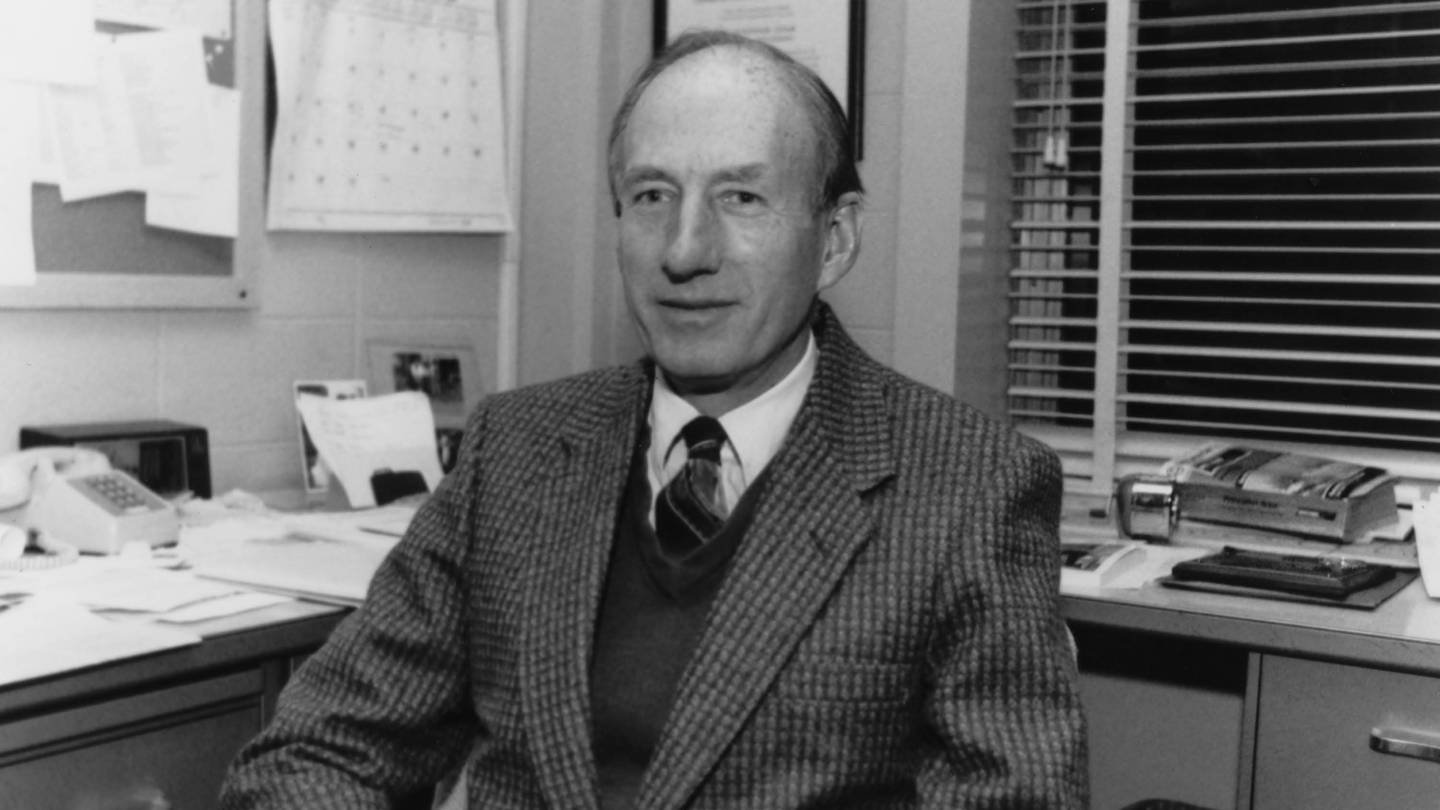
Princeton professor Roy Jackson, who applied mathematical rigor to the study of flowing mixtures to shape a new era of industrial design and engineering, died on July 20. He was 94.
Jackson, the Class of 1950 Professor of Engineering and Applied Science, Emeritus, and professor of chemical engineering, emeritus, joined the Princeton faculty in 1982 and transferred to emeritus status in 1998.
His work from the 1960s through the 1980s established rules for industrial chemical processes that had been developed ad-hoc earlier in the 20th century, including core aspects of oil refining, agriculture and materials manufacture.
Many of those processes involve chemical reactions between liquids or gases mixed with solid grains of catalytic materials. For decades, the way solid pieces moved within these fluids was understood at the level of single particles but poorly understood at the level of the overall mixture, which may include billions of pieces — too many to track individually.
“Before Jackson’s time, engineers who designed these industrial systems relied on estimates and experience, the equivalent of family recipes, bespoke techniques that were often treated as proprietary design rules,” said Sankaran Sundaresan, the Norman John Sollenberger Professor in Engineering, Emeritus, at Princeton. “Roy asked, ‘How do we make these things rigorous?’”
With his signature clarity, Jackson stripped these processes to their bare essentials and transcended their self-limiting qualities with a mathematical framework that opened the way for decades of academic engineering research and a new era of design for industrial engineering. It also extended beyond petroleum and chemical products to a vast set of related problems, including everything from the study of mudslides and lava flows to the dry-powder inhalers used to control asthma.
“He was a scholar and a genius,” said Jennifer Sinclair Curtis, a distinguished professor at the University of California-Davis and one of Jackson’s first Ph.D. students at Princeton, who earned her doctorate in 1989. “I mean, each of us were given research projects that, in different ways, defined the field.”
Jackson’s key early insight was to treat solid grains collectively at an in-between scale, consistent with the physics of individual particles but blurred mathematically into local averages that made modeling large systems feasible. In this paradigm, the particles are treated as a distinct fluid moving in concert with the gas or liquid around it.
In three papers, from 1967 to 1969, Jackson and his collaborator Thomas Anderson, a former graduate student of Jackson’s at the University of Edinburgh, published the seminal equations of motion for the study of fluid-particle flows. These equations became known as the two-fluid model, a foundation on which engineers would simulate countless processes.
“All that work Dr. Jackson did set the stage,” Curtis said. “The equations he developed are in the commercial software that all the industries use.” Crude oil, gasoline, biofuels, drugs delivered in tablets and capsules, emerging battery technologies, ceramics, and the foundations that support roads, railways and other structures are all examples of products made using the mathematical frameworks Jackson developed.
“He was the pioneer,” Sundaresan said.
Jackson also made pioneering contributions to several other topics within the chemical engineering discipline, according to Sundaresan and other colleagues, including granular flow, process optimization and chemical reaction networks.
“What set him apart intellectually was the way he initiated new areas of research, new areas of thought, new directions,” Curtis said. “He was never incremental.” She pointed out that by today’s standards Jackson published only a few papers each year, but those papers amassed hundreds and often thousands of citations, underscoring the quality and focus on impact he brought to every project.
In remarks at Jackson’s 1998 retirement symposium, Pablo Debenedetti, who was chair of the Department of Chemical Engineering at the time, called Jackson the department’s intellectual conscience, committed to a “concern with substance over appearance,” the “unglamorous course of lasting scholarship,” and “seeking the simplicity of causes instead of reveling in the mere description of complexity.”
“Throughout his career, in other words, Roy has sought to enlighten rather than to enchant,” said Debenedetti, who would succeed Jackson as the Class of 1950 Professor in Engineering and served as Princeton’s Dean for Research from 2013 to 2023.
A natural teacher and compassionate mentor
Although Jackson had been fascinated by mathematical models since childhood, former students and colleagues alike admired his abilities as a natural teacher and compassionate mentor. His first encounter with teaching came during mandatory military service as a teenager in 1951. After receiving a scholarship to the University of Cambridge, Jackson, who was born and raised in England, deferred matriculation for two years to complete his service with the Royal Air Force of the United Kingdom. Apparently recognizing his talents, the RAF promoted Jackson to the rank of sergeant instructor, the minimum rank required for teachers. He was stationed at the Number 2 Radio School, Yatesbury, where he taught electricity and magnetism to radar mechanics in training.
Jackson would later tell his colleagues that his time in the RAF had fundamentally shaped his approach to teaching. The structure and clarity of his lecture notes, shared with colleagues who were preparing for courses Jackson had already taught, became legendary in the Princeton chemical engineering department.
Jackson’s students also recall his outsized patience and the empowerment that came with the intellectual freedom he afforded them. He often allowed students to explore the ins and outs of a problem before they settled on the right direction, even when he seemed to have an intuitive sense for what that direction should be.
In those moments when a student finally found the salient point, Jackson would offer a single, totemic word of encouragement: “Bingo.” And they would know they had found the way forward.
Jackson was born in Manchester, England, on Oct. 6, 1931, and grew up an only child in nearby Bolton. His father was a grocer and his mother a homemaker.
He attended the Bolton School on a scholarship and following his RAF service, earned his diploma in physics in 1954.
As an engineer at Imperial Chemical Industries, he published research that solved open problems on automatic control and was hired onto the faculty of the University of Edinburgh’s chemical engineering department in 1961, despite not having a doctoral degree. They awarded Jackson an honorary D.Sc. in 1968.
He left for Rice University in Houston that same year, moved to the University of Houston from 1977 to 1982, spent one year at the California Institute of Technology as a Sherman Fairchild Distinguished Scholar, and joined the Princeton faculty in 1982.
While at Princeton, Jackson focused more sharply on the flow of granular materials, especially through contraptions like chutes and hoppers — a topic that is related to but distinct from his foundational work on particle-fluid flows. Working with his student Paul Johnson, who received his Ph.D. in 1988, Jackson developed a hybrid model combining slow, frictional flow with rapid, collisional flow. A 1987 paper established the Johnson-Jackson boundary conditions, which remains a crucial part of today’s models.
“He was extraordinary for the breadth and depth of his scholarship,” Sundaresan, his former colleague, said.
Jackson loved sailing, owned a small craft for nearly the duration of his time in the United States, and while in Houston became an expert in the rigging of tall ships. He helped restore two tall ships that still sail today: the 1877 Elissa, a 141-foot three-masted iron-hulled barque originally built in Scotland and now homeported in Galveston, Texas, and the Gazela Primeiro, a 177-foot three-masted barquentine, originally built in Portugal and now homeported on the Delaware River in Philadelphia.
These ships have since sailed in some of America’s most visible celebrations, including this year’s semiquincentennial. Jackson served as second mate on the Gazela when it sailed through New York Harbor during the Statue of Liberty’s 100th anniversary celebration.
During his 16 years at Princeton, Jackson was awarded Princeton Engineering’s first Distinguished Teacher Award in 1996, was commended for his teaching several times by the School of Engineering and Applied Science and was twice awarded the Engineering Council Teaching Award.
In a career spanning nearly four decades, Jackson published more than 100 technical papers and two monographs, “Transport in Porous Catalysts” and “Dynamics of Fluidized Particles.” He was elected a fellow of the Royal Society in 2000. In 1999, the Journal of Industrial and Engineering Chemistry Research published an entire issue devoted to his work. The American Institute of Chemical Engineers recognized his contributions with the inaugural Thomas Baron Award in Fluid-Particle Systems in 1993 and the Alpha Chi Sigma Award in 1980, then the field’s highest honor.
After retirement, he moved to New Bern, North Carolina, to be closer to his daughter and her family. There he focused on sailing, painting, teaching his grandchildren, and the pursuit of deep physical truths about the nature of the cosmos.
On the occasion of his 80th birthday, Jackson climbed Helvellyn, one of the highest mountains in the English Lake District. He had developed a fondness for trekking as a young man, when his mathematics teacher at the Bolton School would lead pupils on expeditions over mountains in Lancashire and Yorkshire. Jackson returned to walk these areas many times throughout his life.
After finishing school at Cambridge, in 1954, Jackson led an expedition with three of his fellow graduates across the Yorkshire Three Peaks walk, including the mountains of Ingleborough, Whernside and Pen-y-Ghent, according to his longtime friend, the mathematician Bryan Birch.
Three of the four hikers, including Jackson and Birch, were later elected to the Royal Society. Birch would go on to introduce Jackson to his sister Susan, whom Jackson married in 1957.
Jackson was predeceased by his wife, Susan, in 1991. He is survived by their daughter Fiona Cook, son-in-law Paul Cook, son Andrew Jackson, daughter-in-law Lisa Warren, four grandchildren and three great-grandchildren.
