

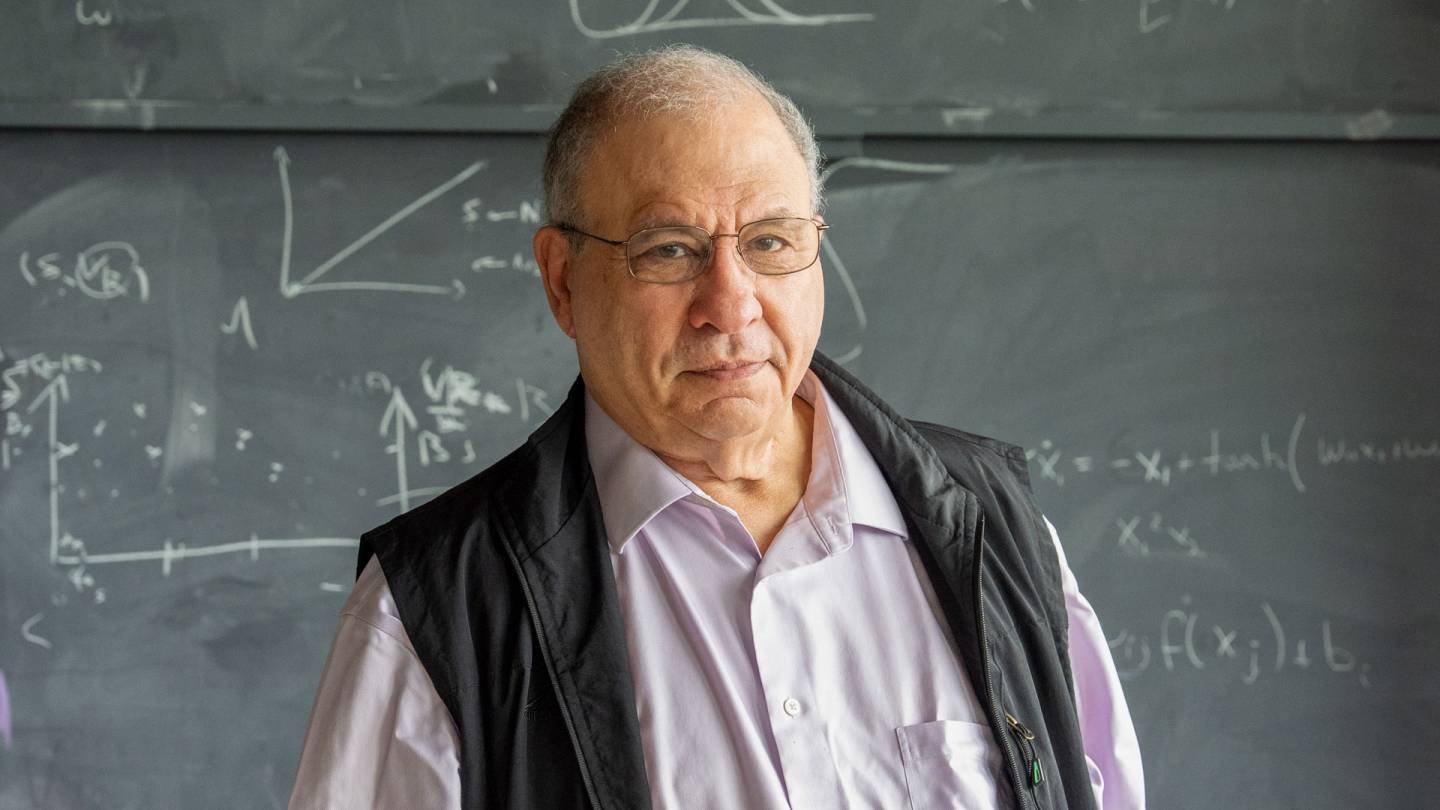
Simon Levin, Princeton University’s James S. McDonnell Distinguished University Professor in Ecology and Evolutionary Biology, has been elected as a fellow of the United Kingdom’s Royal Society, a scholarly academy dedicated to “promoting excellence in science for the benefit of humanity.”
“I am delighted to welcome this newest group of exceptional scientists to the Fellowship of the Royal Society,” said Paul Nurse, the organization’s president, in its announcement of the new fellows. “Their work exemplifies the enduring value of curiosity, creativity and rigorous inquiry.”
The Fellowship of the Royal Society has existed since 1660, and election to it is lifelong.
“I am deeply honored to join the Royal Society,” said Levin. “Not only is it the oldest national scientific academy in the world, but I am especially grateful because the scholars who elected me include colleagues whom I have known and respected for decades. I am thrilled to join them and to contribute in whatever way I can to the great work the Royal Society performs.”
Levin’s work has helped put environmental research into context for experts and the public alike. He focuses on complexity, particularly how large-scale patterns — including at the ecosystem level — emerge from individual behaviors and local environmental factors.
He and his research team use observational data and mathematical models to explore topics such as biological diversity, the evolution of structure and organization, and the management of public goods and shared resources. While primarily focused on ecology, Levin has also analyzed conservation, financial systems, economic systems, and the dynamics of infectious diseases and antibiotic resistance.
Levin joined Princeton’s faculty in 1992, and two years later he was the founding director of the High Meadows Environmental Institute.
He has received many major awards, including the 2015 National Medal of Science, the 2014 Tyler Prize for Environmental Achievement, the Ecological Society of America’s 2010 Eminent Ecologist Award and the 2005 Kyoto Prize in Biological Sciences from the Inamori Foundation of Japan. Most recently, he received an honorary degree from Johns Hopkins University on May 21.
Levin is a member of numerous national and international honorary societies, including the American Academy of Arts and Sciences, the National Academy of Sciences, the American Philosophical Society, and the American Association for the Advancement of Science. He received his bachelor’s degree in mathematics from Johns Hopkins University in 1961 and his doctorate in mathematics from the University of Maryland in 1964.
Other fellows and foreign members of the Royal Society on Princeton’s faculty include:
- Kwame Anthony Appiah, the Laurance S. Rockefeller University Professor of Philosophy and the University Center for Human Values, Emeritus
- Bonnie Bassler, the Andrew K. Golden University Professor of Molecular Biology
- Manjul Bhargava, the Robert C. Gunning *55 and R. Brandon Fradd ’83 Professor in Mathematics
- Roberto Car, the Ralph W. *31 Dornte Professor in Chemistry
- Emily Carter, senior strategic advisor and associate laboratory director for applied materials and sustainability sciences at the Princeton Plasma Physics Laboratory; the Gerhard R. Andlinger Professor in Energy and the Environment; and professor of mechanical and aerospace engineering, the Andlinger Center for Energy and the Environment, and applied and computational mathematics
- Steven Cowley, director of the Princeton Plasma Physics Laboratory and professor of astrophysical sciences
- Jo Dunkley, the Joseph Henry Professor of Physics and Astrophysical Sciences
- B. Rosemary Grant, an emerita senior research biologist in the Department of Ecology and Evolutionary Biology
- Peter Grant, the Class of 1877 Professor of Zoology, Emeritus
- John Groves, the Hugh Stott Taylor Chair of Chemistry
- F. Duncan Haldane, the Sherman Fairchild University Professor of Physics and 2016 Nobel laureate in physics
- David MacMillan, the James S. McDonnell Distinguished University Professor of Chemistry and 2021 Nobel laureate in chemistry
- P. James Peebles, the Albert Einstein Professor of Science, Emeritus and 2019 Nobel laureate in physics
- H. Vincent Poor, the Michael Henry Strater University Professor of Electrical Engineering
- Peter Sarnak, the Thomas D. Jones Professor of Mathematics and the Eugene Higgins Professor of Mathematics at Princeton and an emeritus professor of mathematics at the Institute for Advanced Study
- Gregory Scholes, the William S. Tod Professor of Chemistry
- Shivaji Sondhi, professor of physics, emeritus
- Howard Stone, the Neil A. Omenn ’68 University Professor of Mechanical and Aerospace Engineering
- Shirley M. Tilghman, president of the University, emeritus, and professor of molecular biology and public affairs, emeritus
