


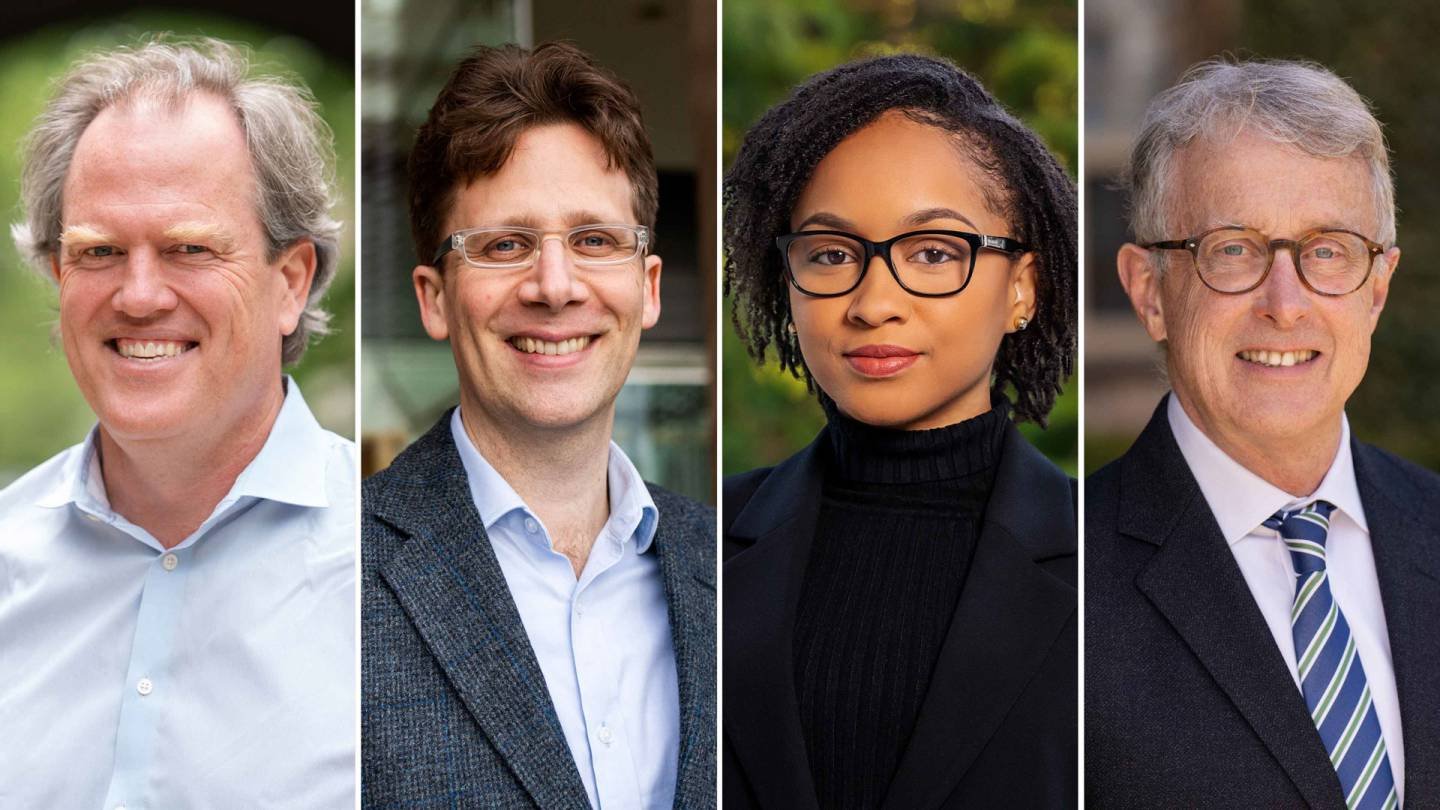

Four faculty members will receive 2026 Graduate Mentoring Awards for their exceptional guidance of graduate students.
The award winners are:
- Edward Baring, professor of history and human values
- Tom Griffiths, professor of psychology and computer science
- Jerelle Joseph, assistant professor of chemical and biological engineering and bioengineering
- Jamie Rankin, University lecturer, German Department, and director of the Princeton Center for Language Study
“Graduate education is about relationships,” said Rodney Priestley, dean of the Graduate School. “As the mentoring relationships between faculty and students become meaningful and important, that’s when the real magic happens. The faculty we honor with these awards exemplify the commitment to sparking that magic. Their dedication has had a profound impact on the educational experience, scholarship and careers of their students.”
Graduate students and former students nominate faculty for the annual awards, which are co-sponsored by the Graduate School and the McGraw Center for Teaching and Learning. A selection committee made up of graduate students, last year’s awardees and senior staff from the Graduate School and the McGraw Center select the winners. The awards honor faculty members from each of the University’s four academic divisions — engineering, natural sciences, social sciences, and the humanities.
“These winners represent the outstanding guidance our faculty offer our graduate students,” said Katherine Stanton, director of the McGraw Center and senior associate dean of the college. “I am impressed each year by the empathy, knowledge and time our award winners share with their students.”
The winners will be honored at the Graduate School’s Hooding and Recognition Ceremony on Monday, May 25, at 4:30 p.m. on Cannon Green. Each will receive a $2,000 prize and a commemorative gift.
Edward Baring
An intellectual historian specializing in modern Europe, Edward Baring is a professor in the Department of History and the University Center for Human Values. He joined the faculty in 2021, and in 2024 the Graduate School named him a Faculty Fellow in Professional Development Innovation for his work creating a communications coaching program for graduate students.
In nominating letters, students described Baring as a role model whose example will guide their careers as scholars and a mentor who combines rigorous intellectual engagement with genuine care.
The students praised him for the time and attention he devotes to providing thoughtful feedback on both their research and teaching, and for the professional advice he offers one-on-one and through his Java & Jobs career sessions. “Beyond his significant influence on shaping my career, Professor Baring’s mentorship has provided me with a model for my future professional relationship with students as a professor,” one student wrote.
Equally striking were the tributes to Baring’s empathy and kindness. One nominator recalled how Baring invited students to his home who’d had no plans for Thanksgiving; another recalled how Baring listened with “courtesy, propriety and empathy” during a family crisis. As one student summed it up: “To both myself and so many others, Ed continues to be one of the brightest and kindest sources of encouragement, mentorship and learning at Princeton.”
Tom Griffiths
Tom Griffiths, the Henry R. Luce Professor of Information Technology, Consciousness, and Culture, is the director of the Computational Cognitive Science Lab and, since September 2024, the inaugural director of the Princeton Laboratory for Artificial Intelligence. When he came to Princeton in 2018, he was the first faculty member to be jointly appointed in the departments of Psychology and Computer Science.
Many of the more than a dozen current and former students who nominated Griffiths wrote that they were impressed by his ability to focus on their individual research interests in the classroom and the laboratory as they pursue their careers. Several said that Griffiths has built a culture in his lab that encourages students to be innovative and independent thinkers. “He creates an environment that is intellectually vibrant,” one student said, and also infused with warmth.
Nominators also praised Griffiths as a mentor who gives generously of his time, meeting with students individually every week, offering thoughtful, incisive and personally tailored guidance on their research and pointing them toward papers that speak directly to their work.
Griffiths “has given me a research path that is both exciting and deeply connected to the questions that first drew me to this field,” one nominator wrote. “He has opened doors I did not know existed, offered guidance without agenda, and shown a quiet, consistent care for my growth as both a scientist and a person.”
Jerelle Joseph
Jerelle Joseph’s research explores how liquid-like compartments inside cells form and function, and how these processes can be harnessed in bioengineering to engineer cellular behavior and develop new therapies. She joined the University in 2023 as an assistant professor of chemical and biological engineering and is jointly appointed in the Omenn-Darling Bioengineering Institute.
Joseph won praise from graduate students for creating a welcoming environment in her classroom and laboratory where students can genuinely thrive, and for the support she provides beyond the lab.
“It is no understatement to say that Professor Joseph has been the most supportive, encouraging, positive mentor and Ph.D. adviser that I could have ever hoped for,” one student wrote.
Joseph brings that same attentiveness to her classroom, tailoring her teaching to individual learning styles and meeting one-on-one with students in her lab every week.
Joseph also champions her students’ futures, encouraging them to pursue fellowships and other professional development opportunities.
One mentee’s reflection best captures the impact of Joseph’s guidance of her students: “I am so incredibly happy at Princeton, I find my work meaningful, and I am basking in the opportunity to learn. This is all because of my Ph.D. mentor.”
Jamie Rankin
A University lecturer in the German Department, Jamie Rankin has devoted his career at Princeton to the study of how languages are learned and taught. Since joining the faculty in 1991, he has focused his research on second language acquisition, teacher training and curriculum development, and he serves as the inaugural director of the Princeton Center for Language Study.
Students lauded Rankin’s approachable and collaborative method of teaching future language instructors. As one student put it, “He has taught me practical methods and given me the tools to direct the attention of language learners.”
Students also had high praise for Rankin’s ability to build community, whether in his “Second Language Acquisition and Pedagogy” seminar, weekly group seminars with teaching assistants, or through the broader work of the Princeton Center for Language Study. Rankin won the Princeton President’s Award for Distinguished Teaching in 1996. Earlier this year, he won Baylor University’s Robert Foster Cherry Award for Great Teaching, a prestigious national recognition.
Several students said Rankin opened their minds to new pedagogical possibilities. One credited him with “completely changing the way that I think about language pedagogy, effective teaching, and the importance of community.” Another put it: “He treats teaching not as a secondary responsibility, but as a craft that can and should be cultivated with the same seriousness as research. His mentorship has had a lasting impact on my confidence, effectiveness, and identity as an educator.”
